AI-Generated D&D Fantasy Character Portraits: A New Creative Tool for Tabletop Gamers

How AI image generation is revolutionizing fantasy character portraits for D&D and tabletop gamers.
AI image generation is reshaping character creation for D&D and tabletop players. New-generation diffusion models, LoRA fine-tuning, and tools like IP-Adapter and ControlNet enable consistent, detailed fantasy portraits. This article explores the technical breakthroughs, creative value, and copyright controversies.
AI Portrait Generation: A New Creative Tool for Tabletop Gamers
In the world of tabletop role-playing games (TRPGs), a vivid character portrait often helps players immerse themselves more deeply in the hero, mage, or rogue they're playing. TRPGs originated in 1974 with Dungeons & Dragons (D&D), co-created by Gary Gygax and Dave Arneson—a collaborative storytelling game in which players advance the narrative together within a fictional world built by a game master (DM, or Dungeon Master), describing their actions and rolling dice to determine outcomes. It's a form of collaborative storytelling powered by imagination and a rule system.
D&D is currently owned by Wizards of the Coast, and its current fifth edition (5e), released in 2014, has seen the largest player growth in its history thanks to simplified rules and an active community. This growth has been driven in large part by actual-play livestream shows like "Critical Role," as well as the widespread adoption of online platforms such as Roll20 and Foundry VTT during the pandemic, doubling the global player base between 2020 and 2023. Within this ecosystem, character portraits are more than mere decoration—they're a core tool for the "embodiment" of tabletop storytelling, helping players transform abstract character concepts into perceivable visual anchors across campaigns lasting hours or even years. A set of AI-generated Dungeons & Dragons-style fantasy character portraits recently circulating in the Reddit community sparked lively discussion, with the poster's concise assessment: "These are excellent. Just keeps getting better."
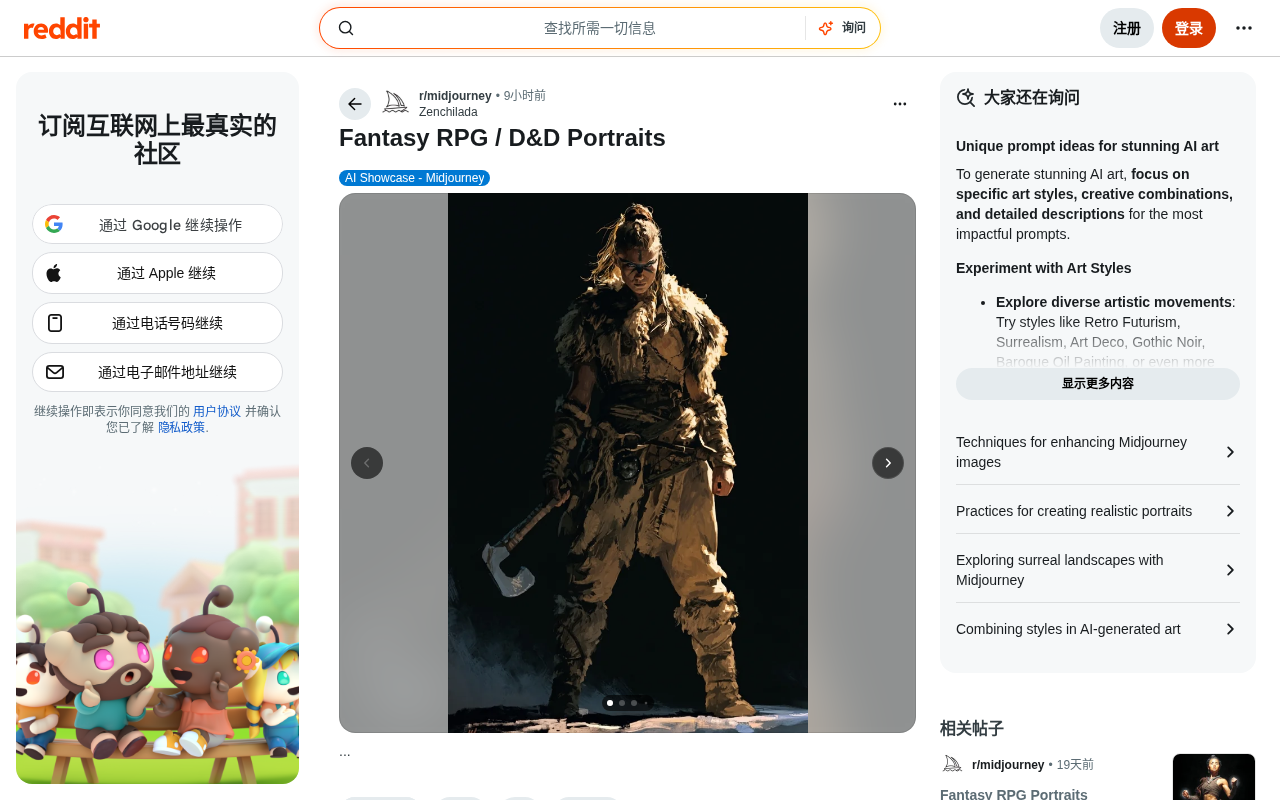
Behind this comment lies a reflection of how rapidly AI image generation technology has matured within the vertical niche of fantasy character design. For tabletop gamers who have long depended on professional illustrators or stock asset libraries, AI character portrait generation is fundamentally changing how they customize their character imagery.
Why Fantasy Character Portraits Are the Ideal Use Case for AI Image Generation
Stylization Needs Naturally Fit Diffusion Models
Fantasy RPG character portraits have a relatively well-defined visual language: exaggerated equipment designs, distinct racial features (elven pointed ears, orcish tusks, dragonborn scales), dramatic lighting, and a rich epic atmosphere. This highly stylized creative demand is precisely the direction modern Diffusion Models excel at.
Diffusion models are the core architecture behind today's mainstream AI image generation technology, with theoretical roots tracing back to diffusion processes and thermodynamics in physics. The 2020 DDPM (Denoising Diffusion Probabilistic Models) paper published by a UC Berkeley team was the first to systematically apply them to image generation. The working principle is to gradually add random noise to training images, then train a neural network to learn how to reverse the noise back into a clear image. This bidirectional "noising-denoising" process gives the model powerful image generation capabilities. OpenAI's DALL-E 2 (2022) and Stability AI's Stable Diffusion (2022) followed in succession, bringing this technology into mainstream applications.
Compared to the previously popular GANs (Generative Adversarial Networks), diffusion models offer significant advantages in generation diversity, detail fidelity, and training stability. GANs are prone to "mode collapse," where the generator gets stuck producing only a few types of images; diffusion models, through their iterative denoising mechanism, cover the data distribution more evenly. In terms of computational efficiency, the Latent Diffusion Model (LDM) compresses the diffusion process from pixel space into a low-dimensional latent space, boosting generation speed several times over—which is exactly why the Stable Diffusion series can run smoothly on consumer-grade GPUs. Compared to photorealistic photography that requires precise replication of reality, fantasy art gives AI greater creative freedom and makes striking results easier to achieve.
Massive Training Data Lays a Solid Foundation
From official Dungeons & Dragons artwork and Magic: The Gathering card illustrations to an enormous volume of fan creations and concept designs, the fantasy art field has accumulated an exceptionally rich body of high-quality visual material, providing a solid learning foundation for AI models.
Take Magic: The Gathering as an example. Since its release in 1993, it has accumulated over 20,000 card illustrations created by top concept artists worldwide, spanning fantasy, horror, sci-fi, and many other visual styles—making it one of the largest and most systematic fantasy illustration databases in the world. This body of data is extremely high in visual quality and diverse in style, spanning a broad spectrum from photorealistic oil paintings to flat illustrations, and it's of great value in helping AI models understand the rules of lighting, materials, and creature design in fantasy aesthetics. This enables AI models to accurately capture the essence of fantasy aesthetics—whether it's the metallic texture of armor or the shimmering glow of spell effects. However, this has also made the Magic: The Gathering artist community one of the focal points of controversy over AI training data, a point we'll detail later.
"Keeps Getting Better": The Technical Evolution of AI Character Generation
The poster's remark that AI "keeps getting better" is no empty praise. From the early Stable Diffusion 1.5 to new-generation base models like SDXL and Flux, and further to finely tuned LoRAs and specialized models targeting fantasy styles, AI's progress in character consistency, detail expressiveness, and compositional aesthetics is now plainly visible.
LoRA (Low-Rank Adaptation) is a parameter-efficient model fine-tuning technique originally proposed by Microsoft Research in 2021, later widely ported to the image generation field. Its core idea is to freeze the pre-trained model's original weights and insert only a small number of trainable low-rank matrices into specific layers, enabling precise customization of style or content at extremely low computational cost. In fantasy character generation scenarios, community creators can train a LoRA plugin using dozens of images of a particular artist's style or a specific character, then layer it onto the base model to stably reproduce the target style.
LoRA technology has given rise to a vibrant creator ecosystem: on model-sharing platforms like Civitai, over 100,000 LoRA models are in circulation, with fantasy and RPG categories among the most downloaded. LoRA files are typically only tens of MB in size—far smaller than complete models that can run to several GB—dramatically reducing the cost of distribution and loading. This "base model + LoRA overlay" paradigm has become the most mainstream customization workflow in the Stable Diffusion ecosystem. Notably, the LoRA ecosystem has also spawned new ethical controversies: some creators train personal-style LoRAs using an artist's work without permission and publish them openly, shifting the "style replication" problem from the platform level down to the individual creator level.
Character Consistency Achieves a Key Breakthrough
For tabletop gamers, one of the most core pain points is maintaining consistency in a character's appearance—the same character should present a recognizable "same face" across different scenes and emotional states. As reference-image control technologies like IP-Adapter and ControlNet have matured, AI can now reasonably maintain a character's core features.
IP-Adapter (Image Prompt Adapter) was proposed by Tencent Research in 2023. It introduces an image encoder (usually based on the CLIP model) to compress the reference image's visual features into feature vectors, then injects them into the diffusion model's generation process via a decoupled cross-attention mechanism, so that the output remains highly faithful to the reference character's facial and identity features even as composition or pose changes—much like giving the model a character "ID card." Traditional text prompts have inherent limitations when describing specific facial features, since language struggles to precisely capture the subtle differences in facial geometry, and IP-Adapter is a targeted solution to this bottleneck.
ControlNet, proposed by Lvmin Zhang of Stanford University in 2023, supports various conditional inputs such as skeletal keypoints (OpenPose), Canny edges, normal maps, and depth maps. By extracting a reference image's skeletal pose, edge lines, or depth information as conditioning signals, it precisely controls the pose and compositional layout of the generated figure.
Used together, the two essentially build a "identity-locked, pose-free" character generation control framework: players can fix a character's appearance while freely switching between combat, rest, spellcasting, and other poses. This is highly practical for tabletop gamers running long-term campaigns that stretch across months or even years.
Both Detail Rendering and Atmosphere Building Improve
New-generation models perform significantly better than earlier versions at handling fine details (such as weapon patterns, fabric folds, and subtle facial expressions) and rendering overall atmosphere (lighting logic, color tone, depth of field). Generated portraits no longer stay at the "barely usable" level but are steadily approaching the quality standards of professional illustration.
The Impact and Considerations of AI Character Portraits on the Creative Ecosystem
Dramatically Lowering the Barrier to Character Creation
The most direct value of AI portrait generation lies in the democratization of creation. In the past, a custom character illustration might cost tens or even hundreds of dollars to commission from an artist, with delivery times often measured in weeks. Now, players need only enter descriptive prompts to receive multiple options within seconds. For budget-conscious amateur player groups and independent DMs, this is undoubtedly a major boon.
The Ongoing Controversy Over Copyright and Artists' Rights
However, the core controversy of AI art is equally unavoidable in the fantasy realm: does the training data include unauthorized use of artists' work? And how should copyright ownership of AI-generated images be defined?
This controversy has been simmering globally since 2022 and has entered a substantive legal phase. In the United States, visual artists Karla Ortiz, Kelly McKernan, and others filed a class-action lawsuit in 2023 against Stability AI, Midjourney, and DeviantArt, alleging they scraped billions of images without authorization for model training. Getty Images also filed a separate lawsuit against Stability AI, seeking damages of up to one billion dollars. The EU's AI Act officially took effect in 2024, requiring AI system providers to publish summaries of copyrighted content used in training data. The U.S. Copyright Office, meanwhile, made clear in 2023 that images generated purely by AI are not protected by copyright, and human creators must make substantive creative contributions to the output before they can claim rights.
In the fantasy art community, highly recognizable-style artists like Greg Rutkowski and Alphonse Mucha are hard-hit areas in model training data, and the personal styles of many renowned concept artists are precisely what models focus on learning. These legal developments will profoundly influence the business models of AI image generation tools and, to a considerable extent, determine the ultimate direction of the tug-of-war between fantasy artists and AI platforms. While the community praises technological progress, it must also confront the potential impact this tool may have on the livelihoods of original artists.
Human-AI Collaboration May Be the Sustainable Long-Term Path
A more pragmatic perspective holds that AI portrait tools may not be replacements for illustrators, but rather accelerators of creative efficiency. Artists can use AI to quickly generate sketches and compositional references, then devote their energy to deep refinement; players can first create "placeholder portraits" with AI, then commission professional creators for customization once their budget allows. This human-AI collaborative workflow may well be the sustainable and healthy form for the long term.
Conclusion
The widespread praise for this set of D&D character portraits on Reddit is a vivid microcosm of the growing maturity of AI image generation technology in vertical applications. From breakthroughs in diffusion model architecture, to the community-driven fine-tuning ecosystem of LoRA, to the character-consistency revolution brought by IP-Adapter and ControlNet, each layer of technical progress is concretely responding to the real needs of tabletop gamers. For the tabletop community, AI is turning "everyone can have a beautiful character portrait" from vision into reality. The accelerating evolution of technology is certainly exciting, but discussions about copyright boundaries, artistic value, and creative ethics should deepen in step—whether it's the ongoing global judicial rulings or the self-protection practices of artist communities, both will collectively shape the future of this ecosystem. As that comment put it—it "keeps getting better," and our thinking about how to responsibly use this technology must advance right alongside it.
Key Takeaways
Related articles
Recurrent Looped Transformers: A New Architecture That Teaches Models to "Think Again"
Recurrent Looped Transformers repeatedly apply the same Transformer block to decouple compute from parameters, enabling variable reasoning depth without scaling model size.
"Everyone Else Should Slow Down AI — Except Me": The Double Standard Trap in Big Tech
A viral Hacker News quip — "Everyone should slow down AI, except me" — exposes the double-standard at the heart of the AI race. We unpack why it's a Prisoner's Dilemma, not mere hypocrisy, and why institutions matter more than moral self-discipline.
OWL: An Open-Source Multi-Agent Framework for Real-World Task Automation
OWL (Optimized Workforce Learning) is an open-source multi-agent framework by camel-ai for real-world task automation, with 19K+ GitHub Stars. Learn how it works.