AI Ghostwriting Government Reports Triggers Trust Crisis: A Deep Dive into the Wellington City Council Incident
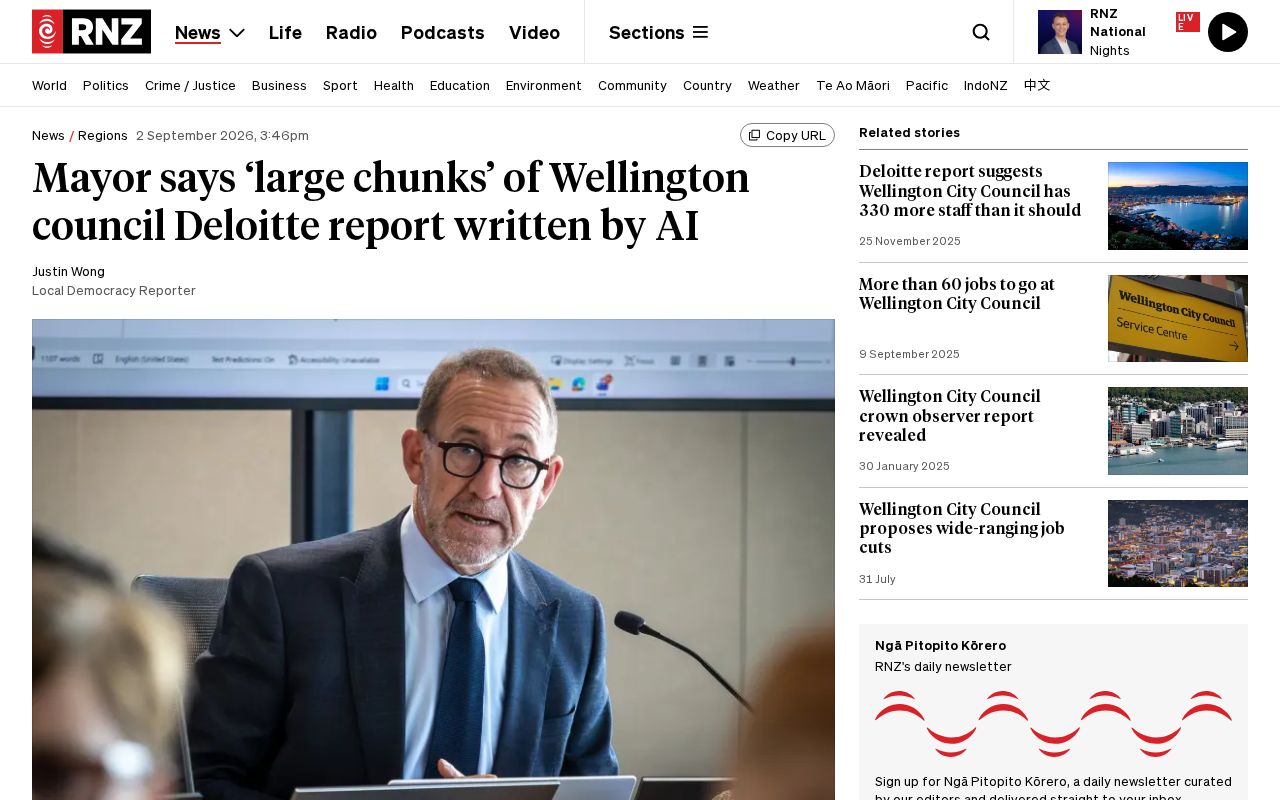
Wellington's AI-generated council report exposes trust and accountability gaps in professional consulting.
New Zealand's Wellington City Council found itself in controversy after its mayor admitted that a Deloitte-authored report contained large chunks of AI-generated content. The incident raises critical questions about transparency, accountability, pricing fairness, and quality standards as AI permeates professional services — particularly those influencing public policy decisions funded by taxpayers.
How It Unfolded: An Official Report "Taken Over" by AI
New Zealand's capital, Wellington, has recently found itself at the center of a controversy over the boundaries of AI use. The city's mayor publicly acknowledged that a formal report commissioned by the city council from Deloitte contained "large chunks" of AI-generated content.
Background on Deloitte: Deloitte is one of the Big Four accounting firms, alongside PwC, EY, and KPMG. As the world's largest professional services network, Deloitte employs over 400,000 people across more than 150 countries, offering audit, consulting, financial advisory, risk advisory, tax, and related services. Its consulting arm is particularly formidable, generating tens of billions of dollars in annual revenue. Deloitte's reports and recommendations are routinely used as key decision-making inputs by government agencies and major corporations, and its brand represents rigorous professional standards and industry credibility. This is precisely why allegations of extensive undisclosed AI-generated content in a formal Deloitte report carry far greater impact than a similar incident involving an ordinary consulting firm.
The mayor's statement quickly sparked widespread public debate about government procurement, consulting report quality, and AI transparency. The core issue isn't whether AI was involved in the writing — it's about three critical questions: Was the commissioning party (the city council) informed? Was the final quality of the report compromised? Did the consulting fees paid correspond to the actual work performed? These three questions strike at the heart of a gap that the entire industry has yet to address: the lack of oversight and disclosure standards as AI permeates professional services at scale.
AI-Written Reports: Efficiency Tool or Trust Crisis Trigger?
The "Invisible Revolution" in Consulting
Top consulting firms like Deloitte, McKinsey, and PwC have long integrated large language models into their daily workflows.
Technical Explanation of Large Language Models: Large Language Models (LLMs) are artificial intelligence systems based on deep learning that learn statistical patterns and semantic relationships in language by training on massive text datasets. Models like the GPT series and Claude, with parameter counts ranging from billions to hundreds of billions, can understand context, generate coherent text, reason, and summarize. These models work by predicting the most likely next word, iteratively generating complete paragraphs. While they excel at text generation and information synthesis, they also suffer from "hallucination" — generating information that appears plausible but is factually incorrect — and lack genuine deep understanding of domain-specific knowledge. In professional consulting contexts, this means human experts must rigorously review AI outputs.
AI can rapidly synthesize data, generate drafts, and format report structures, dramatically compressing delivery timelines. From a pure efficiency standpoint, this is perfectly legitimate technological progress. But the problem is that the value of a consulting report has never been just about the "words" — it's about professional judgment, industry experience, and customized insights. When clients pay premium consulting fees, they're purchasing the cognitive labor of human experts. If "large chunks" of a report are actually AI-generated and this fact isn't proactively disclosed, it creates a form of hidden information asymmetry — even if the final text quality is acceptable, this lack of transparency alone is enough to erode the foundation of trust.
What Does "Large Chunks" Actually Mean?
The mayor's choice of words — "large chunks" — is telling. It implies that AI involvement went well beyond "assisted polishing" and may have extended to core arguments, data interpretation, and even policy recommendations. In a report intended to guide public policy decisions, this level of AI involvement raises more than quality concerns — it breaks the chain of accountability: if the conclusions are wrong, who bears the responsibility? The developer of the AI tool? The consultant who used the AI? Or the commissioning party that failed to conduct proper reviews?
New Challenges Facing Public Sector Procurement
The Special Nature of Government-Commissioned Reports
Government-commissioned consulting reports are fundamentally different from commercial project reports. Their conclusions often directly affect the allocation of public resources, policy direction, and the daily lives of citizens.
Public Policy Decision-Making Context: In modern governance systems, third-party consulting reports are a crucial support for evidence-based government decision-making. Because government departments have limited in-house expertise, they typically commission specialized firms to conduct independent research on complex technical, economic, or social issues. The conclusions of these reports can directly influence the allocation of budgets worth millions, affect the employment of tens of thousands, or shape a city's development trajectory for the next decade. Report quality is therefore not just a technical matter — it's a core issue of democratic accountability and the public interest. If a report is filled with AI-generated content that hasn't been adequately verified, it could lead to policy choices based on flawed premises, with consequences far more severe than consulting errors in the commercial sector. This is why the Wellington incident has provoked such a strong public reaction.
For this reason, such reports demand far higher standards of accuracy, originality, and professional independence than typical commercial documents. The Wellington incident has exposed a systemic vulnerability: existing government procurement contracts and acceptance criteria largely lack explicit provisions regarding AI-generated content. Are consultants obligated to disclose the extent of AI use? Does AI-generated content require additional human review mechanisms? In most current contracts, these questions remain a blank slate.
What Did Taxpayers Actually Pay For?
From a public finance perspective, this incident touches an even more sensitive nerve.
Traditional Pricing Logic: Traditionally, fees for government-commissioned consulting are calculated using a "person-hours" cost model: the number of working hours for consultants at different levels — senior partners, project managers, analysts — multiplied by their respective hourly rates. A major report might involve hundreds or even thousands of hours of human input, including preliminary research, interviews, data analysis, report writing, and multiple rounds of revision. The high cost of consulting fees reflects the professional qualifications, industry experience, and accumulated knowledge of the consultants. However, when AI can generate a first draft in minutes and complete literature reviews in hours that would previously take days, actual human input drops dramatically. This raises a fundamental question: if production costs have decreased by 80% but billing standards remain based on the traditional model, does this constitute unfair enrichment at the client's expense?
Taxpayer money paid for Deloitte's consulting fees, which theoretically correspond to the time and intellectual input of professional consultants. If large chunks were completed by AI at near-zero marginal cost, does the pricing logic for consulting fees need to be reexamined? This isn't about denying the value of AI in professional work — it's about asking a fundamental question: when AI dramatically reduces production costs, who should reap the efficiency dividends?
Industry Standards Are Taking Shape: Disagreements and Consensus
Should AI Use Be Proactively Disclosed?
Currently, there is no unified global consensus on disclosure standards for AI use in the consulting and legal industries. Some firms adopt proactive disclosure strategies, noting in their reports that "portions of this report were generated with the assistance of AI tools and reviewed by professional consultants." Others treat AI as an internal efficiency tool — no different from using Excel or PowerPoint — and see no need for special disclosure.
These two positions reflect fundamentally different judgments about the nature of AI: the former holds that AI-generated content has unique characteristics and readers have a right to know; the latter argues that tools don't affect final quality and excessive disclosure only creates unnecessary anxiety. The ongoing fallout from the Wellington incident may accelerate the entire industry's shift toward proactive disclosure.
Quality Assurance Mechanisms Are Still Missing
AI language models have well-documented limitations: hallucination, gaps in the latest data, and misunderstanding of local context.
AI Hallucination Explained: AI hallucination refers to the phenomenon where large language models generate information that reads smoothly and plausibly but is actually inaccurate or entirely fabricated. This is an inherent limitation of current AI technology: models don't truly "understand" facts but generate content based on statistical patterns in their training data. When confronted with topics not adequately covered in their training data, or when the latest information is needed, models may "fabricate" believable-sounding details, cite nonexistent studies, or provide incorrect data. In professional consulting reports, hallucinations might manifest as: fabricated statistics, nonexistent regulatory provisions, or flawed causal reasoning. In 2023, a lawyer was sanctioned by a court for using fictitious cases generated by ChatGPT — a case that vividly illustrates the severity of this risk.
In a report dealing with specific local government policies, these limitations can produce substantively misleading results. If a consulting firm lacks rigorous human review processes and simply polishes AI output before delivering it as a formal product, the potential risks are obvious. Establishing quality verification mechanisms for AI-assisted content has become an urgent challenge for the industry.
The Bigger Lessons from the Wellington Incident
The Wellington City Council controversy is almost certainly not an isolated case. As AI writing tools continue to improve, similar situations are quietly occurring in consulting projects, legal documents, and academic reports around the world. The value of this incident is that it has thrust a phenomenon usually hidden behind the scenes into the public spotlight, forcing all parties to confront several core issues:
- Transparency: Are professional service providers obligated to disclose the extent of their AI use?
- Accountability: When AI-generated content contains errors, who bears the consequences?
- Pricing Fairness: After AI dramatically reduces production costs, should clients share in the efficiency gains?
- Quality Standards: How should independent verification mechanisms for AI-assisted content be established?
Regulatory Landscape: Currently, global regulation of AI use is fragmented. The EU's AI Act focuses on high-risk application scenarios, individual U.S. states have varying regulations, and many jurisdictions have no clear legislation at all. In the professional services sector, the primary reliance is on self-regulatory standards from industry associations, such as the American Bar Association's (ABA) ethical guidance on lawyers' use of AI, or the accounting profession's requirements for audit working papers. However, these standards often lag behind technological developments and lack enforcement power. At the same time, companies face a dilemma: excessive disclosure of AI use could raise client concerns and hurt competitiveness, while non-disclosure risks triggering a trust crisis. The Wellington incident may prove to be a turning point, pushing regulators and industry organizations to accelerate the establishment of clear AI use disclosure standards and quality assurance mechanisms.
These questions don't have simple answers, but they must be formally raised and taken seriously. AI is reshaping how knowledge work is produced, and the rule-makers — whether governments, industry associations, or the market itself — need to pick up the pace and build governance frameworks that match the technology before it runs too far ahead.
For technology teams and businesses that are integrating AI into their own workflows, the Wellington incident sends a clear signal: the boundaries of technological capability are never the same as the boundaries of professional responsibility. Tools can be iterated, but once trust is lost, the cost of repair far exceeds what anyone imagines.
Related articles

WorkBuddy Agent in Action: From AI Q&A to Automated Office Work
WorkBuddy is Tencent's AI agent desktop workbench that reads local files, operates office software, executes multi-step tasks, and runs on schedules. This article explains its core features, key differences from traditional AI tools, and use cases.

Anthropic Research: LLMs Make Formal Software Verification at Scale Possible
Anthropic Frontier Red Team research shows LLMs can generate formal proofs at the RISC-V assembly level for over 100 real open-source libraries, covering 123 OSS-Fuzz libraries and 239 entry points, totaling about 180 million lines of Rocq proofs and finding hundreds of bugs. The article analyzes specification generation, the proof pipeline, trust boundaries, and cost reduction paths.

Prompt Engineering for Beginners: From Writing Prompts to Building AI Collaboration Skills
From the four functions of prompts to the six-step prompt engineering process, this article systematically covers core concepts, business value, and three layers of limitations to help beginners build a complete cognitive framework for prompt engineering.