Government Rails Site Breached Hours After Patch Release: A Wake-Up Call on n-day Vulnerability Threats
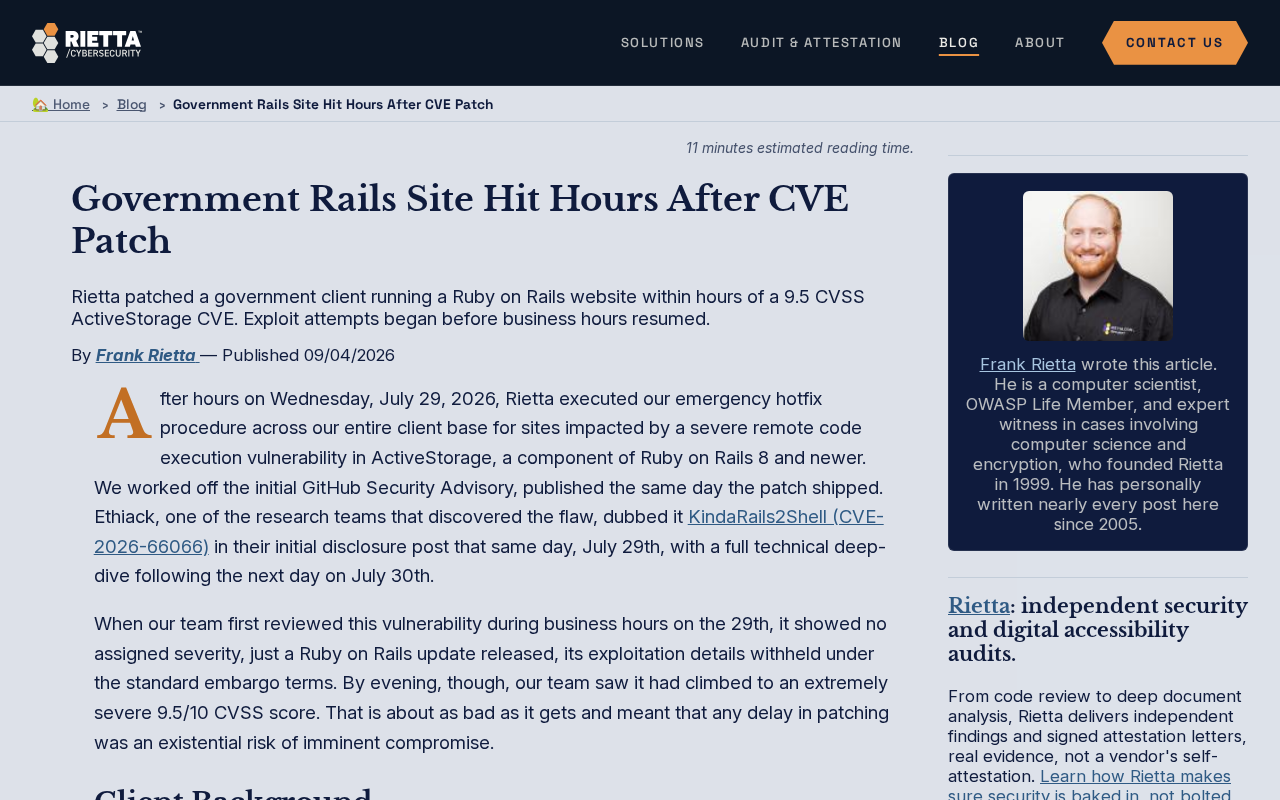
Government Rails site breached hours after CVE patch, exposing critical n-day vulnerability risks.
A government website built on Ruby on Rails was compromised just hours after a CVE patch was released, highlighting the dangerous window between vulnerability disclosure and patch deployment. This article analyzes how attackers weaponize patches through diff analysis, why n-day vulnerabilities often cause more damage than 0days, and why government systems are particularly vulnerable due to slow deployment processes and legacy infrastructure. It offers actionable defense strategies including automated patch monitoring, WAF-based virtual patching, and defense-in-depth approaches.
Incident Overview
A textbook patch race incident has drawn significant attention in the tech community. A government website built on Ruby on Rails was compromised just hours after the relevant CVE patch was released. According to a Hacker News discussion (60 upvotes, 13 comments), this incident once again highlights the extremely narrow window between vulnerability disclosure and active exploitation.
Looking at the timeline, the attack was nearly simultaneous with the patch release, which means attackers either already knew about the vulnerability or reverse-engineered an exploit through differential analysis shortly after the patch dropped. For government systems, this kind of gap in response speed can be fatal.
Why Patch Releases Can Become Attack Signals
Patches as Attack Roadmaps
A counterintuitive reality: the release of a security patch can sometimes accelerate the arrival of attacks. When a vendor publishes a patch, attackers can compare the code before and after the fix — a technique known as "Patch Diffing" — to quickly pinpoint the exact logic that was repaired, and then reverse-engineer the vulnerability's trigger conditions and exploitation method. This technique has a surprisingly low barrier in practice. For open-source projects, attackers simply need to review the diff records in Git commit history; for closed-source software, they use binary diffing tools like BinDiff to compare compiled files. In the hands of experienced attackers, the entire reverse analysis process may take only tens of minutes — which is exactly why "the clock starts ticking" the moment a patch is released.
For open-source frameworks like Ruby on Rails, this problem is especially acute. Since its release in 2004, Rails has rapidly become one of the most popular web development frameworks, thanks to its "Convention over Configuration" and DRY (Don't Repeat Yourself) design philosophy. Well-known platforms such as GitHub, Shopify, and Basecamp are all built on Rails. Because of its widespread adoption and fully open codebase, a framework-level security vulnerability can have an enormous blast radius — potentially exposing thousands of applications worldwide simultaneously. Anyone can view the exact changes in a patch commit on GitHub. Security researchers and malicious attackers stand on the same starting line, but the latter often have a much stronger incentive to weaponize the vulnerability in the shortest possible time.
The Real Threat of n-day Vulnerabilities
The industry often focuses on the danger of 0days, but in reality, n-day vulnerabilities — those that have been publicly disclosed but not yet patched — frequently cause greater actual damage. The reason is simple: developing and exploiting 0days is expensive, while n-days only require "copying the homework." Exploit code may already be circulating in the community or even integrated into automated scanning tools.
Behind this is an increasingly mature vulnerability economy ecosystem. The discovery, trading, and exploitation of security vulnerabilities have formed a complex market spanning legitimate, gray, and black areas. On the legitimate side, there are vendor Bug Bounty programs (through platforms like HackerOne and Bugcrowd) and public acquisition programs from companies like Zerodium. In the gray and black markets, transactions between vulnerability brokers and APT groups have long been active. A critical iOS remote code execution 0day can fetch millions of dollars on the underground market. However, the "democratization" trend of n-day vulnerabilities is even more concerning — as PoC (Proof of Concept) code proliferates across platforms like Exploit-DB and GitHub, the exploitation barrier continues to drop, enabling even less technically skilled attackers to launch effective attacks with ready-made tools.
Every published CVE number (CVE, or Common Vulnerabilities and Exposures, a vulnerability disclosure system maintained by MITRE) means the vulnerability information is transparent to everyone. CVEs are typically associated with CVSS scores (Common Vulnerability Scoring System), which measure vulnerability severity on a scale of 0 to 10 to help security teams prioritize remediation. But the same information transparency also provides attackers with a precise attack blueprint.
The core issue in this government website breach was precisely the exposure window between patch release and actual deployment. Even if that window is only a few hours, it's more than enough for automated attack tools.
Why Government Systems Are High-Risk Targets
Inherent Delays in Deployment Processes
Government IT systems often face a unique predicament. On one hand, they host high-value citizen data and public services, making them prime targets for attackers. On the other hand, due to compliance, auditing, and stability requirements, their patch deployment processes are typically extremely lengthy, requiring testing, approval, change management, and multiple other steps.
This combination of "high value" and "slow response" makes government Rails sites exceptionally attractive attack targets. While private tech companies might push security updates through CI/CD pipelines within minutes, government systems may still be stuck in lengthy change approval processes. CI/CD (Continuous Integration/Continuous Deployment) is a core practice in modern software engineering — continuous integration ensures code changes are validated through automated testing before merging, while continuous deployment automatically pushes tested code to production environments. Mature CI/CD pipelines, leveraging tools like GitHub Actions, GitLab CI, and Jenkins, can compress the entire process from code commit to production deployment down to minutes. However, building a reliable CI/CD pipeline requires significant upfront investment in automated test coverage, rollback mechanisms, and environment consistency — precisely the infrastructure capabilities that many traditional organizations, especially government agencies, lack.
The Maintenance Dilemma of Legacy Systems
Many government websites were built on older Rails versions and have long suffered from a lack of systematic dependency upgrades and security maintenance. These legacy systems are not only running outdated versions but may also be difficult to directly apply official patches due to custom modifications, further extending the remediation cycle. Major version upgrades of the Rails framework itself (e.g., from Rails 5 to Rails 6 or Rails 7) often involve API changes and underlying architectural adjustments. For government systems lacking dedicated maintenance teams, cross-version upgrades carry enormous technical risk and labor costs, leaving many systems stranded on versions that have long since lost security support — creating a vicious cycle of ever-accumulating technical debt.
Response Strategies for Developers and Operations Teams
Build Automated Patch Response Mechanisms
The most direct lesson from this incident is clear: response time after a patch release must be measured in hours, or even minutes. Teams should establish automated monitoring for CVEs affecting critical dependencies, triggering assessment and deployment workflows immediately upon discovery.
For the Rails ecosystem, tools like bundler-audit and Dependabot can enable continuous dependency vulnerability scanning. bundler-audit is a command-line tool specifically designed for the Ruby ecosystem that checks Gemfile.lock for known security vulnerabilities by comparing project dependencies against the Ruby Advisory Database, quickly identifying gems with known CVEs. Dependabot is an automated dependency update service provided by GitHub that monitors version changes and security advisories for project dependencies, automatically creating Pull Requests to upgrade vulnerable dependencies. These two tools represent complementary strategies of "proactive scanning" and "automated remediation" respectively. Integrating them into your CI/CD pipeline builds continuous monitoring capability for supply chain security.
Defense in Depth Is Non-Negotiable
Relying solely on "patching in time" is a fragile strategy. During the patch window, defense-in-depth measures such as Web Application Firewalls (WAF), Intrusion Detection Systems (IDS), and virtual patching can provide critical buffer time.
A WAF is a security layer deployed in front of web applications that identifies and blocks malicious requests by analyzing HTTP/HTTPS traffic. It typically performs detection based on predefined rule sets (such as the OWASP Core Rule Set, covering common attack patterns like SQL injection, XSS, and remote code execution) and behavioral analysis. Virtual Patching is a key WAF capability — when the underlying application hasn't yet completed an actual code fix, security teams can write interception rules at the WAF layer targeting a specific CVE to block known attack payloads from reaching the application layer. This approach doesn't modify the application code itself, can be deployed quickly, and serves as a critical interim measure to bridge the patch window. Major WAF products include Cloudflare WAF, AWS WAF, and ModSecurity, and organizations can choose cloud-based or on-premises deployment depending on their architecture.
Even when the underlying vulnerability hasn't been fixed, these defense-in-depth measures can intercept known attack signatures at the network layer, buying precious time for remediation.
Prioritize Monitoring and Rapid Containment
Timely intrusion detection is itself a critical component of the defense framework. An attacker breaching a system is just the beginning. How quickly an organization can detect anomalies, isolate affected systems, and prevent lateral movement and data exfiltration is the true test of its overall security response capability. Modern Security Operations Centers (SOCs) typically rely on SIEM (Security Information and Event Management) systems to perform correlation analysis across logs, network traffic, and endpoint behavior, combined with preset alerting rules and automated orchestration (SOAR), to achieve a rapid closed loop from detection to response. For Rails applications, combining application-layer log monitoring (such as anomalous request patterns and unauthorized API calls) with infrastructure-level network traffic analysis can significantly reduce the "Dwell Time" — the period between when an intrusion occurs and when it's discovered.
Conclusion
Incidents where systems are "breached just hours after a patch release" are not isolated cases — they are a microcosm of the modern software security landscape. They remind us that in an era of increasingly mature vulnerability economics, security defense has evolved from a question of "whether to patch" to a race of "how fast can you patch."
For government systems that bear public responsibility, shortening the exposure window, building automated response capabilities, and deploying defense in depth are no longer optional — they are fundamental requirements that must be confronted head-on. In this never-ending race between attackers and defenders, falling one step behind could mean losing everything.
Related articles

AI Penetration Testing Learning Roadmap: Four Stages from Beginner to Advanced
A systematic breakdown of the four-stage AI penetration testing roadmap covering AI-assisted vulnerability discovery, automated asset collection, enterprise security integration, and intelligent Agent development.

AI Ghostwriting Government Reports Triggers Trust Crisis: A Deep Dive into the Wellington City Council Incident
Wellington City Council's Deloitte report exposed as heavily AI-generated, sparking debate on consulting transparency, government procurement, and AI accountability.
Gemini 3 Flash vs. CAPTCHA Visual Puzzles: Where Are the Limits of Multimodal Agent Capabilities?
A developer tests Gemini 3 Flash on neal.fun visual puzzles using Playwright to build a visual Agent, revealing VLM limits in spatial reasoning and fine control.