AI Giants Monopolize Everything—How Can Ordinary People Avoid Being Left Behind?

A Reddit debate reasons that AI progress is irreversible, compute monopoly will lead to winner-takes-all dominance by giants, and individual anxiety is emerging.
The article reviews a Reddit debate on "why haven't you been left behind yet." Based on three assumptions—AI keeps improving, surpasses humans, and profitable domains expand indefinitely—the poster reasons that compute and top-tier models will become the only competitive barriers, letting big players squeeze out smaller ones across content, construction, finance, law, and healthcare, with concentration far exceeding Industrial Revolution monopolies. The real questions are AI's capability ceiling, whether compute monopoly is reversible, and where individuals stand amid structural change.
A Reddit Debate About Survival in the Age of AI
A post on Reddit recently sparked widespread discussion, with a title so blunt it borders on provocation: "Why aren't you left behind? (serious question). Let's have friendly debate." The poster set a few rules: stay friendly, focus on the long term, use arguments rather than personal attacks. These rules themselves hint at the sensitivity of the topic—against the backdrop of AI capabilities continuing to leap forward, talking about being "left behind" is no longer an abstract hypothetical but a real anxiety for many people.
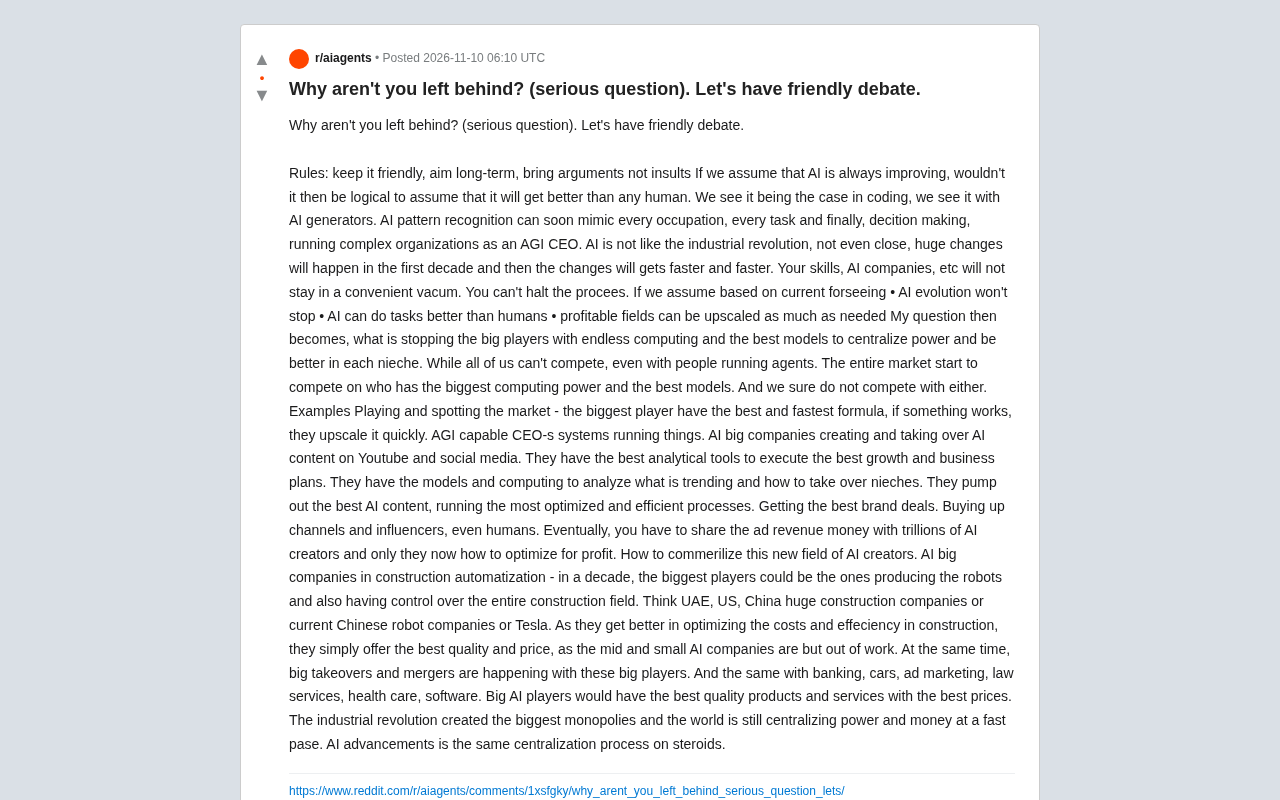
The core assumption the post throws out is: if AI keeps improving, then it is a logical inevitability that it will surpass any human. The poster points out that we have already seen this trend in programming and AI-generated content. AI's pattern-recognition ability will soon be able to simulate every profession and every task, and eventually even replace decision-making—an AGI CEO running complex organizations. This is not an industrial-revolution-level change, the poster emphasizes, "not even close." Massive change will happen in the first decade, and then the pace of change will keep accelerating.
When Compute Becomes the Only Moat
The poster pushes the reasoning further: you cannot stop this process. If we make three assumptions based on currently visible trends—AI evolution will not stop, AI can perform tasks better than humans, and profitable domains can expand indefinitely—then the question becomes: what prevents the big players with endless compute and the best models from concentrating power and becoming the best in every niche?
The sharpness of this question lies in the fact that it shifts the threshold of competition from "skill" to "compute." The poster lists several scenarios: in discovering and capturing markets, the biggest players have the best and fastest formulas, and once a direction is proven effective, they can rapidly scale it up; AGI-level CEO systems can handle operational decisions. In the content space, big AI companies are creating and taking over AI content on YouTube and social media, and they have the best analytical tools to execute growth and business plans. They have the models and compute to analyze trends, take over niches, produce optimal AI content, run the most efficient processes, secure the best brand deals, and even acquire channels and influencers—including real people.
This leads to a brutal corollary: eventually you may have to share ad revenue with trillions of AI creators, and only they know how to optimize for profit.
AGI (Artificial General Intelligence) refers to AI systems that meet or exceed human levels on almost all cognitive tasks, as opposed to current "narrow AI" focused on specific tasks (such as translation or image recognition). The "AGI CEO" mentioned in the article is a thought experiment: if AGI possesses cross-domain reasoning, planning, and decision-making capabilities, it could in theory run complex organizations. It should be noted that AGI remains a theoretical goal, with no公认 implementation path or timeline. There is huge disagreement in the industry about "when AGI will arrive," ranging from a few years to decades, and some researchers believe the current paradigm cannot lead to AGI. This concept is key in the debate because the reasoning that "AI surpasses humans" depends heavily on whether AGI is achievable—if AI remains at the narrow-AI stage for a long time, the speed and breadth of concentration will be significantly limited.
Compute in this context refers to the computational resources needed to train and run AI models, usually measured by the scale of accelerator chips such as GPUs/TPUs, the number of clusters, and energy consumption. Compute is seen as a "moat" because the performance of large models follows a power-law relationship with training compute (scaling law), and building and operating top-tier compute clusters costs billions of dollars, creating an extremely high capital barrier. But compute is not the only variable: data quality, algorithm efficiency, engineering capability, and talent are equally critical. In addition, open-source models are continuously closing the gap with closed-source models through distillation and efficiency optimization, making "whether compute monopoly is irreversible" a focal point of the debate. Reducing competition to the single dimension of "compute" may underestimate the disruptive potential of software innovation and distributed computing.
From Content to the Physical World: The Dominoes of Winner-Takes-All
The poster extends the reasoning to physical industries. In building automation, within a decade the biggest players may be companies that both produce robots and control the entire construction sector. The poster names large construction companies in the UAE, the United States, and China, as well as current Chinese robotics companies or Tesla. As they become increasingly strong at optimizing cost and efficiency, they only need to offer the best quality and price to squeeze small and medium AI companies out. On the other side, acquisitions and mergers among the big players are also underway.
The same logic applies to banking, automobiles, advertising and marketing, legal services, healthcare, and software. The big AI players will have the best-quality, best-priced products and services. The poster offers a sharp historical analogy: the Industrial Revolution created the largest monopolies, and the world is still striding toward the concentration of power and money. AI progress is the same concentration process—just "on steroids."
This analogy deserves serious consideration. Monopoly formation during the Industrial Revolution was built on capital intensity, economies of scale, and control of infrastructure. What is special about the AI era is that economies of scale have been compressed into two variables: models and compute. An organization with top-tier models and ample compute can replicate into almost any knowledge-intensive field in an extremely short time—an expansion speed unimaginable in the industrial age.
Economies of Scale refers to the phenomenon where increased output or scale leads to lower unit costs. The reason monopolies formed in the industrial age is precisely that in industries with heavy assets and high fixed costs, the larger the scale, the lower the unit cost, making it hard for latecomers to catch up. What is special about the AI era is that the object of economies of scale has shifted from "physical capacity" to "model performance": larger models and more compute often bring stronger capabilities, and once a model is trained, the marginal cost of copying and distributing it approaches zero. This means leaders can extend their advantage into new fields in an extremely short time, and unlike the industrial age, they are not constrained by factories, logistics, or geography. This combination of "near-zero marginal cost + performance improving with scale" is the core mechanism behind the poster's view that concentration will accelerate "on steroids."
The Real Questions Behind the Debate
The value of this post is not that it provides answers, but that it twists together several questions usually discussed separately: where the ceiling of AI capability lies, whether compute monopoly is reversible, and where individuals stand amid structural change. The poster offers no solutions, but the way the question is framed is itself a reminder—when the infrastructure of competition shifts from human skill to machine compute, the marginal utility of the traditional path of "working hard to improve yourself" may be substantially diluted.
The direction of the post's discussion section is also worth noting. The poster repeatedly emphasizes using "arguments rather than insults," indicating that this topic easily slides into emotional confrontation. One side believes concentration is the inevitable result of technological evolution, while the other hopes that open-source models, regulatory intervention, or new distributed technology paths can break down compute barriers. Neither position currently has decisive evidence, but the debate itself already shows that in the AI era, the discussion about who will be left behind is turning from a fringe topic into mainstream anxiety.
As for the original question—why haven't you been left behind yet—the poster actually implies a less reassuring answer: perhaps you just haven't reached the point in time when you will be left behind. Change will happen first in programming and content generation, then spread to decision-making and physical industries. The time window exists, but it may not be very long.
Open-source models and distributed AI are the "anti-concentration" forces often cited in the debate. Open-weight models represented by Llama, Mistral, and others allow anyone to download, fine-tune, and deploy locally, lowering the barrier to entry; distributed training and inference technologies attempt to spread compute demand across many participants. However, open-source models typically lag behind closed-source frontier models by months to a year in capability, and training top-tier models still requires enormous compute, so open source alone cannot fully eliminate compute barriers. Regulatory intervention is another path, such as antitrust review, compute export controls, and AI safety legislation, but its effectiveness and speed are uncertain. The outcome of the contest between these two forces determines whether concentration is an "inevitability" or "one of several trends"—and there is currently no consensus.
One-line Summary
A Reddit debate reasons that AI progress is irreversible, compute monopoly will lead to winner-takes-all dominance by giants, and individual anxiety is emerging.
Paragraph Summary
The article reviews a Reddit debate about "why haven't you been left behind yet." Based on three assumptions—AI keeps improving, capabilities surpass humans, and profitable domains expand indefinitely—the poster reasons that compute and top-tier models will become the only competitive barriers, and that big players can squeeze out small and medium players in content, building automation, finance, law, healthcare, and other fields through optimal quality and price, with concentration far exceeding Industrial Revolution monopolies. The article points out that the real questions behind the debate are the ceiling of AI capability, whether compute monopoly is reversible, and where individuals stand amid structural change, and that the traditional path of "working hard to improve skills" may see its marginal utility substantially diluted in the era of compute competition. Divergence in the discussion centers on whether concentration is inevitable, and whether open-source models and regulation can break down barriers remains undecided.
Related articles

Lazy-CPBS: Making Industrial AGV Fleet Coordination More Efficient
A new study proposes the AGV-MAPF_R-CTC formal framework and the Lazy-CPBS algorithm, significantly reducing the search overhead of continuous-time MAPF in industrial AGV fleet coordination through lazy materialization of high-level nodes, with experiments showing the best robustness/runtime trade-off on industrial road networks.

How Do Random Feature Networks Solve Stochastic Optimal Control? New Theory Reveals Error Trade-offs
New research analyzes objective error of random feature neural networks (RFNNs) as feedback policies in stochastic optimal control, revealing trade-offs between feature width and sample paths, and the improvement of pruning strategy PRFL.

Configuration Traps in Explainable AI Evaluation: Alignment Metrics Are Not a Fixed Yardstick
Alignment evaluation in explainable AI is not a fixed yardstick. This study formalizes it as a configuration space and reveals how GT representation, metric families, soft/hard metrics, and thresholding strategies systematically shape evaluation conclusions, proposing an attribution behavior taxonomy based on local entropy and boundary mass ratio to guide more reliable XAI evaluation protocols.