AI Helps a Hacker Crack Monitor Firmware in 15 Minutes, Erasing the Reverse-Engineering Barrier

AI-assisted reverse engineering cracked Dell monitor firmware keys in 15 minutes, exposing peripheral security design flaws.
A vulnerability researcher used an AI model to complete the key location and decryption verification of a Dell S3422 monitor's firmware in about 15 minutes, whereas the traditional process takes days to a week. The AI autonomously identified the EUPG container, decompiled the binary, located the key block constructor, generated a decryption script, and verified the result using the MD5 checksum and MSTAR8051 reset vector. The author notes that the real hidden danger is Dell placing the key block near the encrypted image—a structural design flaw. The article argues that AI is automating the most time-consuming hypothesis-verification steps in reverse engineering, flattening the cost curve of peripheral attack surfaces, and that manufacturers' design reviews must assume attackers have AI assistance.
A vulnerability researcher posted a mind-bending test on Bilibili: a firmware reverse-engineering project that used to take one or two days, or even a week, was completed in just 15 minutes with the help of an AI model—he located the Dell monitor's firmware encryption key and verified the decryption. This isn't a show-off video; it's a field record of the security industry's rules changing.
Monitor Firmware: An Overlooked Attack Surface
The video's author targeted a Dell S3422 34-inch monitor. Many people assume monitors are passive output devices, but their firmware handles HDMI commands, video signals, and even wireless communication logic—essentially making it an embedded computer. The author downloaded the XE-format firmware update package from Dell's official website, used tools like Binwalk to extract it layer by layer, and found the update image and the Dell ISP Library—the in-system programming library containing core functions for uploading and downloading firmware.
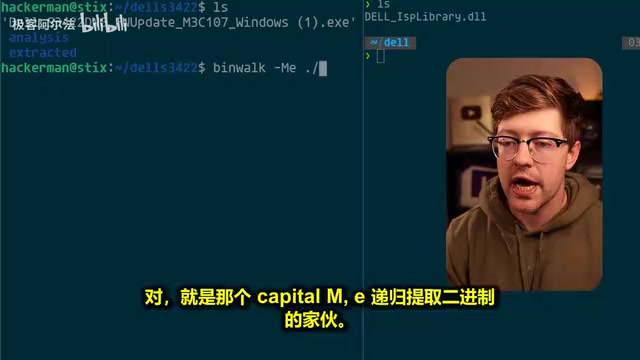
The perennial challenge in firmware research is manufacturer encryption. The author used an entropy analysis tool to examine the extracted image and found entropy values as high as 0.96 at the edges—highly disordered data, almost certainly encrypted. The key is likely hardcoded in the motherboard's microcontroller; under the traditional approach, this would be a dead end. Based on the author's past experience, such projects require extensive manual iteration, guesswork, and hypothesis testing—what he calls "brute-force cracking, constant trial and error."
Binwalk is a classic open-source tool for firmware image analysis. Its core capability is identifying and extracting nested file systems, compressed archives, bootloaders, and other structures within an image. It locates data boundaries by scanning for known magic signatures and is often paired with the dd command to slice by offset. In the early stages of firmware reverse engineering, Binwalk can quickly answer "what exactly is inside this update package," but it doesn't handle decryption; when it encounters encrypted sections with entropy near 1, it can only flag them, and further manual or toolchain intervention is still needed.
Entropy analysis is a common method for determining whether data is encrypted or compressed. Shannon entropy is calculated in blocks over the byte stream; plaintext code and structured data typically have lower entropy (around 0.5–0.7), while encrypted or highly compressed data approaches 0.95 or above. The author observed entropy as high as 0.96 at the image edges, which is how he inferred the firmware was encrypted—a judgment that gave the AI a direction for locating the decryption logic.
How AI Compressed a Week into 15 Minutes
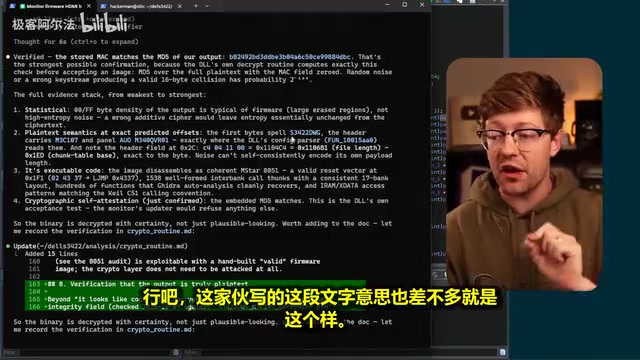
The turning point came with AI intervention. The author handed the reverse-engineering task to the model: locate the firmware in the image, find the HDMI command parser, and determine the encryption status. The model autonomously completed several key actions—identifying the EUPG container (the update package containing the actual image), invoking a decompiler to convert the binary into C-like pseudocode, and locating a function numbered 1001, 2A60 in the Dell ISP library that contains a constructor for generating the key block, while another function directly uses the key block data to perform decryption.

In under a minute, the model wrote a decryption script in Python; in under 40 seconds, decryption succeeded. The author admits that as an AI skeptic, his first reaction was, "How do we know the output isn't just noise?" The model's self-verification dispelled his doubts: the decrypted image contains an MD5 checksum at the ECD offset, and the script zeroed out the Mac field and recalculated the MD5 over the entire image, which matched the stored value exactly. The model also found that the decompiled code corresponded perfectly with the MSTAR8051 microcontroller inside the monitor, and the image contained a valid reset vector at the correct offset—hard evidence that the firmware is executable.
One detail: the author mentioned that the complete AI-assisted workflow actually took about 16 minutes—the "15 minutes" in the title isn't clickbait but actual timing. He also judged that if he worked on it full-time, finishing within a day would be no problem.
MSTAR8051 is a series of 8051-core microcontrollers from Morningstar Semiconductor (MStar, later acquired by MediaTek) aimed at monitor and TV control scenarios. The 8051 is an 8-bit architecture introduced by Intel in the 1980s, with a simple instruction set and limited resources, and has long been active in embedded control. Monitor main controllers often use such MCUs for HDMI handshaking, OSD menus, backlight and power sequencing, and other logic. Therefore, if the decompiled pseudocode matches the 8051's register layout, interrupt vector table, and reset vector addresses, it serves as corroborating evidence that the image is genuinely executable—this is exactly why the author used "valid reset vector" to cross-validate the decryption result.
MD5 checksums are commonly used in firmware update packages for integrity protection: manufacturers store the MD5 digest of the original data at a fixed offset in the image, and compare it during updates to prevent corruption. By zeroing out the Mac field and recalculating the MD5 to compare with the stored value, the author essentially used the manufacturer's own verification mechanism to reverse-validate the correctness of the decryption—more reliable than simply "it looks like code."
Design Flaw: The Key Is Right Next to the Encrypted Data
What truly unsettled the author wasn't the AI's speed but the structural flaw in Dell's firmware design. According to his description, the ideal approach would be: flash data encrypted at rest, the key hardcoded in the MCU's ROM and non-extractable, and decryption performed only on the motherboard side. But in this monitor, the key block and the encrypted image are almost placed together—any reverse engineer who obtains the image effectively obtains the key.
The author offered a brutal estimate in the video: what a traditional expert could accomplish in a few days to a week, AI compresses to minutes. This isn't exposing someone's technical shortcomings; it's flattening the cost curve of the entire peripheral security system—attack surfaces that previously required professional expertise to reach now have a dramatically lowered barrier to entry.
AI's Real Role in Vulnerability Research
The value of this test isn't the sensational headline "AI can hack" but the specific division of labor it demonstrates for AI in reverse engineering: automated hypothesis verification, cross-file structure correlation, identifying encryption logic from pseudocode, and generating and executing verification scripts. These are the most time-consuming mechanical steps in reverse engineering. The author's judgment is measured—AI won't replace vulnerability researchers, but it will greatly accelerate the process of "staring at binary files and slowly figuring out the manufacturer's intent."
The video also includes an interlude: the author used an MCP server to combine anomaly data from a monitoring platform with the local codebase, and AI located a URL-handling bug within 15 seconds—users submitted links with subfolders rather than full GitHub addresses, which the project repository couldn't handle, causing the anomaly to go uncaught. This case and the firmware cracking point to the same conclusion: AI is becoming a default part of the vulnerability discovery process.
MCP (Model Context Protocol) is an open protocol proposed by Anthropic in 2024 for connecting AI models to external tools and data sources in a standardized way—local codebases, monitoring platforms, databases, and so on. It abstracts "what the model can call" into a server-declared tool list, and the model initiates calls on demand and reads the returned results. The author used an MCP server to bridge anomaly data from a monitoring platform with the local codebase, enabling AI to correlate clues across data sources within a single session and locate the URL-handling bug in 15 seconds. This case shows that protocols like MCP are turning AI from a "chat window" into an agent capable of actively retrieving and operating on engineering context.
Real-World Impact on the Security Industry
For manufacturers, firmware encryption can no longer rely on "hiding the key next door"-style obscurity. Entropy detection can determine encryption in a minute, and AI can complete structure identification and key location in minutes; design reviews must assume attackers have AI assistance. For security practitioners, the author's experience is a clear signal: the experience barriers built up over time are thinning, and judgment—knowing what to have AI verify and how—matters more than manual speed.
The author's closing remark is blunt: cracking and dissecting poorly designed things has become widespread—basically anyone can do it. This statement is both a technical observation and a warning to the entire embedded security industry.
One-line Summary
AI-assisted reverse engineering cracked Dell monitor firmware keys in 15 minutes, exposing peripheral security design flaws.
Paragraph Summary
A vulnerability researcher used an AI model to locate and verify the decryption of a Dell S3422 monitor's firmware in about 15 minutes—a process that traditionally takes days to a week. The AI autonomously identified the EUPG container, decompiled the binary, located the key block constructor, generated a decryption script, and verified the result using the MD5 checksum and MSTAR8051 reset vector. The author points out that the real danger is Dell placing the key block near the encrypted image—a structural design flaw. The article argues that AI is automating the most time-consuming hypothesis-verification steps in reverse engineering, flattening the cost curve of peripheral attack surfaces, and that manufacturers' design reviews must assume attackers have AI assistance.
Related articles

Kimi K3.1 Hands-On Test: Open-Source Model Nears Opus, Video Generation Steals the Show
Kimi K3.1 completed motion graphics, 3D rendering, mini-games, and video generation in a live test. Analysis of its 2.8T MoE architecture, gap vs Opus/GPT, and hidden video generation.

Sam Altman: Why Life's Biggest Advice Should Still Come from Humans
OpenAI CEO Sam Altman on the limits of AI advice: AI can talk you out of an impulsive email, but life's biggest advice should still come from humans.

"Black October": Did AI Uncover 3% of All Critical Vulnerabilities Ever?
A Reddit post claims 3% of all critical software vulnerabilities ever were found in the past month, dubbed 'Black October.' We break down the statistical issues, how AI-assisted code auditing accelerates discovery, and how developers should respond.