AI in Four Years Will Be Unrecognizable: The Leap from GPT-3.5 to Superintelligence
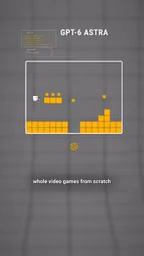
AI leapt from toy to expert intern in four years; verifiable domains will be surpassed first.
The article reviews AI's qualitative shift over the past four years: from GPT-3.5 writing limericks and completing simple functions to models like Aster independently building full video games and producing publishable-level math results. The author stresses that the key lies in "verifiable domains"—math proofs, code generation, chip design, and financial trading, where clear success criteria enable self-verification and rapid iteration, making AI progress far faster than in hard-to-quantify fields like art. If a comparable leap occurs over the next four years, by around 2030 AI could surpass NVIDIA in chip design, crush top hedge funds in trading returns, and outdo all of humanity in materials search such as room-temperature superconductors. The author warns that the next leap starts from expert intern, and the result is not assisting humans but replacing or surpassing them in verifiable domains.
From "Toy" to "Expert Intern": A Qualitative Shift in Four Years
Four years ago, GPT-3.5 could write a barely coherent limerick and auto-complete a simple Python function, but beyond that it was little more than a useless toy. Today, models like Aster can build complete video games from scratch and produce so many mathematical contributions worthy of top-tier journals that we have grown completely numb to them.
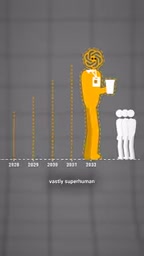
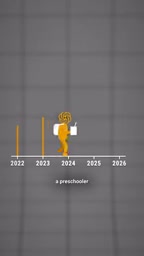
According to analysis from a YouTube tech channel, over the past four years AI has vaulted from "kindergarten level" to "expert-level intern." This rate of evolution is itself a signal: if another jump of the same magnitude occurs starting in 2026, four years from now we will face an agent that vastly exceeds humans in any even slightly verifiable domain.
What Is a "Verifiable Domain"? Why Is It So Critical?
The original article emphasizes a key qualifier—"even slightly verifiable domains." Mathematical proofs, code generation, chip design, financial trading strategies—these domains have clear success criteria, allowing AI to self-play, self-verify, and iterate rapidly. In these domains, AI's rate of progress will far outstrip that in domains that are hard to quantify, such as artistic creation or emotional understanding.
In other words, AI's capability boundary is not uniform: in verifiable domains it may iterate on a timescale of months; in non-verifiable domains it remains clumsy. This asymmetry is precisely the most important variable to watch over the next four years.
In the context of reinforcement learning, the "verifiable" qualifier corresponds to an automatically verifiable reward signal (verifiable reward). Its core requirement is: given an output, there exists a low-cost, deterministic program that can judge its correctness—for example, a compiler checking whether code passes unit tests, a proof assistant (Lean, Coq) checking whether a mathematical proof closes, or a backtesting engine evaluating the historical returns of a trading strategy. By contrast, "non-verifiable" tasks can only be assessed through human preference scoring or subjective judgment, and their feedback signals are sparse and noisy, making it difficult to support large-scale self-iteration. This distinction is critical because current model capability improvements depend heavily on reinforcement learning and synthetic data generation—the more reliable and cheaper the reward signal, the more "generate—verify—improve" cycles a model can complete in a shorter period. DeepMind's AlphaGo/AlphaZero is precisely the prototype of this paradigm: a board with clear rules provides a perfect verifier. From this we can infer that AI's capability boundary will unfold along the line of "how easy is the verifier to write," rather than along the line of "how difficult is the task for humans."
Three Things AI Could Completely Rewrite
If the magnitude of the leap over the next four years is comparable to the past four, then by around 2030 we may see the following scenarios:
First, AI chip design surpassing NVIDIA. An AI that is superhuman in "verifiable domains" can find better solutions faster than human engineers in the chip architecture search space. It doesn't need rest, doesn't need meetings, and can explore design paths in parallel that humans have never considered.
Second, financial trading returns crushing top hedge funds. If AI has equal market access, it could earn more than the human teams at Citadel and Jane Street. The reason is simple: trading strategies can be backtested and verified on historical data, making this a classic verifiable domain.

Third, breakthroughs in materials science, such as room-temperature superconductors. If AI can remotely access materials laboratories, it could be better than all of humanity combined at finding room-temperature superconductors. Materials search is essentially a high-dimensional combinatorial optimization problem, and AI has a natural advantage in verifiable search tasks.
"Chip architecture search" refers to finding the optimal combination of performance, power, and area within a high-dimensional design space composed of parameters such as bus width, cache hierarchy, pipeline depth, and the number of operator units—a search space usually too large to exhaustively enumerate. Traditionally this work relies on the experience of senior engineers and iteration with EDA toolchains. If the generation and simulation of hardware description languages (such as Verilog/Chisel), along with synthesis and timing analysis results, are used as verifiers, AI can transform architecture design into an automatically judgeable optimization problem—generate a design, run simulation and synthesis, and obtain feedback based on timing margin, power, and area to improve. The key difference from human engineers lies in parallelism: a human team can only advance a few options at a time, while AI can simultaneously explore hundreds or thousands of paths that humans have never considered due to intuition or convention.
From "Kindergarten" to "Expert Intern": Where Are We?
The original article uses a precise metaphor: four years ago it was kindergarten level; today it's an expert intern. This intern can already independently complete complex tasks such as game development and mathematical proofs, but it still needs humans to set goals, provide verification standards, and steer the direction.
The problem is: the starting point of the next leap is no longer kindergarten, but the expert intern. Jumping another order of magnitude up from the expert intern yields a system that comprehensively surpasses humans in verifiable domains. This capability difference is not linear but a qualitative rupture.
The accuracy of the "expert intern" metaphor lies in how it captures a state of asymmetry between capability and autonomy: in the execution of specific tasks it has already reached or exceeded a skilled human, but in goal setting, task decomposition, result acceptance, and accountability it still depends on humans. This state is closely related to the concept of an "agent"—a system capable of autonomously planning, invoking tools, and persistently advancing goals in multi-step environments. Moving from intern to "comprehensively surpassing humans" is not just about improving single-step capability but about improving long-horizon autonomy: whether it can, over tasks lasting hours or even days, discover its own errors, adjust strategies, and request the resources it needs. Therefore, when assessing the next leap, looking only at benchmark scores will underestimate the change; what deserves more attention is the length and reliability of the model's autonomous operation in open environments.
Conclusion: The Next Four Years Will Be Stranger Than the Last Four
The AI progress of the past four years has already left many people caught off guard. But the real shock may still lie ahead: when models take another step forward from "expert intern," their performance in verifiable domains such as mathematics, chips, finance, and materials will no longer be assistance to humans but replacement or even transcendence. In the next four years, AI may look nothing like it did in the past four—and we had better understand this asymmetry in advance.
Related articles

The Battle of Bakhmut: How Political Symbols Hijacked Military Rationality
Military analysts on the Lex Fridman podcast review the Battle of Bakhmut: Wagner's prisoner attrition tactics, Ukraine's two-front dilemma, and how "Bakhmut Syndrome" let political symbols override military rationality, leading to overcommitment and strategic misallocation.

Skills as Programs: A New Paradigm for LLM Application Development
Skills are the programs of LLMs—this analogy reveals a new paradigm for LLM app development: skill modularization, message-board orchestration, experimentation, and community sharing.
How Will the RASA Act Throw the Open-Source LLM Ecosystem into Disarray?
The U.S. House passed the RASA remote access security bill restricting adversary nations' remote access to critical AI tech. Reddit fears it will fragment the open-source LLM ecosystem and raise compliance costs.