How Will the RASA Act Throw the Open-Source LLM Ecosystem into Disarray?
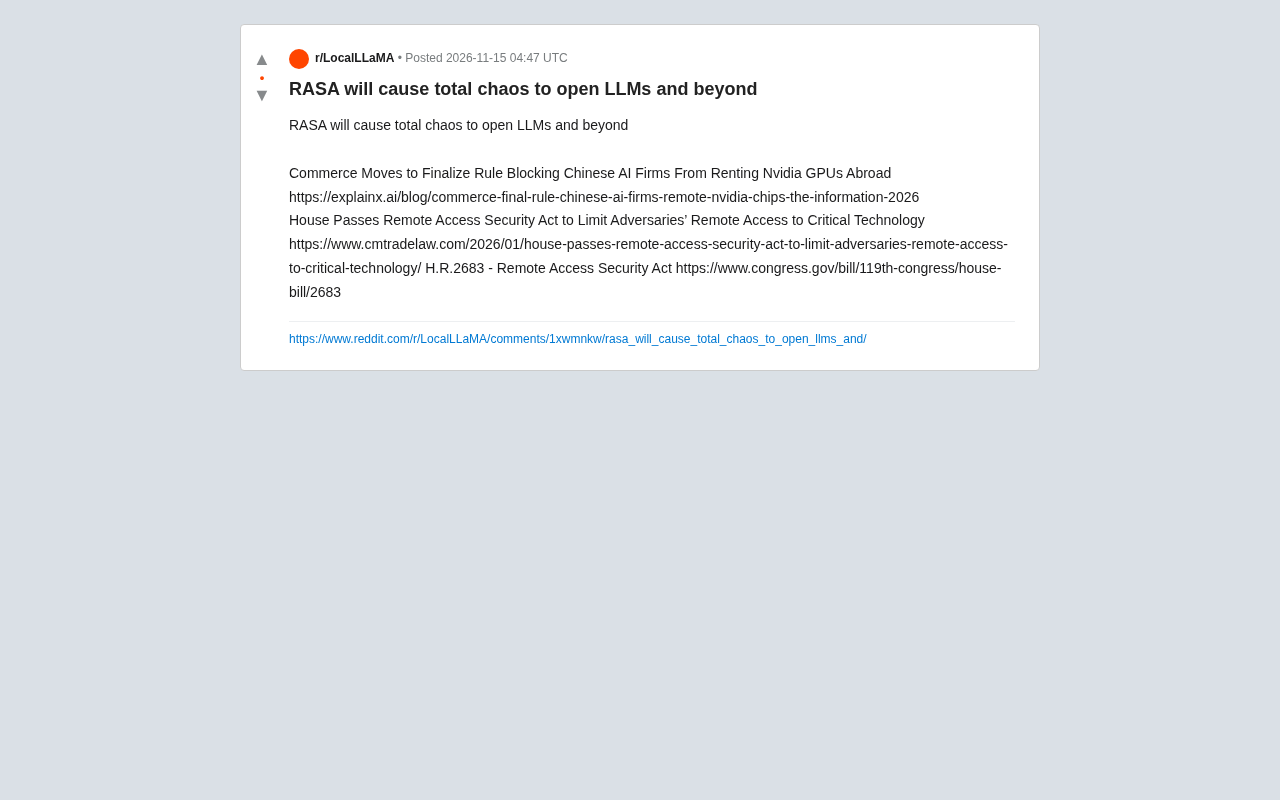
The U.S. RASA bill aims to regulate remote access to computing power and models, exposing the open-source LLM ecosystem to compliance and fragmentation shocks.
The U.S. House has passed the Remote Access Security Act (RASA, H.R.2683), shifting regulation from physical chip exports to the "remote invocation" of computing power and models—foreign entities renting GPUs via overseas clouds, downloading weights, or calling inference APIs could fall under control. Open-source LLMs are hit first: if weight downloads or API calls require approval, distribution chains fracture and cloud platforms may block high-risk IPs wholesale. Combined with the Commerce Department's pending GPU rental ban, compliance costs rise and fragmentation worsens.
A Legislative Storm Targeting "Remote Access"
The Reddit community has recently been buzzing about a bill called RASA, arguing it will bring "total chaos" to open-source large models and the entire AI technology ecosystem. RASA stands for the Remote Access Security Act, which has already passed the U.S. House of Representatives (H.R.2683). The bill aims to restrict "adversary countries'" remote access to critical American technologies.
Unlike export controls, RASA's focus is not on the physical shipment of chips, but on the "remote invocation" of computing power and technology. This means that even if a Chinese AI company cannot directly purchase Nvidia GPUs, its behavior of renting computing power through overseas cloud service providers, accessing model weights, or calling APIs may also fall within the scope of regulation.
Export control is a category of restrictive measures in international trade law, typically implemented by a national government through a licensing system to regulate the export, re-export, or transfer of specific goods, software, or technology to foreign entities. In the United States, the relevant authority mainly derives from the Export Control Reform Act (ECRA) and the Commerce Control List (CCL) maintained by the Bureau of Industry and Security (BIS). Traditional export controls regulate the cross-border movement of "items," such as the physical shipment of chips or the cross-border transmission of source code. What makes RASA's legislative approach noteworthy is precisely that it attempts to extend regulatory reach from "item delivery" to "remote invocation"—that is, users who, without obtaining a physical item or copy, access computing power or models on overseas servers solely via the internet may also constitute regulated conduct. This shift has no mature legal precedent, and how to define the boundary between "remote access" and ordinary cross-border cloud services at the technical level is one of the biggest points of contention when the bill is implemented.
Why Are Open-Source LLMs Hit First?
The core philosophy of open-source models is open weights, open code, and global collaboration. Developers can freely download models, fine-tune them locally or in the cloud, and redistribute derivative versions. But RASA's regulatory logic may treat "remote access" itself as an act requiring approval—putting the open-source ecosystem in a fundamental contradiction: you cannot both keep a model open and control who can access it over the internet.
Specifically, if the bill's final rules treat model weight downloads, cloud inference API calls, or even obtaining code through platforms like GitHub as "remote access," then the distribution chain of open-source models will be severely fractured. Overseas developers may be unable to legally contribute code to open-source projects from specific regions, and cloud service providers may be forced to conduct geopolitical screening of users.
Model weights are the set of parameters saved after a neural network finishes training, typically stored as files (such as safetensors, GGUF, and other formats) containing billions to hundreds of billions of floating-point numbers. For open-source large models, the weight file is the "body" of the model's capabilities: whoever obtains the weights can reproduce inference locally, continue fine-tuning, or redistribute derivative models without any authorization or service from the original developer. Precisely for this reason, public downloading of weights is regarded as the core hallmark of open-source AI. If RASA interprets "downloading weight files" as remote access, it creates a regulatory paradox the moment the weights are made public—the files are already freely copyable on the internet, and any geographic-based access control can only rely on self-declaration at the download end or IP blocking by cloud platforms, and cannot technically prevent distribution. This is also the technical root of why the community considers the bill "difficult to enforce."
Compliance Costs and Technical Fragmentation
According to an analysis by the explainx.ai blog, the U.S. Department of Commerce is finalizing a rule to cement a ban preventing Chinese AI companies from renting Nvidia GPUs through overseas channels. This creates a compounding effect with RASA: the hardware side restricts physical chips, and the remote access side restricts computing power invocation, with both lines tightening simultaneously.
For the open-source community, the most direct impact is soaring compliance costs. Small open-source teams lack the legal resources to determine whether each contributor's geographic location triggers regulation, and cloud platforms may adopt a "one-size-fits-all" strategy—directly blocking access to IPs from high-risk regions. Technical fragmentation follows: model training and inference may be forced into regional partitions, weakening the economies of scale of open-source collaboration.
An inference API is a common form in which cloud service providers package large models into callable interfaces: users send text requests, the server completes forward computation on GPU clusters and returns results, and users never touch the model weights throughout the process. This model allows small and medium-sized developers without computing resources to use large models, and is the mainstream approach in current AI application development. From a regulatory perspective, the inference API happens to be a typical scenario of "remote access to computing power"—the requester is overseas, computation occurs in a U.S. cloud vendor's data center, and model capabilities are delivered across borders in the form of output results. If RASA brings such calls under control, cloud vendors will have to perform identity and geographic verification of API callers, which may spawn compliance processes similar to KYC (Know Your Customer) in the financial industry, significantly raising the operating costs of API services and potentially prompting some providers to split service endpoints by region, further exacerbating technical fragmentation.
Community Concerns and Uncertainty
The original Reddit post describes RASA as "total chaos," reflecting a widespread anxiety: do legislators truly understand how open-source software works? Remote access restrictions have precedents in traditional technology fields (such as encryption software and satellite communications), but in open-source AI, once weight files are public, their copying and distribution are almost impossible to track.
Some also argue that the bill's specific implementing rules have not yet been fully finalized, and the final rules may narrow the scope of application to target only large-scale commercial rental behavior rather than small-scale access by individual developers. But uncertainty itself is a cost—companies will delay investment in open-source projects before the rules become clear, and international collaboration conferences may scale back cross-border participation.
How the Open-Source Ecosystem May Respond
Facing tighter regulation, the open-source community may accelerate its evolution toward "decentralized distribution": sharing model weights through peer-to-peer networks, using distributed storage to bypass censorship by single cloud providers, and developing localized training toolchains to reduce dependence on remote APIs. At the same time, open-source foundations and legal advocacy organizations may launch compliance guidance projects to help developers understand where the red lines lie.
At the technical level, model architecture may also be affected. If cloud invocation is restricted, smaller, more efficient models that can run on consumer-grade hardware will receive more attention. This is not necessarily a bad thing—efficiency-first design thinking is inherently in line with the open-source spirit. But in the short term, ecosystem fragmentation and migration costs are hard to avoid.
RASA's final form remains to be seen, but the question it raises is already on the table: between national security and open-source openness, how far should the regulatory hand reach? The open-source LLM community is waiting for an answer.
One-line Summary
The U.S. RASA bill seeks to regulate remote access to computing power and models, and the open-source LLM ecosystem faces compliance and fragmentation shocks.
Paragraph Summary
The U.S. House of Representatives has passed the Remote Access Security Act (RASA, H.R.2683), whose regulatory focus shifts from physical chip exports to the "remote invocation" of computing power and models—meaning that foreign entities renting GPUs through overseas cloud services, downloading model weights, or calling inference APIs may also fall under regulation. The article points out that open-source LLMs are hit first due to their open weights and global collaboration: if downloading weights or calling APIs is treated as remote access requiring approval, the open-source distribution chain will be fractured, and cloud platforms may impose one-size-fits-all IP blocking on high-risk regions. RASA compounds with the Commerce Department's pending GPU rental ban, creating a dual tightening on both the hardware and remote access fronts, driving up compliance costs and exacerbating technical fragmentation. The Reddit community worries that legislators do not understand how open source works, and the uncertainty of the rules itself is already suppressing investment and international collaboration. The open-source ecosystem may accelerate decentralized distribution and localized toolchains, with small efficient models gaining more attention, but short-term fragmentation is hard to avoid.
Related articles

The Battle of Bakhmut: How Political Symbols Hijacked Military Rationality
Military analysts on the Lex Fridman podcast review the Battle of Bakhmut: Wagner's prisoner attrition tactics, Ukraine's two-front dilemma, and how "Bakhmut Syndrome" let political symbols override military rationality, leading to overcommitment and strategic misallocation.
Skills as Programs: A New Paradigm for LLM Application Development
Skills are the programs of LLMs—this analogy reveals a new paradigm for LLM app development: skill modularization, message-board orchestration, experimentation, and community sharing.

AI in Four Years Will Be Unrecognizable: The Leap from GPT-3.5 to Superintelligence
Over four years AI went from GPT-3.5 toy to expert intern like Aster. Why verifiable domains are key, and how AI may surpass humans in chip design, trading, and materials.