AI Investment Breaks VC's Unspoken Rule? Benchmark Admits the 'No Competitor Bets' Code Is Loosening
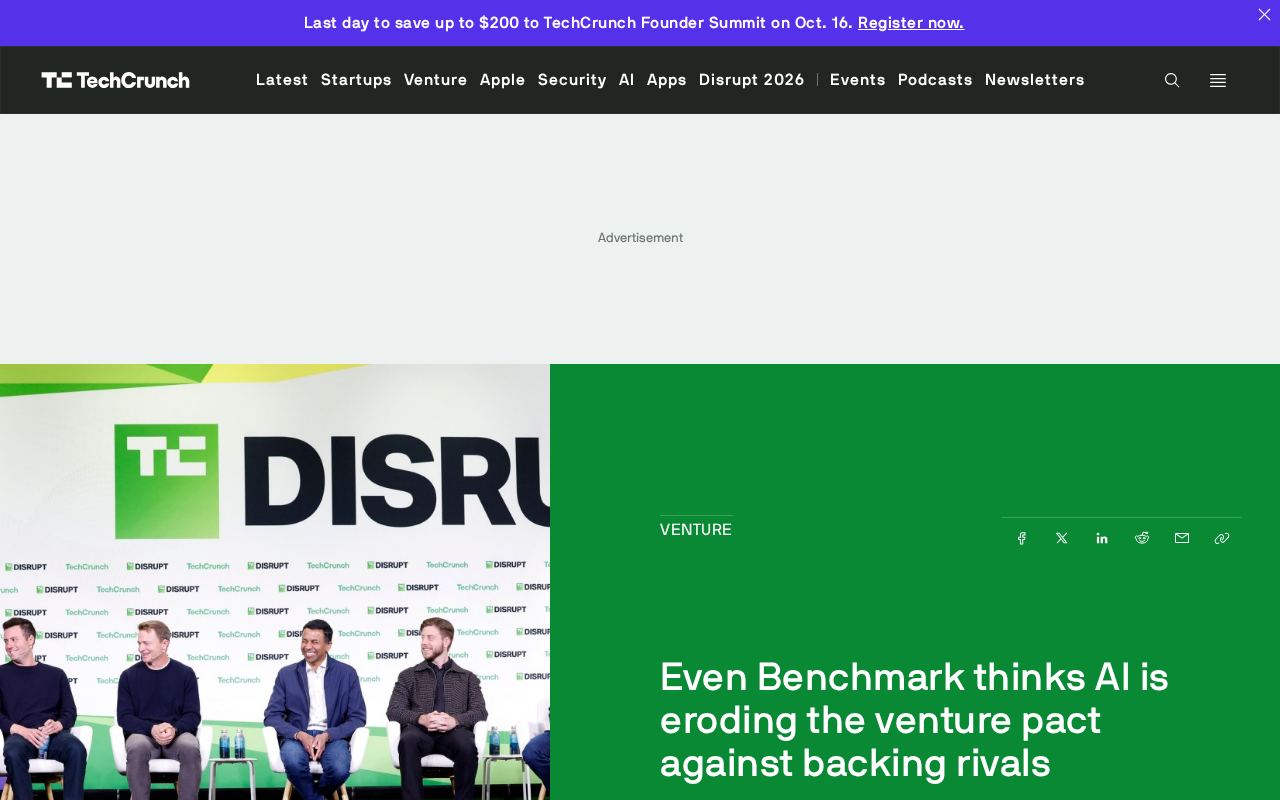
In the AI era, blurred sector boundaries are structurally eroding Silicon Valley VC's 'no competitor bets' understanding.
Silicon Valley VC has long followed an unwritten rule: don't bet on direct competitors of portfolio companies. But TechCrunch reports that even the famously restrained Benchmark admits this understanding is untenable in the AI era. Three reasons: AI companies have blurred sector boundaries, so a foundation model company may simultaneously be a rival in multiple directions; fundraising windows are extremely short, making the cost of missing a star project enormous; and founders themselves are crossing sectors, making competitors hard to define. Add LP pressure on AI allocation and the high-valuation, fast-fundraising pace of AI companies, and funds' incentive to maintain self-discipline is further weakened. The breakdown of this understanding may raise founders' trust costs and push the industry toward more explicit exclusivity clauses.
The Unwritten 'No Competitor Bets' Rule in VC Is Being Torn Open by AI
In Silicon Valley venture capital circles, there's a long-circulated unwritten rule: if a firm has already invested in a company in a certain space, it shouldn't place bets on its direct competitors. This rule has never been written into any formal agreement, yet for decades it has been tacitly observed by top-tier funds.
But according to TechCrunch, even a storied firm like Benchmark is beginning to admit that this understanding is becoming increasingly difficult to maintain in the AI era.
What makes Benchmark's statement notable is that it has long been one of the most committed practitioners of a "small and focused" strategy in Silicon Valley — with very few partners, restrained dealmaking, and historically strict enforcement of the "no competitor bets" principle. When a firm like this publicly acknowledges that the rule is eroding, it signals that the problem is no longer an isolated phenomenon, but rather a structural one.
Benchmark is one of Silicon Valley's most recognizable established venture capital firms, founded in 1995, with early investments in companies including eBay, Uber, Twitter, and Instagram. Its uniqueness lies in maintaining an extremely small partner team over the long term (typically only around five equal partners), with no traditional hierarchy and no fundraising of excessively large funds. This "small and focused" structure allows it to stay deeply involved with portfolio companies while remaining restrained and selective in its dealmaking. Precisely because of this, Benchmark's enforcement of self-discipline codes like "no competitor bets" has long been regarded as a benchmark in the industry. When even such a firm admits the rule is untenable, the signal it sends goes far beyond an ordinary fund's statement.
Why AI Makes 'No Competitor Bets' Unrealistic
Sector Boundaries Have Blurred
Traditional VC had it relatively easy when judging "competitors": if you do CRM, and I do CRM, we're competitors. But in AI, a company building foundation models might simultaneously be a competitor to search companies, coding tool companies, and customer service companies. The same AI startup can overlap with different companies in a portfolio across multiple directions.
This blurring of boundaries turns "no competitor bets" from a true-or-false question into countless judgment calls in gray areas. If a fund strictly avoids all potential overlap, it essentially means giving up on the entire AI sector.
Foundation model companies refer to enterprises developing large-scale pre-trained models (such as large language models and multimodal models) that provide underlying general-purpose capabilities rather than finished applications aimed directly at end users. What's special about such companies is that their model capabilities can be invoked by countless downstream applications, making them both an "infrastructure supplier" for numerous directions like search, coding, customer service, and content generation, and potentially a direct entrant into these sectors through self-developed products, competing with their own customers or other companies in an investment portfolio. This dual identity of being both upstream and a rival is something traditional VC competitor judgment frameworks struggle to handle, and it's also where conflicts of interest are most concentrated in AI investment.
The Window Is Too Short — Miss It and It's Gone
The competitive pace in AI is far faster than any previous technology cycle. A leading project in a hot space can complete fundraising and open up a gap within months. For funds whose creed is "invest in the next big thing," missing a star project due to a competitor clause may cost more than violating the understanding.
Founders Themselves Are Crossing Sectors
Many AI entrepreneurs are simultaneously pushing multiple product lines, even writing three or four potential directions into their fundraising decks. During due diligence, investors find it hard to determine what the company "actually does," which means they cannot clearly define who its true competitors are.
This Isn't Benchmark's Dilemma Alone
Benchmark's candor actually reflects a widespread anxiety across the industry.
On one hand, limited partners (LPs) are increasingly focused on whether funds can secure a position in the AI wave. Missing AI could mean the return story for an entire fund doesn't hold up. This pressure directly transmits to investment decisions, pushing self-discipline rules like "no competitor bets" aside in favor of commercial considerations.
On the other hand, the valuations and fundraising speeds of AI companies have made traditional "exclusive binding" relationships fragile. Even if a fund wants to maintain loyalty to one company, founders themselves may simultaneously engage with multiple institutions seeking faster capital and higher valuations.
Limited Partners (LPs) refer to the parties that contribute capital to venture capital funds, typically institutional investors such as pension funds, university endowments, and family offices. GPs (General Partners) manage and invest, while LPs provide capital and bear limited liability, together forming a typical limited partnership structure. What LPs care about is whether the entire fund can achieve excess returns in a particular technology wave, not the success or failure of a single investment. So when AI becomes a market consensus, LPs will pressure GPs to increase AI allocation. This top-down pressure directly weakens the space for funds to maintain self-discipline rules at the individual project level, subordinating soft constraints like "no competitor bets" to the overall return demands of capital providers.
What Happens After the Understanding Breaks Down
If the "no competitor bets" understanding continues to loosen, several chain reactions may follow.
Rising trust costs. When founders choose investors, they previously assumed by default that the other party wouldn't turn around and back their rivals. Once this default premise is shaken, founders will be more cautious in negotiations, even demanding explicit exclusivity clauses in terms.
More naked competition between funds. When everyone stops observing the gentleman's agreement, competing for deals becomes more direct, and the value of information advantages and relationship networks gets repriced.
The industry may move toward explicit rules. When understandings can no longer constrain behavior, more formal contractual arrangements tend to emerge — such as more detailed non-compete restrictions and clearer information barrier mechanisms. For both entrepreneurs and investors, this means higher transaction costs.
A More Fundamental Question
Benchmark's statement ostensibly addresses "whether to invest in competitors," but in essence it touches on a more fundamental question: when technological change moves faster than rules can keep up, what does the industry rely on to maintain order?
The old understandings were built on assumptions of relatively controllable pace and clear sector boundaries. AI has broken these assumptions, and the old rules naturally begin to fail. What the new equilibrium will look like, no one can currently give a definitive answer — but when even the most restrained players are beginning to loosen up, it shows the change is irreversible.
One-line Summary
In the AI era, blurred sector boundaries are structurally eroding Silicon Valley VC's 'no competitor bets' understanding.
Paragraph Summary
Silicon Valley VC has long followed an unwritten rule: don't bet on direct competitors of portfolio companies. But according to TechCrunch, even the famously restrained Benchmark admits this understanding is untenable in the AI era. Three reasons: AI companies have blurred sector boundaries, so a foundation model company may simultaneously be a rival in multiple directions; fundraising windows are extremely short, making the cost of missing a star project enormous; and founders themselves are crossing sectors, making competitors hard to define. Add LP pressure on AI allocation and the high-valuation, fast-fundraising pace of AI companies, and funds' incentive to maintain self-discipline is further weakened. The breakdown of this understanding may raise founders' trust costs and push the industry toward more explicit exclusivity clauses.
Related articles

WorkBuddy Full Tutorial: Build an AI Office Automation Agent from Scratch
A complete WorkBuddy tutorial: installation, three working modes, multimodal picture book video practice, expert team agent building, and workflow configuration for low-cost AI office automation.

WorkBuddy Agent Complete Guide: From Beginner to Automation in 7 Days
Based on Bilibili's 256-episode WorkBuddy masterclass, this systematically breaks down Tencent's AI office workbench core capabilities: Agent principles, Skill encapsulation, cross-platform connectors, scheduled automation, knowledge bases, and zero-code development, with learning path recommendations.

8 AI Accounts, 7 Failed: An Honest Review of Using AI to Get Work Done
Only 1 of 8 AI-run Bilibili accounts succeeded. We break down the real difference between "performing AI" and "using AI to get work done."