AI Journals vs. Top Conferences: A Complete Guide to Submission Difficulty and Acceptance Thresholds
A practical guide to choosing between top AI conferences and journals after a borderline rejection.
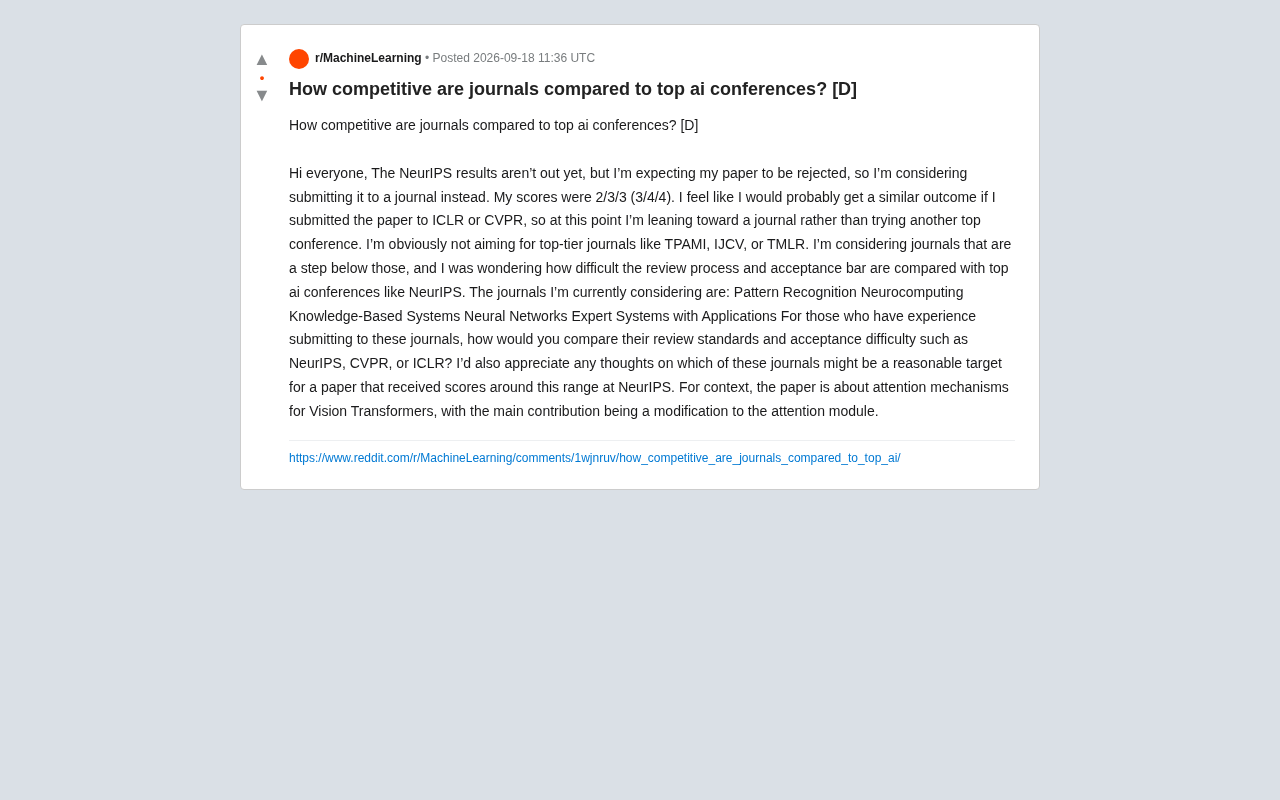
This article addresses a real dilemma from the Reddit ML community: a Vision Transformer attention mechanism paper scored 2/3/3 at NeurIPS, prompting the question of whether to try another top conference or pivot to a journal. The piece systematically contrasts the two paths — conferences favor novelty in fast binary reviews with little room for borderline papers to recover, while journals allow multi-round revisions and reward methodological completeness. The five target journals are ranked by difficulty, with Neurocomputing, KBS, and ESWA being more accessible for incremental work. The final recommendation: incorporate reviewer feedback, strengthen the paper, then choose a submission target aligned with your specific goals — graduation, job search, or PhD applications.
A Tough Call After Getting Rejected from a Top Conference
Every year during the NeurIPS, ICLR, and CVPR review seasons, countless researchers wait in anxious anticipation. A question recently posted in the Reddit machine learning community captured a frustration shared by many early-career researchers: a paper received scores of 2/3/3 (confidence 3/4/4) at NeurIPS — almost certainly a rejection. Should the author try another top conference, or pivot to a journal?
The paper in question focused on improving the attention mechanism in Vision Transformers, with the core contribution being a modification to the attention module. The author was candid about not aiming for top-tier venues like TPAMI, IJCV, or TMLR, and instead wanted to understand the review standards and acceptance difficulty of second-tier journals — specifically how they compare to top conferences.
Underlying this question is a topic that has long existed in the AI research community but rarely gets discussed systematically: the rules of the game are completely different for conferences versus journals.
Top Conferences vs. Journals: Two Fundamentally Different Review Philosophies
Understanding submission strategy starts with understanding the essential differences between conferences and journals.
Conferences: One Shot, All or Nothing
Top venues like NeurIPS, CVPR, and ICLR operate on a single-round, fast-paced, high-volume review model. Review cycles are measured in weeks, rebuttal windows are short, and outcomes are binary — accept or reject. A borderline paper (like one scoring 2/3/3) has almost no room to recover in this system, because reviewers don't have the time or incentive to iterate with you on revisions.
Crucially, top conferences place heavy emphasis on novelty and topic trendiness. An "improvement-type" contribution to the attention module — if it lacks a significant theoretical breakthrough or a dramatic empirical gain — is easily labeled "incremental." This is one of the most common reasons scores stay low.
It's worth noting that acceptance rates at top conferences have been under sustained pressure in recent years. NeurIPS 2023 accepted around 26% of submissions, ICLR 2024 around 31%, and CVPR 2024 around 23%. But these numbers obscure an important structural reality: the proportion of papers that are genuinely "safe" (with consistently high scores across reviewers) is far lower. A large share of papers fall in the contested range, and whether they get in often comes down to the Area Chair's judgment and the discussion phase. A score combination like 2/3/3 — where not a single reviewer has offered a clear accept recommendation — historically has an extremely low probability of making it into the acceptance pool (historical data suggests below 5%). Rebuttal phases exist, but their actual impact is limited; research shows roughly 10–15% of papers see score improvements after rebuttal, but far fewer actually flip to an acceptance.
Journals: A Long Game with Room to Evolve
Journal review operates on a multi-round, slower-paced, revision-friendly model. Major Revision and Minor Revision decisions give authors real opportunities to meaningfully improve their work. Reviewers focus more on methodological completeness, experimental rigor, and argumentative coherence rather than sheer "impressiveness."
This means that a solid piece of work rejected from a top conference for "insufficient novelty" might actually find a warm reception in the journal system — precisely because the method is complete and the experiments are thorough. The difference in review logic means switching to a journal isn't "downgrading" — it's changing the playing field.
The Five Journals in Question: How Do They Stack Up?
The five journals the author listed each occupy a distinct niche in the AI/ML landscape, and their acceptance difficulty varies considerably. Based on community consensus, here's a rough ranking:
Tier 1 (Relatively Harder)
- Pattern Recognition: A long-established, authoritative journal in computer vision and pattern recognition. It has a high impact factor and demands strong methodological innovation and experimental rigor. A paper on ViT attention mechanisms is right in its wheelhouse — but review standards are strict and turnaround times tend to be long.
- Neural Networks: A classic journal covering neural networks and learning systems. It has a relatively high theoretical bar and tends to favor work with meaningful theoretical depth.
Tier 2 (More Accessible)
- Neurocomputing: Broad scope, faster publication cycle, and relatively tolerant of incremental improvements. A common destination for papers rejected from top conferences.
- Knowledge-Based Systems: Clearly application-oriented. As long as the method is effective and the experiments are solid, it doesn't demand as much novelty.
- Expert Systems with Applications (ESWA): Emphasizes practical value and real-world problem-solving. Highly receptive to "improvement-type" contributions, and generally considered the most accessible of the five.
For a paper sitting at borderline NeurIPS scores with an incremental contribution to attention mechanisms, Neurocomputing, Knowledge-Based Systems, and ESWA are realistically the most viable targets. Pattern Recognition and Neural Networks would likely require additional experiments and stronger framing before making a serious attempt.
Publication timelines vary significantly across these journals and are an important factor to consider. Neurocomputing and ESWA are both Elsevier journals, typically with review cycles of 2–4 months and relatively fast post-acceptance online publication — making them suitable for authors under time pressure. Knowledge-Based Systems, also under Elsevier, has a similar timeline. Pattern Recognition and Neural Networks tend to involve more review rounds, with the full process from submission to final decision often taking 6–12 months or more, and additional waiting time after a Major Revision. Additionally, if you opt for open-access publication in ESWA or KBS, the Article Processing Charges (APCs) can be substantial — it's worth checking in advance whether your institution has relevant agreements or reimbursement channels.
Things Worth Thinking Through Before You Submit to a Journal
Don't Rush to Resubmit Right Away
Review comments from a top conference — even with a rejection — are free, high-quality feedback. The 2/3/3 scores almost certainly come with specific reviewer concerns about novelty or experimental coverage. Before redirecting to a journal, use those comments to substantively strengthen the paper — add comparison experiments, expand ablation studies, deepen the theoretical analysis. This can meaningfully improve your chances at a journal.
Be Clear About Why You're Publishing
If the goal is graduation, promotion, or completing a funded project, a journal with a fast review process and reasonable acceptance rate is perfectly sufficient — there's no need to fixate on the prestige of top conferences. But if the goal is landing a research role at a top industry lab or applying to a leading PhD program, top-conference papers still carry unique weight as hard currency. In that case, iterating on the paper and taking another shot at a top venue may be the better investment.
Watch Out for Predatory Journals
All five journals mentioned above are legitimate, reputable SCI-indexed publications. But the AI field is also flooded with pay-to-publish "junk journals" that promise fast turnarounds. While optimizing for acceptance efficiency, always verify a journal's indexing status and reputation in the field — a publication in a predatory journal can do more harm than good to your CV.
For context: the Vision Transformer (ViT) was originally proposed by Google Brain in 2020. It splits images into fixed-size patch sequences and processes visual tasks using Transformer self-attention, breaking the long dominance of CNNs in computer vision. Since then, a wave of work improving ViT's attention modules has emerged — including the local window attention introduced by Swin Transformer, various linear-complexity approximations, and cross-scale attention designs. As a result, competition in this subfield is fierce, and the bar for "improvement-type" contributions keeps rising. Reviewers' expectations for novelty in attention mechanism modifications are considerably higher than they were in 2021–2022. This context explains why a seemingly reasonable improvement might be labeled "incremental" — not because the work is worthless, but because the competitive baseline in the field has been substantially raised.
Closing Thoughts: Rejection Isn't the End — It's the Starting Point for a Better Strategy
The dilemma this Reddit user faced is fundamentally a trade-off between efficiency and prestige in academic publishing. Top conferences offer fast recognition and high visibility, but come with high barriers and significant randomness. Journals offer a more stable, controllable publication path — at the cost of longer timelines and a slightly lower profile.
For a borderline ViT attention mechanism paper, a rational path forward might look like this: absorb the conference reviewers' feedback → strengthen the experiments and argumentation → choose a well-matched second-tier journal based on your specific publishing goals. Academic publishing has never been a black-and-white success-or-failure equation. It's an ongoing negotiation between time, ambition, and resources.
Related articles

MosMos: An AI Voice Writing Tool Built for the Entire Meeting Lifecycle
MosMos is an AI voice writing tool built for the full meeting lifecycle — ranked #2 on Product Hunt. It goes beyond dictation with style-aware drafting, a personal glossary, web search, speaker diarization, and structured meeting notes.
Getting Started with Claude Code: Capabilities and Installation Essentials for This AI Coding Assistant
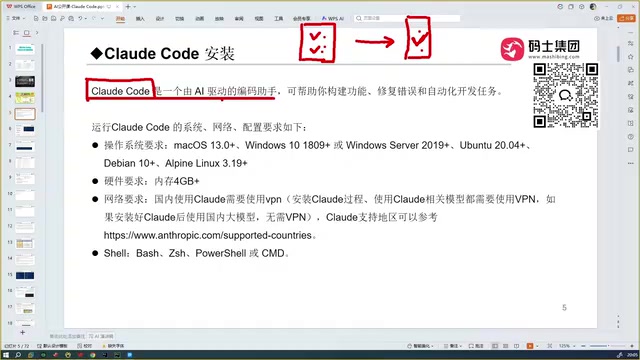
Claude Code is Anthropic's AI coding agent that reads your full codebase, generates accurate code, and auto-debugs. Compare with Cursor, TRAE, Codex, plus key install requirements.

AINA: An AI Career Coach That Uses a Video Avatar to Uncover Your Job Search Blind Spots
AINA topped Product Hunt with its AI career coach that uses a video avatar to help job seekers find blind spots, polish their profile, and practice interviews.