AI Key Hunters: Octopus, Gecko, and Tortoise — Three Scanners
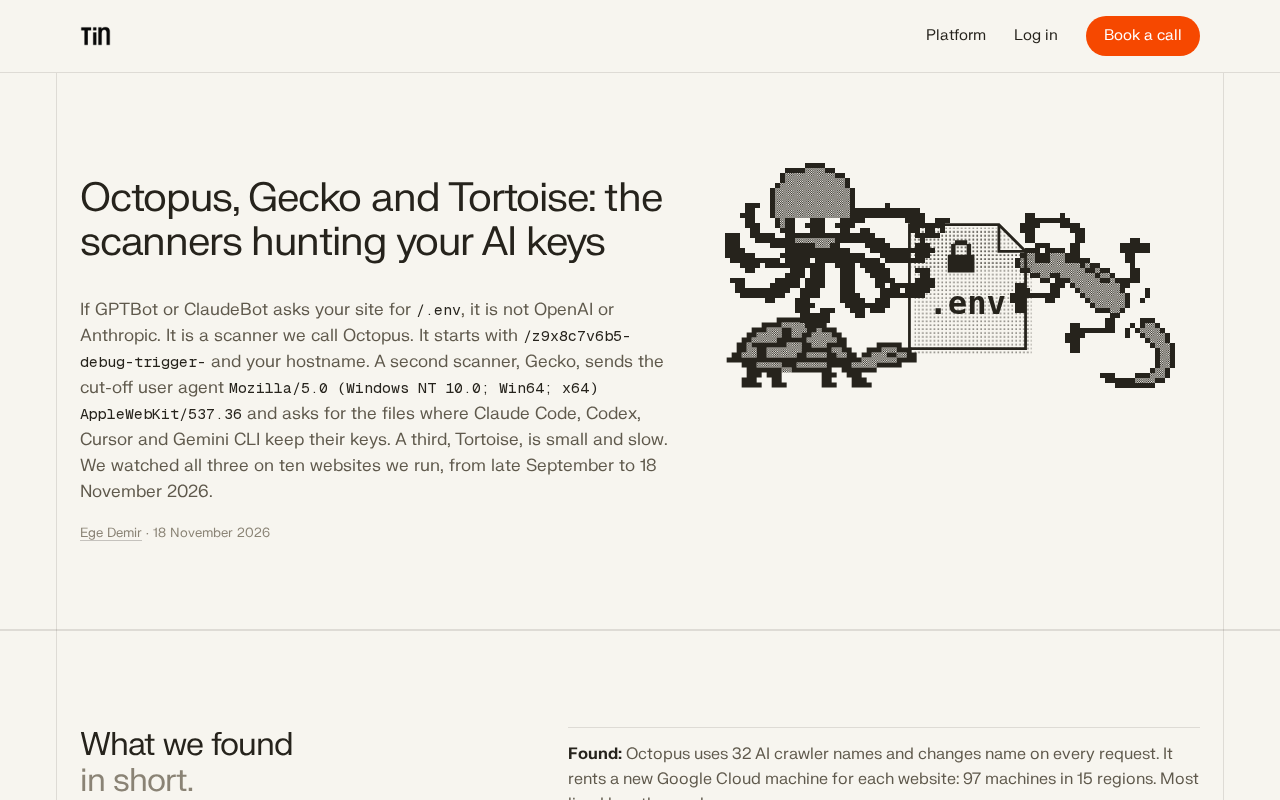
Octopus, Gecko, and Tortoise scanners reflect the risk of AI key leaks and the need for proactive defense.
Inspired by a Hacker News discussion about three AI key scanners — Octopus, Gecko, and Tortoise — this article analyzes why AI API keys are high-value attack targets: high pay-per-use costs, single credentials lacking scope isolation, and storage habits that make them easy to push to public repositories. Based on naming metaphors, it infers the scanning strategies the three tools may represent — broad coverage, stealthy clinging, and persistent depth — and notes their dual-use nature: attackers can use them to hunt leaked keys at scale, while defenders can apply the same logic to detect and rotate keys before malicious exploitation. The conclusion is that developers should treat AI keys as first-class security assets, avoid hardcoding, prioritize key management services, and establish a unified key lifecycle management process.
In an era of rapidly proliferating AI applications, API keys have become one of the most easily exposed assets for developers. A Hacker News discussion (12 points, 1 comment) turned its attention to three scanners codenamed Octopus, Gecko, and Tortoise, which are being used to hunt for leaked AI keys. Although the original information consisted only of a title and brief engagement data, the topic itself points to a real and increasingly serious security issue: as large model services become deeply embedded in development workflows, why has key management become a focal point of attack and defense?
Why AI Keys Are High-Value Targets
Unlike traditional cloud service keys, API keys for AI models are often directly tied to high pay-per-use costs, and once leaked, attackers can invoke the models for content generation, data theft, or even service abuse. Because many AI tools store keys by default in local configuration files or environment variables, a single careless move by a developer can push them to a public repository. The emergence of scanners like Octopus, Gecko, and Tortoise is precisely an automated response to this risk — they traverse code repositories, configuration files, or network-exposed surfaces using different strategies to find usable AI credentials.
An API key is essentially a string of credentials used for authentication; the server identifies the caller and grants corresponding permissions through it. In the context of AI services, this key directly corresponds to a billing account: platforms such as OpenAI and Anthropic charge by token usage, and a leaked key can be invoked indefinitely by others until the quota is exhausted or the account is banned. A more insidious risk is that attackers can use legitimate keys to launch content generation, data scraping, or even model distillation, with behavior that appears indistinguishable from a normal user to the service provider. Traditional cloud keys are usually bound to IP whitelists or fine-grained IAM policies, whereas many AI platforms initially offered only a single global key, lacking scope isolation and call-origin restrictions, further amplifying the blast radius after a leak. This is precisely why key scanners list AI credentials as an independent detection target.
The Naming and Positioning of the Three Scanners
Judging by their names, these three animals each suggest a different scanning strategy. Octopus likely emphasizes multi-tentacled breadth of coverage, monitoring multiple sources or protocols simultaneously; Gecko perhaps focuses on clinging and stealth, suited to discovering forgotten corners in complex environments; Tortoise may represent slow but persistent deep scanning, leaving no historical commit or long-stale configuration unchecked. It should be noted that these positions are reasonable inferences based on naming metaphors and common design patterns of security tools; the original material did not provide specific technical details.
Attacker Perspective vs. Defender Perspective
Such scanners are essentially a double-edged sword. Attackers can use them to search for leaked keys at scale and then steal AI services; defenders can likewise deploy tools with the same logic to discover and rotate keys before they are maliciously exploited. The level of discussion on Hacker News (despite few comments) reflects the developer community's interest in automated detection of key leaks. One consensus is that the cost of passively waiting for a leak to occur and then remediating is far higher than proactive scanning.
Credential scanning (secret scanning) is a mature security practice. Tools such as GitHub Advanced Security, TruffleHog, and Gitleaks can already recognize key formats for platforms like AWS and Stripe; their core approach is regex matching of known key prefixes and length characteristics, combined with entropy analysis to find high-randomness strings. Specialized scanning for AI keys adds platform-specific format rules on top of this, such as the sk- prefix common to OpenAI keys and Anthropic's sk-ant- prefix. The scanning scope typically includes the current code tree, the full Git commit history, CI logs, and public Docker image layers, because keys often remain in history records even after deletion. Only by understanding this technical foundation can one judge whether the strategic differences represented by Octopus, Gecko, and Tortoise lie in coverage breadth, stealth, or historical depth.
Key rotation refers to the process of retiring old credentials and issuing new ones periodically or after a suspected leak; ideally it should be automated and not disrupt business continuity. For AI keys, rotation faces additional challenges: multiple environments (development, testing, production) often share the same key, and all reference points must be updated synchronously during the rotation window, otherwise service interruptions occur. A mature practice is to host keys in key management services such as Vault or AWS Secrets Manager and have applications fetch them dynamically at runtime, minimizing rotation costs. In addition, the principle of least privilege requires issuing independent keys for different purposes and setting usage caps, so that even if a single key leaks, the damage is limited to a controllable scope. These mechanisms complement proactive scanning, forming a complete closed loop for the key lifecycle.
Practical Implications for Developers
Regardless of the specific implementations of these scanners, the signal they convey is clear: AI keys must be treated as first-class security assets. Developers should avoid hardcoding keys in source code and prioritize environment variables or key management services; at the same time, they should regularly scan code repositories and historical commits to check for accidentally exposed credentials. For teams using multiple AI services, establishing a unified key lifecycle management process is more effective than point fixes.
Gaps and Opportunities in the Tool Ecosystem
Currently, publicly available tools specifically for AI key scanning remain limited. The emergence of Octopus, Gecko, and Tortoise (or at least discussion of their naming) shows that demand is emerging. In the future, we may see more key scanning solutions integrated into CI/CD pipelines, as well as specialized detection rules for the credential formats of major AI platforms. For security practitioners, this is a niche area worth watching.
Conclusion
Security management for AI keys should not rely on after-the-fact remediation. The three names Octopus, Gecko, and Tortoise remind us that automated scanning is already underway — the only question is whether defenders or attackers find the keys first.
Related articles

Win a Car for Getting Close to 50 Pounds? The Whatnot Marketing Behind a YouTube Challenge
An analysis of the YouTube challenge "Get Close to 50 Pounds and Win a Car," exploring how it drives traffic to livestream platform Whatnot and why weight-guessing content attracts viewers and converts commercially.

The Binding of Isaac Developer Removes AI Music, Steam Review Bombing Subsides
The Binding of Isaac: Repentance+ faced Steam review bombing over AI music, and the developer has removed the tracks. This article reviews the incident, analyzes player anxiety about AI replacing human creation, and explores transparency and trust costs around AI content in the game industry.

Why Data Centers Have Become the Center of Big Tech's Backlash
Tech journalist Paris Marx's book Hyperscale reveals how data centers became the flashpoint for Big Tech backlash—from resource costs and environmental impacts to policy battles.