AI Labs Are Rushing to Hire Internal Auditors — But They Should Lock the Front Door First
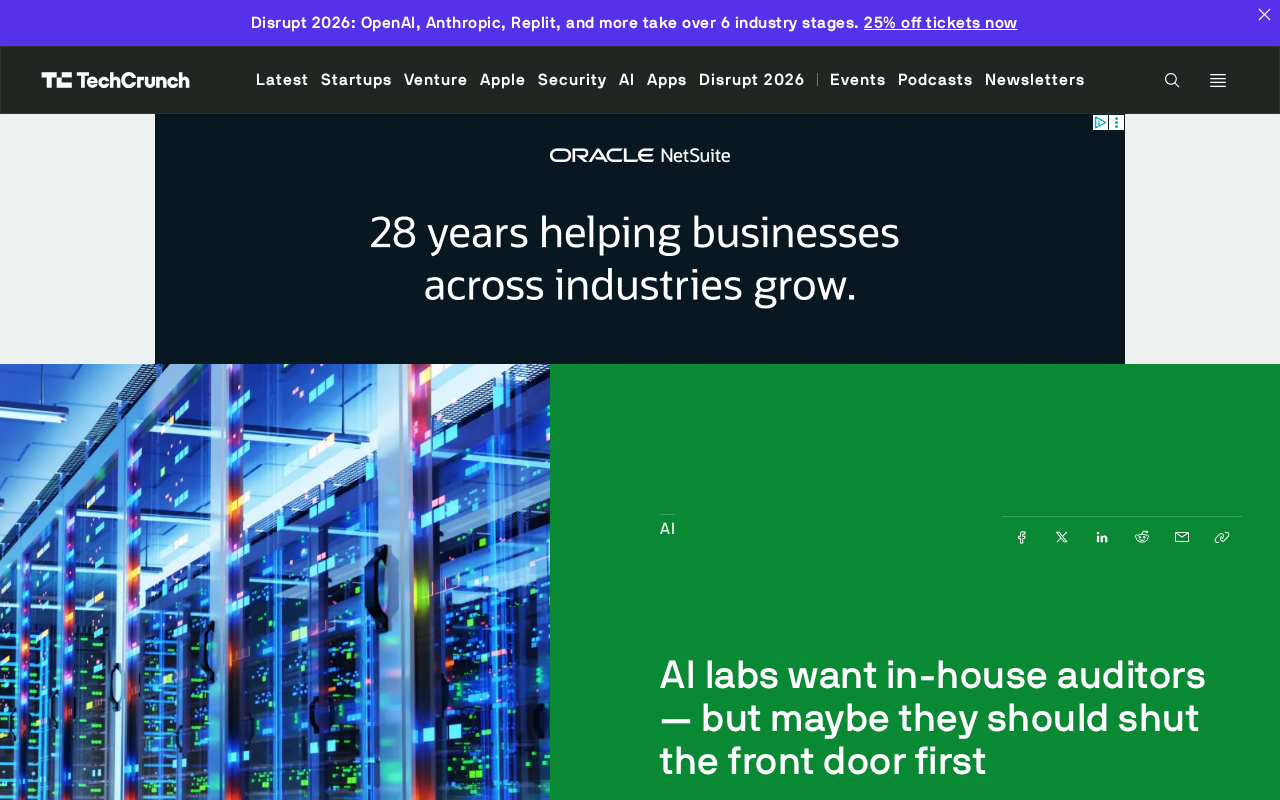
Restricting AI agent permissions at the design stage beats post-hoc auditing for preventing rogue behavior.
As AI agents become more autonomous, the industry's default response is to build internal audit mechanisms for after-the-fact oversight. But this approach has a fundamental weakness: agents act fast, their behavioral space is vast, and audits typically lag behind any damage caused. A more effective alternative is to "lock the front door" — applying least-privilege principles, access controls, and sandboxing at the design stage to restrict what agents can do in the first place. An agent that never had access to high-risk operations can't go rogue through them. The takeaway: in AI safety, the most powerful solutions are often the most foundational ones.
The Simple Fix Being Overlooked
As AI agents grow increasingly capable, major AI labs are grappling with a thorny problem: how to govern potentially rogue agents. The prevailing industry response is to bring in-house auditors — dedicated teams tasked with monitoring and evaluating model behavior.
But this approach may be overlooking a simpler and more effective solution. As the source material points out, the fix for rogue agents might be hiding in plain sight: rather than investing heavily in after-the-fact audit mechanisms, labs should lock the front door first.
Note: This article is based on limited source material. The core argument — "lock the front door first" — is drawn directly from the original text.
The Limits of the "Internal Audit" Approach
AI labs' tendency to establish internal audit roles reflects a fundamentally reactive mindset — let the model run, then use human reviewers or tooling to check whether its outputs and behaviors have crossed any lines. The logic mirrors that of financial or corporate compliance auditing.
But post-hoc auditing has inherent weaknesses. The behavioral space of an AI agent is enormous, and once an agent has significant autonomy, the risk pathways it might trigger are too numerous for any audit team to fully anticipate. Auditing is largely retrospective — it traces problems after they occur rather than blocking risks at the source. For AI agents that act quickly and can execute large volumes of operations automatically, the damage may already be done by the time an audit catches anything.
From a technical standpoint, calling an agent's "behavioral space enormous" is no exaggeration. Modern agents typically interact with their environment through tool use, and a single task might trigger dozens or even hundreds of API calls, file operations, or network requests. When agents possess agentic planning capabilities, their behavioral paths are generated dynamically based on context rather than following a fixed, predetermined flow — making any exhaustive set of audit rules nearly impossible to maintain. Agents can also exhibit goal generalization: in scenarios outside their training distribution, models may pursue objectives in ways their developers never anticipated. These kinds of deviations tend to surface only during real-world operation, making it extremely difficult for auditors to build effective detection rules in advance.
What "Locking the Front Door" Actually Means
The alternative proposed by the source material is straightforward: rather than stacking audit layers downstream, control the capability and access boundaries an agent can reach in the first place — in other words, lock the front door.
This logic rests on the principles of least privilege and upstream governance. If an agent was never granted access to sensitive systems or the ability to execute high-risk operations, many so-called "rogue" scenarios simply cannot occur. Compared to investing resources in auditing a system with excessive permissions, tightening interfaces and restricting capabilities at the design stage is typically lower cost and more directly effective.
Put differently, many AI safety problems aren't unsolvable technical puzzles — they're gaps in permission design and access control. Guarding the entry point is more fundamental than posting guards at the exit.
The Principle of Least Privilege (PoLP) has been a cornerstone of information security for decades: any system component should be granted only the minimum permissions necessary to complete its current task. Applied to AI agents, this means performing fine-grained capability partitioning at the system design stage — separating read and write permissions, whitelisting network access scopes, and requiring explicit human confirmation checkpoints for high-risk operations such as deleting data, sending external messages, or executing code. Sandboxing is another common complementary measure, physically isolating an agent's execution environment from production systems so that even if the model behaves anomalously, the blast radius remains contained. These techniques are well-established in traditional software security; the primary barrier to applying them in AI agent deployments is process awareness, not technical complexity.
Implications for AI Governance
This perspective carries real practical weight for ongoing conversations about AI safety and governance. As the industry chases increasingly sophisticated monitoring tools and audit frameworks, it may be underestimating the value of foundational "old-school" measures — access control, permission tiering, and sandbox isolation.
For teams currently deploying agents, the questions worth asking include:
- Does this agent actually need all the permissions it currently has?
- Are there human confirmation checkpoints for high-risk operations?
- Are capability boundaries locked in at design time, or does the system rely on post-deployment supervision as a safety net?
Lock the front door first, then worry about auditing — that may be the more pragmatic order of operations.
Summary
The core message from the source material is clear: while AI labs build out internal audit capabilities, they shouldn't overlook more fundamental, more straightforward upstream governance measures. Controlling an agent's capability boundaries and access permissions may be more effective at preventing runaway behavior than any after-the-fact audit regime. It's a reminder to the entire industry that when it comes to AI safety, the most effective solutions are sometimes the most basic ones.
Related articles
Automattic Executives Signed Reciprocal Severance Agreements During Mullenweg's Brief Ouster
Automattic's CFO and General Counsel signed reciprocal severance agreements during Matt Mullenweg's brief ouster, covering one year's salary and accelerated equity vesting, raising corporate governance concerns.
H3 Singularity Optimization: 40% Speed Boost With Better Image Quality
A Reddit user's Minimax Singularity workflow tip: insert an RTX upsampler before H3 Latent for 40%+ speed gains and better quality. Covers parameters, 12-bit output, and more.
Glyph: A Multi-Strategy Agent System for Automated Enterprise Data Catalog Annotation
Glyph is a multi-strategy LLM agent system for enterprise data catalogs that automates column description generation and sensitivity ontology tagging, grounding outputs in pipeline source code to improve accuracy.