AI Large Language Model Career Transition Roadmap: A Three-Phase Learning Guide from Zero to Enterprise-Ready

A three-phase roadmap for transitioning into AI LLMs: Transformer basics, RAG/Agent development, and model fine-tuning.
This guide presents a structured three-phase learning roadmap for transitioning into AI large language models. Phase 1 covers Transformer architecture fundamentals. Phase 2 focuses on RAG, Agent, and LangChain for practical AI application development. Phase 3 advances into LoRA model fine-tuning. Designed for beginners to build enterprise-ready skills within two months.
Want to transition into AI large language models but don't know where to start? 90% of people don't fail because they can't learn — they fail because they're headed in the wrong direction, wasting massive amounts of time on scattered, unsystematic knowledge. This article lays out a clear three-phase learning roadmap to help beginners build a complete AI LLM skill set within two months, directly aligned with real enterprise demands.
Why Now Is the Best Time to Get Into AI Large Language Models
AI large language models are undeniably the hottest track in tech right now. Large Language Models (LLMs) refer to deep learning models with parameters ranging from billions to hundreds of billions. The release of ChatGPT in late 2022 marked the moment LLMs transitioned from academic research to mainstream applications. Major tech companies quickly followed with their own LLM products: Google's Gemini, Meta's LLaMA series, and Chinese models like Qwen (通义千问), ERNIE Bot (文心一言), and DeepSeek. The fundamental difference between this technology wave and the mobile internet era is that LLMs aren't just creating new application scenarios — they're restructuring workflows across virtually every existing industry. This means talent demand is cross-industry and cross-functional.
Looking at hiring market signals, major tech companies are aggressively rolling out AI application development positions, and salaries for AI-related roles have far surpassed those of traditional development positions.
Every technology wave brings enormous career opportunities. Just as the mobile internet era created a wave of early beneficiaries, the AI LLM wave is reshaping the job market landscape. For regular developers or career changers, rather than watching from the sidelines, it's better to position yourself early — even if the future trajectory of AI remains uncertain, mastering core skills ahead of time is inherently a low-risk, high-reward investment.
The key is: Don't study aimlessly — study systematically. Many people learn a bunch of scattered knowledge points and still end up unable to do anything meaningful. The root cause is that their knowledge lacks coherence and logical connections. The three-phase roadmap below is designed to solve exactly this problem.
Phase 1: Build a Solid Foundation — Master the Transformer Architecture
This phase has one single mission — understand the underlying logic of deep learning and neural networks, especially the Transformer architecture.
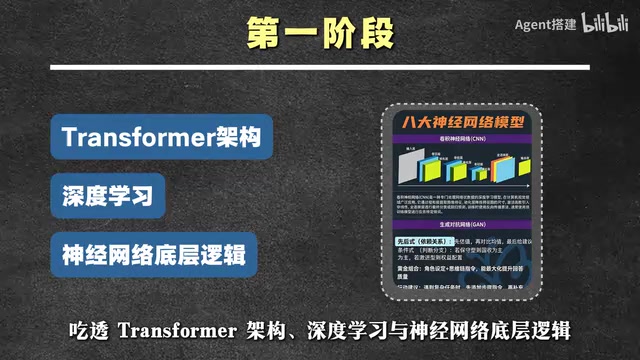
The Transformer is the core architecture behind virtually all mainstream large models today (GPT, LLaMA, Qwen, etc.). It was first introduced by a Google team in the 2017 paper Attention Is All You Need, originally designed to solve the bottleneck of Recurrent Neural Networks (RNNs) being unable to perform parallel computation in machine translation tasks. Its core innovation is the Self-Attention mechanism, which allows the model to attend to information from all other positions in a sequence simultaneously when processing each position, thereby capturing long-range dependencies. In the encoder-decoder structure, the encoder transforms the input sequence into high-dimensional semantic representations, while the decoder generates output step by step based on these representations. Positional Encoding addresses the self-attention mechanism's inherent inability to perceive sequential order by assigning each position a unique vector representation using sine and cosine functions.
If you don't understand basic concepts like Attention, encoder-decoder structure, and positional encoding, everything you learn afterward — tools, frameworks, you name it — will be built on sand.
Learning recommendations for this phase:
- Don't rush. Many people jump straight to calling APIs and building applications, skipping the underlying principles. This may seem more efficient in the short term, but when real problems arise, you'll have zero ability to debug or optimize.
- Focus on understanding, not memorization. The Transformer paper Attention Is All You Need is worth reading multiple times, supplemented by visualization tools (like Tensor2Tensor). Also consider Jay Alammar's illustrated Transformer blog series and Harvard NLP's "The Annotated Transformer" code-annotated version — these resources help you build intuition from different angles.
- Implement simple models by hand. Building a simplified Transformer from scratch in PyTorch is more effective than watching tutorials ten times over. Specifically, start by implementing single-head attention, then extend to multi-head attention, and finally build a complete encoder layer. This progressive process helps you truly understand each component's role.
This phase takes approximately 2–3 weeks. Once the foundation is solid, everything that follows becomes significantly easier.
Phase 2: Master RAG and Agents — Two Must-Have Skills for the Workplace
RAG: Connecting LLMs to Enterprise Private Data
RAG (Retrieval-Augmented Generation) is one of the most frequently deployed technologies in enterprise settings. Its core value lies in addressing several critical shortcomings of LLMs:
- Hallucination: LLMs can "confidently make things up." RAG constrains the accuracy of generated content by introducing external knowledge bases.
- Data freshness: LLM training data has a cutoff date. RAG enables real-time retrieval of the latest information.
- Enterprise private data: Internal company documents, FAQs, product manuals, etc. can't be used to train LLMs, but RAG can build private knowledge bases for intelligent Q&A.
RAG implementation typically involves three core steps: First, document chunking and vectorization (Embedding) — splitting enterprise documents into appropriately sized text chunks and converting them into high-dimensional vectors using embedding models (such as OpenAI's text-embedding-ada-002 or open-source models like BGE). Second, vector retrieval — when a user asks a question, the question is also vectorized and a similarity search is performed in a vector database (such as Milvus, Pinecone, ChromaDB, or Weaviate) to find the most relevant document fragments. Third, augmented generation — the retrieved relevant documents are fed as context along with the user's question into the LLM, guiding the model to generate answers based on real data. The advantage of this architecture is that it gives the LLM domain-specific expertise without requiring model retraining.
Mastering RAG enables you to build practical solutions like intelligent customer service and internal knowledge Q&A systems for enterprises.
Agent: Enabling LLMs to Think and Execute Tasks Autonomously
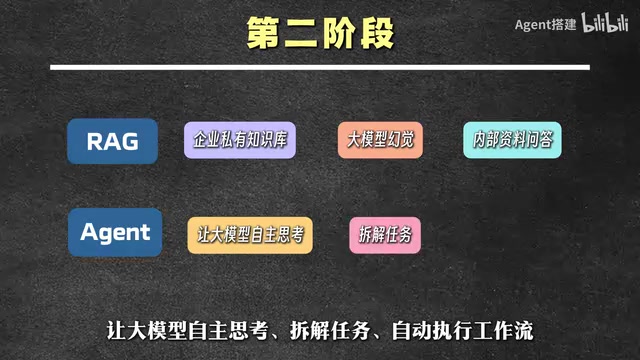
Agent is one of the hottest directions in AI right now. Unlike simple conversations, Agents enable LLMs to think autonomously, decompose complex tasks, invoke external tools, and automatically execute complete workflows.
The core design philosophy of Agents originates from the "Think-Act-Observe" loop in cognitive science (the ReAct framework, i.e., Reasoning + Acting). A complete Agent system typically contains four key components: the LLM serves as the "brain" responsible for reasoning and decision-making; the Memory module stores conversation history and intermediate results, divided into short-term memory (current conversation context) and long-term memory (persistently stored experience); the Tools set provides external capabilities such as code execution, web search, database queries, and API calls; and the Planning module handles decomposing complex tasks into executable sub-steps. Beyond LangChain, current mainstream Agent frameworks include AutoGPT, CrewAI, and MetaGPT, each with different strengths in multi-agent collaboration and task orchestration.
For example: you tell an Agent "analyze this sales data and generate a weekly report," and it automatically completes data reading, cleaning, analysis, visualization, and report writing — that's the power of Agents.
Supporting Framework: LangChain Ties RAG and Agents Together
After learning the concepts of RAG and Agents, you need a development framework to tie them together. LangChain is currently the most mainstream LLM application development framework, created by Harrison Chase in October 2022, and it quickly became the de facto standard for LLM application development. It provides:
- Standardized LLM calling interfaces (supporting dozens of backends including OpenAI, Anthropic, local models, etc.)
- Comprehensive RAG Pipeline components (document loaders, text splitters, vector stores, retrievers, etc.)
- Flexible Agent building tools (supporting multiple Agent paradigms like ReAct, Plan-and-Execute, etc.)
- Rich third-party integrations (hundreds of connectors for databases, search engines, SaaS tools, etc.)
In 2024, the LangChain team also launched LangGraph, specifically designed for building more complex multi-step, stateful Agent workflows, as well as LangSmith for debugging, testing, and monitoring LLM applications. It's worth noting that LlamaIndex is also an important alternative in RAG scenarios, offering more fine-grained control over document indexing and retrieval optimization.
By using LangChain to connect RAG and Agents, you can independently develop production-ready AI applications. At this point, whether you're building enterprise intelligent customer service or delivering AI implementation solutions for traditional industries, you already have practical capabilities.
This phase takes approximately 3–4 weeks and offers the highest return on investment across the entire roadmap.
Phase 3: Advanced Model Fine-Tuning — Pull Ahead of the Competition
If the first two phases gave you the ability to "use LLMs well," the third phase teaches you how to "tune LLMs well."
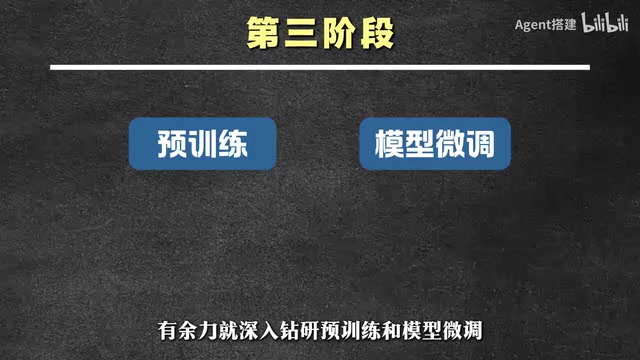
Key topics to master include:
- Mainstream lightweight fine-tuning methods: Such as LoRA and QLoRA, which enable model fine-tuning on consumer-grade GPUs, dramatically lowering both the technical barrier and hardware costs. LoRA (Low-Rank Adaptation), proposed by Microsoft Research in 2021, is based on the core insight that parameter changes during fine-tuning actually exhibit low-rank properties. Therefore, instead of updating all parameters, you only need to insert two small low-rank matrices (decomposition matrices A and B) alongside the original weight matrices and train only these small matrices. This reduces the GPU memory required for fine-tuning from hundreds of GBs to just a few GBs. QLoRA further introduces 4-bit quantization on top of LoRA, loading the base model in 4-bit precision into GPU memory, making it possible to fine-tune a 7-billion-parameter model on a single 24GB GPU (such as an RTX 4090).
- Supporting fine-tuning frameworks: Hugging Face's PEFT (Parameter-Efficient Fine-Tuning) library provides a unified interface for multiple lightweight fine-tuning methods including LoRA, Prefix Tuning, and P-Tuning. LLaMA-Factory further simplifies the entire fine-tuning workflow, supporting data configuration, training parameter setup, and model export through a web interface, enabling rapid completion of the full pipeline from data preparation to model training.
- Hands-on project experience: Build complete LLM projects hands-on, going through the entire process from requirements analysis, data collection, model selection, fine-tuning, to deployment. Start with vertical domain Q&A systems or text classification tasks, then gradually progress to more complex instruction tuning and alignment training (RLHF/DPO).
After completing this phase, you'll have a significant edge over others making the same career transition. Most people plateau at the "can call APIs" level, while you'll have the ability to customize models based on business requirements.
AI LLM Learning Roadmap Summary and Key Reminders
| Phase | Core Content | Recommended Duration | Resulting Capability |
|---|---|---|---|
| Phase 1 | Transformer architecture, deep learning fundamentals | 2–3 weeks | Understand LLM underlying principles |
| Phase 2 | RAG + Agent + LangChain | 3–4 weeks | Independently develop AI applications |
| Phase 3 | LoRA model fine-tuning, pre-training advanced topics | 2–3 weeks | Model customization capability |
Key reminders:
- Follow the sequence strictly. Don't skip phases — each phase is a prerequisite for the next. For example, without understanding the attention mechanism in Transformers, you can't truly grasp why vector-based retrieval is needed in RAG; without understanding the model's reasoning process, you can't design effective Agent prompts.
- Prioritize practice over theory. After learning each concept, immediately build a project to validate it — don't just read without doing. Consider creating your own learning project repository on GitHub to both accumulate a portfolio and demonstrate hands-on capability during job searches.
- Focus on core skills. The AI field has an enormous number of knowledge points, but the core skills enterprises actually need are the ones listed above. Don't try to learn everything. Especially in the early stages, you don't need to dive deep into model pre-training, distributed training, or other lower-level technologies — these can be explored later based on your specific role requirements.
- Keep learning continuously. The AI field iterates extremely fast. Even after completing this roadmap, you need to stay current with new developments. Follow the latest papers on arXiv, technical blogs from major model providers, and trending open-source projects on GitHub to maintain your sensitivity to the technology frontier.
After completing this entire roadmap, you'll have the ability to independently interface with real enterprise business requirements and deliver complete AI solutions. In today's market environment, this capability translates directly into tangible career competitiveness.
Related articles

The Truth Behind Codex 'Build a Website in 5 Minutes': AI Isn't Creating Sites—It's Helping You Copy Them
Exposing the truth behind viral Codex 5-minute website videos: creators aren't building original sites with AI—they're copying shared prompts or scraping others' work. Learn AI coding tools' real limits.

Getting Started with AI Agent Development: A Complete Guide from Concept to Practice
A comprehensive guide to AI Agent architecture and development, covering automated marketing, intelligent customer service, and investment analysis scenarios with single and multi-agent collaboration.

The Truth Behind Codex 'Build a Website in 5 Minutes': AI Isn't Creating Sites — It's Helping You Copy Them
Exposing the truth behind viral Codex 5-minute website videos: creators aren't building original sites with AI — they're copying shared prompts or scraping others' work.