AI Large Language Model Job Seeker's Guide: Engineering & Deployment vs. Algorithm Research — A Complete Breakdown

A practical guide to navigating LLM careers across engineering deployment and algorithm research tracks.
This guide cuts through the noise of AI large model job hunting by distinguishing two core career tracks: engineering deployment and algorithm research. It outlines entry requirements, key technologies like RAG and Agents, and how to build a coherent learning path — helping tech professionals find their footing in a fast-evolving field.
As the AI large model wave continues to surge, more and more tech professionals are looking to break into this field. But faced with a dizzying array of job titles and tech stacks, many find themselves lost: which direction should I focus on? What core technologies do I need to master? Based on analysis of the frontline LLM job market, this article maps out a clear career path and technical framework to guide your job search.
Two Core Directions in the LLM Job Market
When analyzing the AI large model job market, there's a common misconception: many people instinctively use "job titles" to define their positioning. In reality, a more accurate classification should be based on the actual nature of the work, not the title.
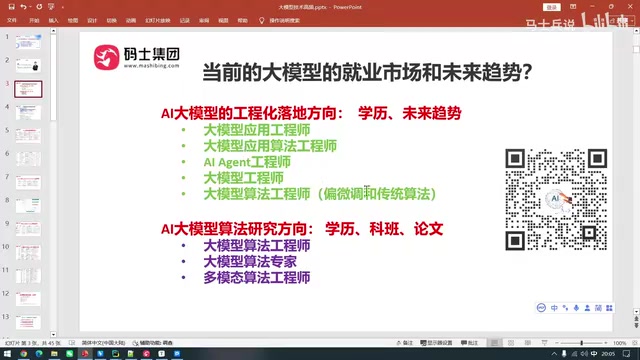
Based on the nature of the work, LLM-related roles can be clearly divided into two categories:
- LLM Engineering & Deployment: Application and engineering-focused, responsible for bringing LLM capabilities into real-world business scenarios.
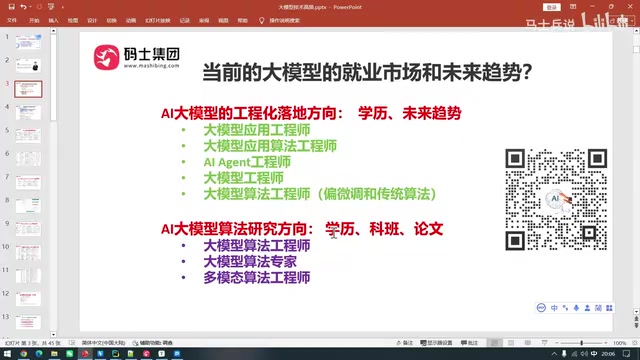
- Algorithm Research: Focused on foundational research, covering model architecture, training methods, algorithmic innovation, and cutting-edge exploration.
These two directions differ significantly in compensation, entry requirements, and career trajectory. Which path you choose often determines your learning priorities and professional direction for years to come.
Algorithm Research: High Barriers, High Rewards
Roles focused on algorithm research typically offer compensation well above the industry average. These positions sit at the cutting edge of LLM technology, responsible for core innovation in model development.
The technical scope of LLM algorithm research is extremely broad, covering areas such as: pre-training architecture optimization (e.g., attention mechanism improvements, long-context modeling), efficient fine-tuning methods (e.g., LoRA, QLoRA, Prefix Tuning), alignment techniques (e.g., RLHF, DPO, aimed at aligning model behavior with human intent), model compression and inference acceleration (quantization, distillation, speculative decoding), and multimodal fusion. The key players in this space are top-tier tech companies (OpenAI, Google DeepMind, Anthropic, Baidu, Alibaba, ByteDance) and elite university research labs.
But behind those high rewards lie steep entry barriers:
- Educational requirements: A Master's degree from a top-ranked university is typically the minimum — not a bonus.
- Research background: Published papers in relevant fields are often a prerequisite. The reason publications have become a hard requirement is that these roles are essentially "industry research positions" — they require candidates who can independently identify problems, design experiments, and produce reproducible results. Academic publications are the most direct proof of that capability.
If you hold a Master's or PhD from a top university and have relevant research output to show, the algorithm research track is a high-value path worth pursuing. However, for most general tech professionals, the entry barriers are quite high, and an honest self-assessment is essential before committing to this direction.
Engineering & Deployment: The Better Fit for Most Job Seekers
For the majority of job seekers, LLM engineering and deployment is the more realistic and actionable choice. This direction places less emphasis on elite academic credentials and research backgrounds, focusing instead on engineering capability and hands-on technical practice.
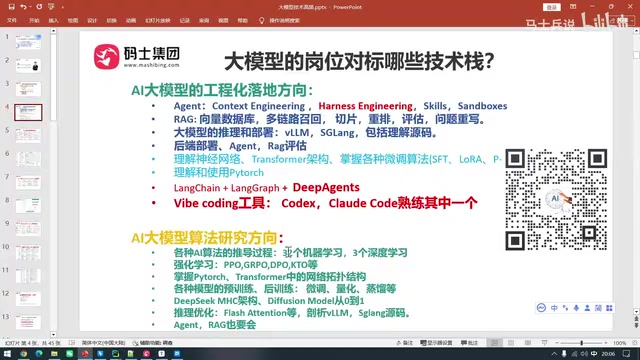
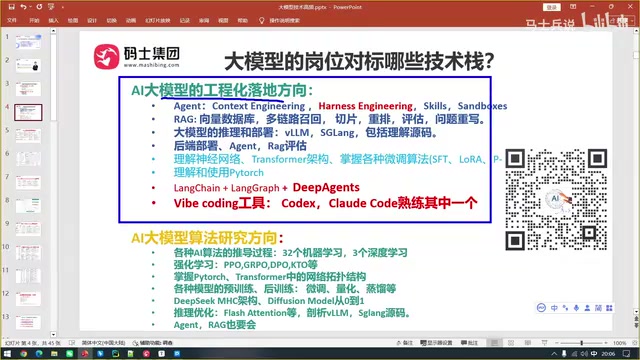
The essence of engineering and deployment is putting LLM capabilities to actual use — transforming general-purpose model capabilities into products and systems that solve real business problems. This requires mastering an entire engineering stack built around LLM applications.
To truly understand this stack, it helps to trace its evolution along a timeline: the Transformer architecture laid the foundation in 2017; from 2020 to 2022, models like GPT-3 demonstrated "emergent capabilities" and Prompt Engineering took off; early 2023 saw ChatGPT ignite widespread application enthusiasm, with frameworks like LangChain rapidly rising and RAG becoming the dominant deployment solution; mid-to-late 2023 brought the Agent paradigm and Function Calling (tool use) into the spotlight; and from 2024 onward, Multi-Agent systems, long-context handling, and the fusion of RAG and Agents (Agentic RAG) have emerged as new hotspots. This timeline reveals a key pattern: each new technology tends to address the limitations of the previous one. Understanding this evolutionary logic lets you anticipate the next technical trend rather than perpetually chasing the last one.
It's worth noting that LLM technology iterates extremely fast, and the engineering stack it relies on continues to evolve. For this reason, understanding the relationships between technologies is far more valuable than studying any single technology in isolation.
Agents and RAG: The Two Technical Pillars of LLM Deployment
Within the engineering and deployment ecosystem, two technologies stand out as especially critical: RAG (Retrieval-Augmented Generation) and Agent technology.
RAG: Solving the Knowledge Freshness and Hallucination Problem
RAG (Retrieval-Augmented Generation) is a technical paradigm introduced by Meta AI Research in 2020. Its core idea is to retrieve relevant document snippets from an external knowledge base before the model generates a response, then inject those snippets as context into the prompt to guide the model toward answers grounded in real source material. This approach effectively sidesteps two major weaknesses of LLM parametric knowledge: knowledge cutoff dates that cause information to go stale, and the model's tendency to "make things up" when uncertain — the hallucination problem.
In practice, RAG typically relies on vector databases (such as Chroma, Milvus, or Pinecone) to store document embeddings, retrieving relevant snippets via semantic similarity search. As the technology has matured, RAG has evolved from basic "naive RAG" into more sophisticated variants like Modular RAG and Graph RAG, becoming the standard solution for enterprise knowledge base Q&A, customer service bots, compliance review, and similar use cases. In enterprise application scenarios, RAG is essentially a baseline requirement.
Agent Technology: From Conversational Tool to Task Executor
The core idea behind Agent technology originates from research into "enabling LLMs to plan and act autonomously." It entered the mainstream in 2023 with the viral attention surrounding the ReAct (Reasoning + Acting) paper and AutoGPT. The typical operating loop works as follows: upon receiving a task, the model performs Chain-of-Thought reasoning to decompose it into sub-steps, then selects and invokes appropriate external tools (e.g., search engines, code executors, database query interfaces), observes the results, and continues reasoning until the task is complete. This paradigm transforms LLMs from passive "answer machines" into active "task executors" — a significant breakthrough in real-world LLM deployment.
The most widely used Agent frameworks today include LangChain, LlamaIndex, AutoGen, and CrewAI. Multi-Agent (multi-agent collaboration) architectures are also becoming an increasingly important pattern for handling complex workflows. In production deployments, tool-call reliability, error recovery mechanisms, and context management in long-running tasks are the core engineering challenges.
Understanding the internal logic of these two technologies — RAG addresses the limitation of pure Prompt Engineering in incorporating external dynamic knowledge, while Agents address RAG's constraint of being purely "passive retrieval" rather than "active execution" — and tracing their development along the technology evolution timeline is the key to building solid engineering and deployment capabilities. Technologies don't exist in isolation; only by understanding how they interconnect and progressively evolve can you maintain your footing in a rapidly changing industry.
Four Practical Tips for Job Seekers
Putting it all together, here are some frameworks to keep in mind when pursuing opportunities in the AI large model space:
- Clarify your direction first: Honestly assess your academic background and capabilities to determine whether algorithm research or engineering deployment is the better fit. For most people, engineering deployment is the safer entry point.
- Focus on core technologies: Within the engineering deployment track, prioritize developing deep expertise in RAG and Agent technology — understand the underlying mechanisms, not just how to call APIs.
- Build a full-picture mental map: Avoid studying individual technologies in isolation. Understand the relationships between them and their evolution over time to form a systemic view. From Prompt Engineering to RAG to Agents, every step in the evolution has an internal logic — trace that thread and you'll be able to generalize far more effectively.
- Stay current with rapid iteration: LLM technology moves extremely fast. Keeping up with high-frequency changes is essential to maintaining long-term competitiveness.
Whichever path you choose, having a clear sense of direction and a systematic technical understanding are prerequisites for establishing yourself in this fast-moving field. Rather than blindly chasing the latest trend, start by mapping out the technical landscape clearly — then build your capabilities with purpose and focus.
Key Takeaways
Related articles

Code with Claude Event: AI-Powered Creative Experiments on Tiny Computers
At Code with Claude, Anthropic gave participants tiny computers to build creative projects with AI assistance, showcasing how AI coding tools empower the maker community.
Claude Code Adds Agent View: A Research Preview for Unified Session Management
Claude Code's new Agent View feature (research preview) consolidates all coding sessions into a unified list, advancing AI tools toward multi-agent orchestration.
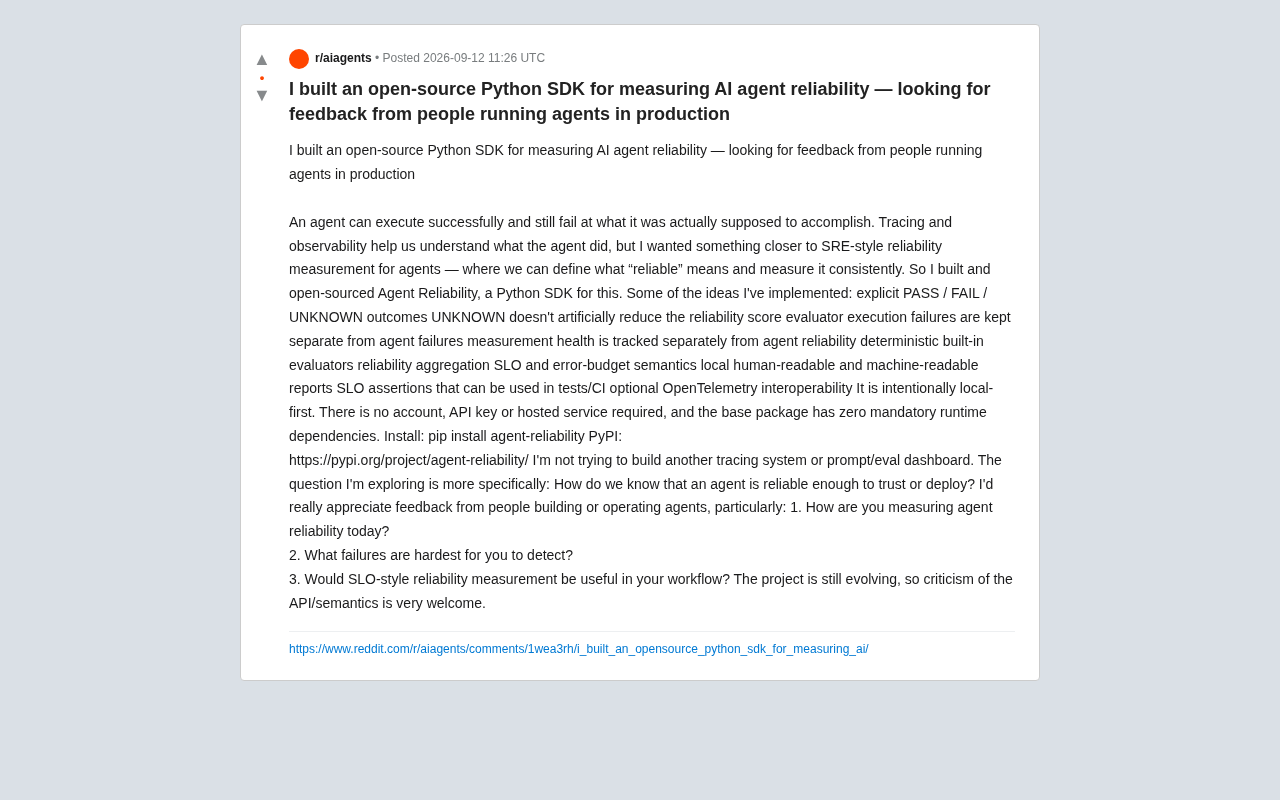
Open-Source Python SDK: Measuring AI Agent Reliability with SRE Principles
Agent Reliability is an open-source Python SDK that applies SRE's SLO and error budget concepts to AI Agent evaluation, with PASS/FAIL/UNKNOWN states, CI assertions, and zero forced dependencies.