AI Large Model Development: A Zero-to-Application Learning Roadmap for Beginners

A phased, employment-focused roadmap from backend basics to AI application development for undergrads.
This article outlines a practical, employment-oriented AI application development roadmap for undergraduates, built on the logic of "backend foundation first, then AI capabilities." It maps out the three-layer AI industry structure — infrastructure, model, and application layers — and explains why 90% of enterprise hiring happens at the application layer, making it the most accessible entry point. The three-phase roadmap covers Java backend and data structures, then Python, prompt engineering, RAG, and Agent frameworks, and finally progressive project practice from local demos to deployable enterprise systems. The roadmap targets aspiring AI application engineers, not researchers or model trainers.
Many computer science students are asking the same question: if I want to learn AI, where do I even start? Should I dive straight into training large models, or build AI agents? Do I need a solid backend foundation first? This article is based on a comprehensive tutorial from a Bilibili AI developer, and it focuses on two things: a clear picture of the job landscape in the AI industry, and a practical, employment-oriented learning roadmap. One important caveat up front — this roadmap is not about training hundred-billion-parameter models. It's about AI application development: building AI-powered systems that real users can actually use, on top of existing large models.
As the original video points out, roughly 90% of companies today are hiring for exactly this kind of application development talent. It's also the most realistic career path for graduates from non-elite or average universities. Even better — this roadmap isn't major-specific. Whether you're in CS, engineering, or an interdisciplinary field, you can make it work.
The AI Industry at a Glance: Infrastructure, Model, and Application Layers
Before diving into the learning roadmap, let's clear up a common misconception: learning AI ≠ training large models to become an algorithm engineer. The real AI industry is far more complex than that. From chips and compute all the way to user-facing products, it takes many different types of talent working together. Broadly, the industry can be divided into three layers.
The Infrastructure Layer is the foundation that makes AI run. Without it providing compute, data, and the underlying environment, large models simply can't be trained or deployed. This layer includes data engineers and AI data specialists (responsible for data collection, cleaning, annotation, anonymization, and compliance), compute scheduling and MLOps roles (keeping hundred-billion-parameter models training stably across tens of thousands of GPUs), and — the most technically demanding — AI chip designers.
Data roles have relatively low educational requirements (a bachelor's degree is typically sufficient) and offer salaries around ¥10K–18K per month, but the work is repetitive with limited growth potential. The original video doesn't recommend this path as a first choice. Compute scheduling roles typically require a master's degree, with starting salaries of ¥200K–350K per year; senior architects can earn ¥800K–1M. AI chip design usually requires a graduate degree from a top university (985) or even a PhD, with starting salaries of ¥350K–600K and senior specialists earning ¥1.5M–2M.
The Model Layer is where AI's "brain" is built — solving how AI thinks and learns. Key roles include large model algorithm engineers (designing and optimizing foundation models, researching Transformer architectures and training methods; annual salary ¥500K–1.2M), large model fine-tuning engineers (SFT-focused, adapting existing models to enterprise use cases; ¥400K–800K), and reinforcement learning engineers (RLHF, continuously improving models through reward mechanisms).
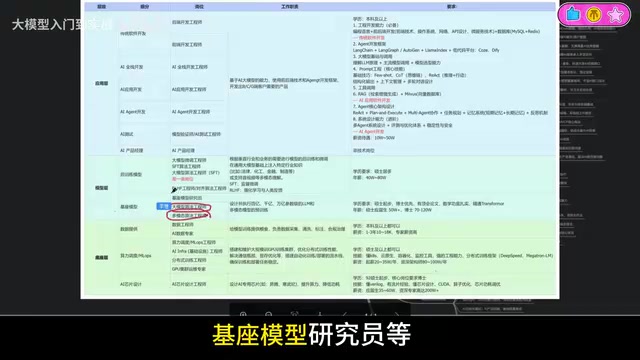
There's an important distinction to understand here: a foundation model is a general-purpose large language model like GPT, Doubao, or DeepSeekAd; a post-trained model is one that's been fine-tuned on top of a foundation model using industry-specific data. For example, a bank needing an intelligent customer service system wouldn't train a GPT from scratch — it would take an existing model and inject domain-specific knowledge through supervised fine-tuning (SFT) or LoRA fine-tuning, making the model fluent in financial services.
The Application Layer: The Most Accessible Career Path for Most Students
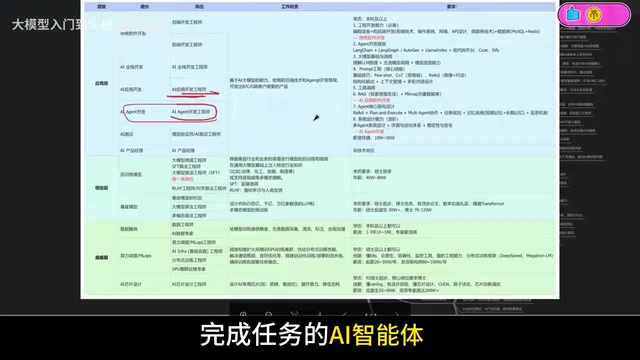
The application layer is where the bulk of enterprise hiring happens, and it's the most accessible direction for most students. Put simply: the model layer builds the brain, and the application layer puts that brain into products so everyday users can actually use it.
AI full-stack engineers are in extremely high demand at large companies right now. Think of this as traditional software development (frontend + backend + database) with AI capabilities layered on top. Beyond the fundamentals of Java, Python, and API design, you'll need to master large model integration, prompt engineering, and RAG (Retrieval-Augmented Generation) knowledge base technology. The original video gives a nice prompt comparison: asking "write me a proposal" yields mediocre results, but asking "You are a product manager with 10 years of experience. Please structure a proposal across three dimensions: user needs, market analysis, and business model" produces significantly higher-quality output.
AI application engineers focus on building new AI-powered products — things like AI customer service agents, AI office assistants, and AI education tools. The core challenge is turning AI capabilities into software that users can actually operate.
AI Agent engineers represent one of the hottest roles in recent years. Agents can autonomously complete complex tasks — for instance, if you type "help me plan a 7-day trip to Japan," an agent will automatically check flights, plan an itinerary, recommend hotels, and generate a complete travel guide. This role requires mastery of agent framework design (task decomposition, tool calling, workflow design) and multi-agent collaboration (a product manager agent handles requirements, a programmer agent writes code, a testing agent finds bugs).

Other roles worth knowing: AI test engineers (validating model response accuracy and safety) and AI product managers (bridging user needs and AI capabilities, deciding which scenarios AI should be applied to). The original video uses a city analogy: the infrastructure layer builds the roads and power grid, the model layer trains superintelligent brains, and the application layer turns AI into everyday products. For most CS students, the most realistic opportunities are in application development, agent development, AI testing, and AI product management.
RAG (Retrieval-Augmented Generation) is one of the most critical technologies in AI application development, and understanding it is essential for this entire learning roadmap. Large models have a fundamental limitation: their training data has a cutoff date, and they have absolutely no knowledge of a company's internal documents, product manuals, or customer service knowledge bases. RAG solves this by retrieving the most relevant document chunks from an external knowledge base before the model generates a response, then feeding both the retrieved content and the user's question to the model — essentially letting it "reference materials" before answering. It's like an open-book exam: the model doesn't need to memorize everything, it just needs to know how to search and summarize. Typical use cases include enterprise intelligent customer service, internal knowledge Q&A systems, and legal document assistance tools. From a technical stack perspective, RAG involves text vectorization (embedding), vector databases (such as Milvus, Chroma, and Faiss), and similarity-based retrieval — which is exactly why data structures and algorithms appear as a prerequisite in this roadmap. The underlying logic of vector search is closely related to classical retrieval algorithms.
The Complete Employment-Oriented Learning Roadmap
For the application layer — where market demand is highest — the original video lays out a clear learning sequence. The core logic is: build a solid traditional backend foundation first, then layer on AI application capabilities.
Phase 1: Traditional Backend Foundation
An AI application is ultimately a software system. The large model is just the brain in the middle; everything around it — receiving requests, storing data, message queuing, permission management, and API routing — all relies on traditional backend infrastructure. Without a solid foundation, what you build will only ever be a toy demo, not something that can ship.
This phase covers: C (building core programming instincts), Java fundamentals (OOP, I/O, collections, exceptions), data structures and algorithms (mandatory for interviews and the foundation for RAG retrieval and vector search), databases (MySQL, which directly impacts AI response speed), and Java advanced topics (Spring Boot, Spring Cloud microservices, Redis, MQ). Completing this phase puts you at the level of a solid traditional backend developer.
Spring Boot and microservice architecture are among the most important engineering skills in this phase — and they're the key dividing line between "building toy demos" and "shipping production-grade AI systems." Spring Boot is the most mainstream backend framework in the Java ecosystem. Its "convention over configuration" philosophy dramatically simplifies building web services and is the standard tech stack at the vast majority of internet companies. Spring Cloud microservices is an architectural approach that splits a monolithic application into multiple independent services (e.g., user service, conversation service, document parsing service) that run in coordination, using service discovery, load balancing, circuit breaking, and other mechanisms to maintain stability under high concurrency. For AI systems specifically, microservices matter because large model calls have high latency and consume significant resources — they must be isolated and deployed independently to avoid dragging down the rest of the application. RAG retrieval, vector storage, and user permission management also need to scale independently. Redis, as an in-memory database, handles conversation context caching and accelerates frequent queries; MQ (message queuing) decouples asynchronous large model call requests, preventing interface timeouts from crashing the system.
Phase 2: Core AI Application Development
This is the heart of the entire roadmap. The recommended learning order is:
- Python basics + Python web development
- Large model fundamentals: Understanding LLM limitations, knowing when to use RAG vs. Agent vs. MCP
- Prompt engineering: Learning to communicate effectively with AI
- Vibe Coding (AI-assisted programming): Using AI tools to accelerate code development and debugging
- Enterprise-grade RAG development: Solving the problem of LLMs being unaware of private data — a high-frequency topic in campus recruiting
- Agent development in practice: LangChain, LangGraph, MCP protocol, and more
- Large model fine-tuning: LoRA, QLoRA
Completing this phase brings you to the level of an AI application engineer. After that, it's all about hands-on practice.
MCP (Model Context Protocol) is an open protocol introduced by Anthropic in late 2024, and it's rapidly becoming a key standard in the AI Agent ecosystem. Its core purpose is to standardize how large models communicate with external tools and data sources — similar to how the USB standard unified how peripheral devices connect to computers. Before MCP, every AI application required custom adapter code for each different tool (databases, file systems, API services), making development expensive and hard to reuse. MCP decouples tool providers (MCP Servers) from AI callers (MCP Clients): developers simply expose tool interfaces according to the protocol, and models can automatically discover and invoke them. This design makes tool extension in agent systems far more standardized and modular. LangChain is currently the most widely used AI application development framework, offering high-level abstractions for chain calling, memory management, and tool integration — significantly reducing the complexity of building RAG systems and agent workflows. LangGraph is its advanced counterpart, designed specifically for building multi-step, stateful agent workflow graphs, making it well-suited for complex task decomposition scenarios.
Phase 3: Project Practice, from Simple to Complex
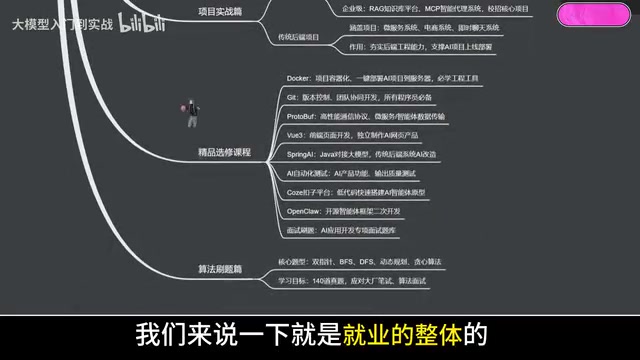
The original video strongly emphasizes building projects progressively — get it running first, then increase complexity. Don't force yourself into overly difficult projects just to show off:
- Entry level: Andrew Ng-style AI chatbot, single-turn RAG Q&A system (Python basics + prompt engineering + simple RAG). Can run locally as a demo or course project.
- Intermediate level: Multi-turn conversation system, AI retrieval Q&A system (FastAPI + RAG + Redis + MySQL). Can be deployed online, supports multi-user registration and document uploads — worthy of including on your resume.
- Enterprise level: Microservice-based AI knowledge base, MCP intelligent agent system (Java microservices + MQ + Docker + RAG + Agent + MCP). Close to real enterprise production environments — suitable for targeting top-tier companies.
Who Is This For? Target Roles and Company Types
This roadmap is a good fit for: university students who want to cover both traditional backend and AI development, broadening their career options; engineering-oriented undergraduate students at non-elite or average universities who want to land a job right out of college. It is not a good fit for: master's or PhD students focusing on large model training or algorithm research, or students specializing in image recognition or low-level NLP algorithms — those directions require deeper theoretical and mathematical foundations.
Target roles include: AI application engineer (the most direct fit), large model intelligent agent engineer (Agent + MCP), AI full-stack engineer, and traditional Java backend developer (with AI skills added, you're significantly more competitive).
Companies hiring for this talent profile fall into four main categories: major internet companies (ByteDance, Alibaba, Tencent, Baidu — building enterprise knowledge bases, AI office assistants, internal intelligent customer service); AI startups (vertical applications in legal AI, education AI, etc., with heavy RAG and Agent demand); traditional software companies (integrating large models into existing systems for smart reporting and knowledge bases); and B2B enterprise service companies (building private deployments for enterprises, requiring the full microservices + RAG stack).
Practical Advice for New Students
The original video wraps up with a few actionable recommendations: Don't skip traditional backend and jump straight into AI. Without a solid foundation, you'll only ever build toys. In your first year, prioritize programming fundamentals, data structures, and databases — you can try a simple RAG demo to get a feel for things. In your second year, go deep on Java, Python backend, and FastAPI, dive into RAG, and complete a project you can actually deploy online. Having one or two real projects on hand gives you something honest to show when you apply for internships.
Also, be clear about what's essential vs. optional. Don't try to learn everything — traditional backend and core AI application skills are non-negotiable; things like Docker, Kubernetes, Spring AI, API test automation, and LeetCode grinding can be added based on your specific goals and circumstances.
Finally: prioritize projects that actually run, can be deployed, and have real GitHub activity. That's far more persuasive to recruiters than a resume stuffed with buzzwords.
In summary, this is a clearly defined undergraduate employment-oriented AI application development roadmap. The foundation is backend engineering skills; the upper layer is real-world large model application. It's not about model training or algorithm research. For students looking to maximize their employability as undergraduates, it provides an actionable, phased framework you can actually execute on.
Related articles

Chain of Thought Isn't Just for AI: How Humans Can Use CoT to Improve Thinking Quality
Chain of Thought isn't just a prompt trick for large models. Starting from a Hacker News discussion, this article analyzes why CoT works for human thinking too, breaks down actionable ways to transfer it, and highlights the key differences between human CoT and machine CoT.
Cloudflare Teams Up with OpenAI: Closi…
Cloudflare Teams Up with OpenAI: Closing the Loop from Vulnerability Discovery to Defense with AI
Cloudflare uses OpenAI Daybreak to investigate security vulnerabilities and generate reviewable remediation plans, while developers use Codex to boost coding efficiency and quality.

Orca Multi-Agent Orchestration in Practice: A Guide to Parallel Collaboration with Claude and Codex
Orca is Stable AI's free open-source agent workbench supporting 34 agents like Claude Code and Codex in parallel. Learn its Git worktree isolation, multi-model orchestration, and mobile management.