AI Large Model Interview Deep Dive: Agent Architecture and Project Practice

Learn Agent, prompt engineering, and RAG systematically over three months, and speak with depth in interviews through hands-on projects.
Addressing the pain point of "being unable to speak with depth" in large model job interviews, the article proposes a three-month learning path. The author emphasizes that interviewers assess underlying understanding of Agent architecture, prompt engineering, and the full RAG pipeline, not a pile of tools. The first month builds fundamentals, understanding the difference between large models and Agents and component principles; the second month focuses on prompt template design and the full RAG process of chunking, vectorization, retrieval, and reranking; the third month completes two to three full projects from user research to MVP. The article also uses frameworks such as LangChain to illustrate how to demonstrate depth of thought through technology selection comparisons, and reminds job seekers to avoid quick-success gimmicks and build real interview competitiveness through "dumb work."
When interviewing for large model positions, how to explain things in depth is a pain point for many job seekers. In the video, the Bilibili creator shares a complete learning path from zero to landing an AI product offer, emphasizing that ordinary people need three months of solid accumulation, rather than being misled by clickbait titles like "get started in three days." This article combines that path to break down how to demonstrate real technical depth in interviews through systematic learning of Agent architecture, prompt engineering, RAG knowledge bases, and hands-on projects.
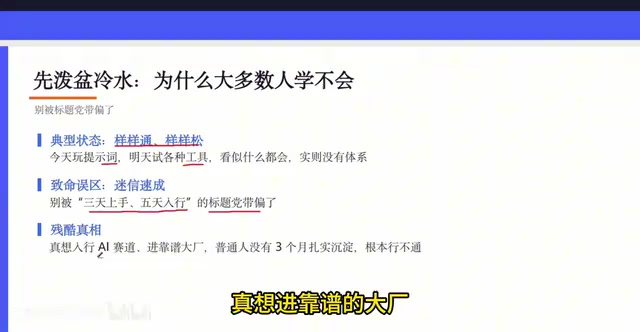
Why interviews require "depth" rather than "breadth"
Many beginners play with prompts today and try various tools tomorrow, yet end up "jack of all trades, master of none." The creator points out that ordinary people simply can't make it without three months of solid accumulation. What interviewers assess is not how many tools you've used, but whether you understand the essential difference between large models and Agents, whether you can design stable prompt templates, and whether you clearly understand the full RAG pipeline. Depth means you can explain the underlying principles clearly, rather than staying at the level of API calls.
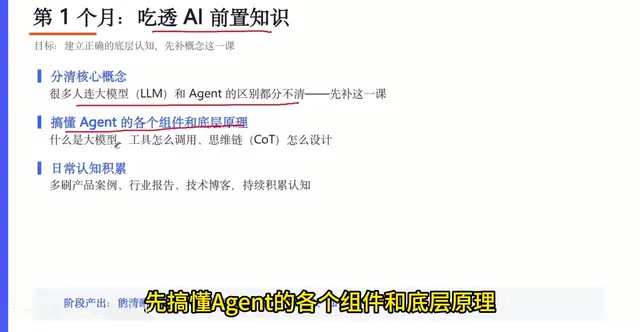
Three-month learning path: from fundamentals to practice
First month: master AI prerequisite knowledge
The creator suggests fixing two hours a day in the early stage to build a solid foundation. In the first month, focus on understanding the difference between large models and Agents, and understand each Agent component and its underlying principles, including how tools are called and how the chain of thought is designed. At the same time, consume more product cases, industry reports, and technical blogs to continuously accumulate knowledge. Interviews often ask "what modules does the Agent architecture include"—if you can clearly explain components such as planning, memory, and tool use, you've already surpassed most candidates.
Chain of Thought (CoT) is a prompting technique that makes a large model output a step-by-step reasoning process before giving the final answer. Its core value lies in breaking complex problems into intermediate steps, thereby improving accuracy on multi-step reasoning tasks. In Agent scenarios, the chain of thought is not just a prompting trick but the working foundation of the planning component: an Agent needs to first "think clearly" about what to do and in how many steps, then decide which tools to call. If asked in an interview "how do you design an Agent's reasoning flow," being able to explain the difference between CoT and ReAct (alternating reasoning and action), when to use explicit reasoning, and when to directly call a tool demonstrates an understanding of the underlying mechanism, rather than just writing "Let's think step by step."
Second month: focus on core Agent capabilities
The second month focuses on the underlying logic and architecture design of prompt engineering, creating stable, reusable prompt templates from a product perspective. At the same time, go deep into RAG (Retrieval-Augmented Generation), understand exactly what problem it solves, and fully master the entire pipeline of text chunking, vectorization, retrieval, and result reranking. The creator emphasizes that this is the key to distinguishing "can use" from "knows the trade" in interviews.
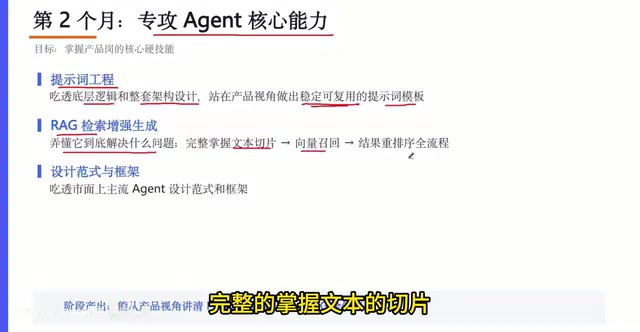
Vectorization and reranking in the full RAG pipeline are high-frequency follow-up points in interviews. Vectorization refers to using an embedding model to map text chunks into high-dimensional vectors, so that semantically similar content is closer in vector space; the retrieval stage usually uses approximate nearest neighbor (ANN) indexes to quickly retrieve Top-K chunks. But retrieval only guarantees "relevant," not "most useful," so reranking (Rerank) is needed: using a cross-encoder to score each query-candidate chunk pair, putting the chunks that truly answer the question first. Understanding the division of labor between these two steps—the embedding model determines the retrieval ceiling, reranking determines the final precision—and knowing how chunk granularity, overlapping windows, and Top-K values affect results, is what it means to truly master RAG, rather than staying at the level of "throw documents into a vector database."
Third month: produce practical, deployable projects
The third month is the most important: combining what you've learned, pick suitable scenarios and do two to three hands-on projects, going through user research, requirement sorting, outputting a PRD, drawing product prototypes, and finally using Web Coding to build a demonstrable MVP. The creator believes that only after completing a full implementation do you have the hard skills to land a high-paying offer. In an interview, being able to show a complete 0-to-1 project loop is far more convincing than listing tools.
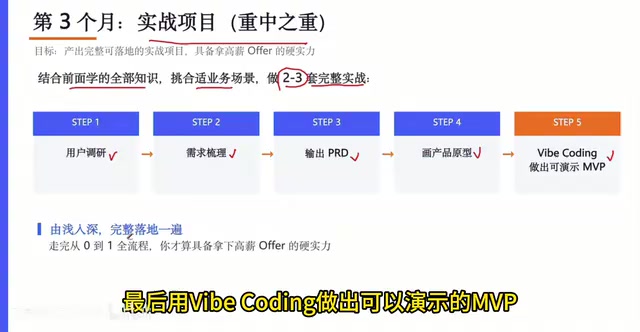
MVP (Minimum Viable Product) refers to building a demonstrable product version at minimum cost that can validate the core value. For job seekers in large model positions, the significance of an MVP is not complete functionality but proving that you have the closed-loop ability from requirements to implementation: being able to define the problem, choose an appropriate technical solution, control scope, and build an interactive demo. What interviewers care about is how you make trade-offs with limited resources—which features must be kept, which can be replaced by rules or ready-made APIs, and how to evaluate results. A candidate who can clearly explain "why the MVP was designed this way" demonstrates product thinking and engineering judgment far more than someone who lists ten tools.
How to explain things in depth in interviews: OpenClaw and LangChain as examples
The video title mentions the OpenClawAd application and LangChain development. Although the main text does not elaborate, it can be inferred that interviewers expect candidates to compare the design philosophies of different frameworks. For example, LangChain provides chained calls and an Agent executor, while OpenClaw may focus on optimization for a certain type of scenario. A deep answer should include: why this framework was chosen, how its components collaborate, what pitfalls were encountered, and how they were solved. The creator repeatedly emphasizes "standing from a product perspective," meaning you should not only understand the technology but also explain the impact of technology choices on user experience.
LangChain is an open-source framework for developing large model applications. Its core abstractions include Prompt templates, Chain (chained calls), Memory, Retriever, and Agent executor. Its strengths are a rich ecosystem and composable components; its weakness is a relatively thick abstraction layer, which tends to become a "black box" during debugging. When comparing frameworks, what interviewers really want to hear is the difference in design philosophy: whether it emphasizes declarative orchestration or code-first, how memory and tool calls are decoupled, and how error handling and observability are implemented. In your answer, combining the reasons for your choices in your own projects, migration costs, and lessons learned from pitfalls demonstrates depth better than reciting framework documentation.
Pitfall avoidance guide: don't be misled by quick-success gimmicks
The creator says bluntly that 90% of people who want to learn AI are waiting for shortcuts—thinking that learning one or two knowledge points will land them a high-paying job, preferring to believe quick-success gimmicks rather than doing the work steadily. This path is not for people who only take shortcuts. Depth in interviews comes precisely from that "dumb work": hand-writing prompt templates, debugging RAG retrieval, and repeatedly iterating on the MVP. If you are preparing for a large model position, you might as well follow this path and spend three months accumulating, turning each knowledge point into a story rather than memorizing answers.
Related articles

DeepSeek Harness in Detail: DIY Your Own Software Like Building with LEGO
What is DeepSeek Harness? Using the metaphor of a car assembly platform, this article explains this equipment system of freely combinable functional modules, analyzes its spatiotemporal composability technical foundation, and shows how ordinary users can DIY exclusive software that does not exist on the market at extremely low cost.

DeepSeek Harness Step-by-Step Tutorial: Master DSH and Its Plugin Ecosystem in 50 Minutes
DeepSeek Harness step-by-step install tutorial: from Node.js environment setup to client installation, covering three plugin install methods — chat, marketplace, and command line — plus practical uses of local file access and plugin extensions.

DeepSeek Open-Sources Super-agent Architecture: A Turning Point for Proactive AI
DeepSeek's open-source Super-agent architecture proposes a new proactive AI paradigm: a central Agent dispatches tasks, sub-Agents execute autonomously, and humans only decide and accept. This article analyzes the watershed between passive and proactive AI, and the implementation logic of proactive Agents in scenarios like short-video lead generation.