AI Large Model Self-Study Roadmap: A Four-Stage Practical Framework from Prompt Engineering to Fine-Tuning

A practical four-stage AI learning roadmap: from Prompt Engineering to RAG, Agents, and model fine-tuning.
This article uses a popular Bilibili AI tutorial series as a framework to map out a structured self-study path for beginners. The four progressive stages cover Prompt Engineering, LLM core competencies, RAG and Agent development, and hands-on model fine-tuning. It also critically examines marketing claims like "master AI in 7 days," noting that real proficiency takes months and requires genuine project experience. The key takeaway: focus on completing one or two deployable projects rather than chasing course volume.
The workplace demand for AI skills is rapidly shifting from "knowing how to use it" to "being able to deploy it." Most AI courses on the market are heavy on theory and light on hands-on practice, leaving learners unable to apply what they've learned — a trap many beginners fall into repeatedly. This article uses a popular AI large model tutorial series circulating on Bilibili as a starting point to map out a relatively complete self-study path, objectively analyzing the key technical milestones along the way to help you decide where your time is best invested.
Why "Deployment Ability" Has Become the Defining Line in AI Learning
Technology is evolving faster than ever, and professionals who only master the basics face significant risk of being replaced. What truly sets people apart is the ability to embed large model capabilities into real business contexts — such as building a functional knowledge base, deploying an automated Agent, or fine-tuning a model for better performance on a specific task.

This tutorial series has a clear focus: cut out redundant theory and concentrate on real-world deployment. It breaks the learning journey into four progressive stages, moving from foundational concepts all the way to project delivery. This structured approach matters for beginners because it avoids the fragmented "learn a little here, a little there" trap. That said, claims like "go from zero to expert in 7 days" or "get hired immediately after finishing" are obvious marketing language. Realistically, mastering these skills takes far longer than a week, and readers should approach such promises with healthy skepticism.
Breaking Down the Four-Stage Learning Path
Stage 1: Fundamentals and Prompt Engineering
The journey begins with understanding the core concepts and underlying principles of large models, with a focus on Prompt Engineering. Mastering various prompt techniques is the first and most cost-effective way to unlock model capabilities. For most working professionals, writing precise prompts alone can meaningfully boost day-to-day productivity — making this the highest-ROI stage of the entire learning path.
Stage 2: Building Core Competencies
Stage two dives deeper into large language models (LLMs), covering contextual reasoning, model capability boundaries, API invocation methods, and the mindset for matching models to specific use cases. This layer is often skipped by beginners — but understanding "what a model can and cannot do" is more critical to project success than blindly stacking techniques.

Stage 3: Advanced Project Deconstruction and Replication
Stage three benchmarks against high-quality industry projects, with a core focus on understanding how RAG (Retrieval-Augmented Generation) knowledge bases and Agents work in practice. RAG addresses the limitations of large models in terms of knowledge recency and domain specificity, making it one of the most mainstream approaches for enterprise AI deployment. Agents represent the direction of automated task execution. By thoroughly deconstructing the deployment logic of real projects, learners build genuine development and application thinking — rather than staying at the surface level of calling an API.
A closer look at RAG: The core idea behind RAG (Retrieval-Augmented Generation) is to retrieve the most relevant document chunks from an external knowledge base before sending a query to the model, then pass those chunks as context alongside the question. This approach offers two key benefits — the model can access up-to-date or proprietary knowledge without retraining, and answers become traceable and grounded, significantly reducing hallucinations. A typical RAG pipeline consists of three stages: document chunking and embedding (vectorization), similarity-based retrieval (usually via a vector database like Chroma, Pinecone, or Milvus), and final answer generation and synthesis. Understanding this pipeline is the critical leap from "using ChatGPT" to "building an enterprise knowledge base."
A closer look at Agents: Agents go a step further by giving large models the ability to autonomously plan and invoke tools. A typical Agent iterates through a "think → select tool → execute → observe result → think again" loop (the ReAct framework) until the task is complete. Tools can include search engines, code interpreters, database query interfaces, or any API. Frameworks like LangChain and AutoGen have significantly lowered the barrier to Agent development, though stability in complex, multi-step tasks remains the primary challenge in production deployments.
Stage 4: Fine-Tuning in Practice and Project Delivery
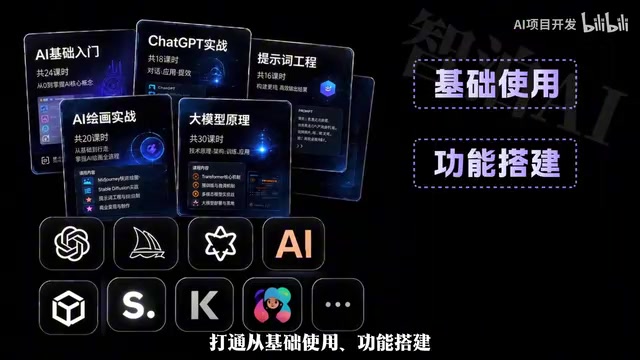
The final stage is hands-on model fine-tuning — independently building functional scenarios and polishing a complete, deliverable project. Fine-tuning is the key technique for adapting a model to a specific domain and represents a relatively high technical bar. Reaching this stage means you have a complete end-to-end capability: from foundational usage and feature building to commercial-grade delivery.
A closer look at fine-tuning: Fine-tuning refers to continuing the training of a pre-trained large model on domain-specific labeled data, so that its output style, knowledge emphasis, or task performance better aligns with the target use case. Full fine-tuning requires massive GPU memory and is impractical for most learners. The mainstream approach today is Parameter-Efficient Fine-Tuning (PEFT), with LoRA (Low-Rank Adaptation) being the most widely used method — it trains only a small number of additional parameters, dramatically reducing memory requirements, and can be run on consumer-grade GPUs. Using open-source models like Llama, Qwen, or ChatGLM as the base for LoRA fine-tuning is currently the most cost-effective path for local enterprise deployment. One important note: fine-tuning results are highly dependent on data quality. Building a clean, diverse, and task-aligned training dataset often has more impact on final performance than tweaking training hyperparameters.
Core Skills Covered by This Framework
Overall, the curriculum centers on the following transferable, practical skills:
- Precise Prompt writing: Improve efficiency and consistency when working with models
- LLM scenario matching: Identify and apply the right model for the right use case
- RAG knowledge base construction: Build specialized, controllable Q&A systems
- Agent automation deployment: Enable autonomous task execution
- Model fine-tuning and project delivery: Complete the last mile from prototype to production
The course claims to cover both GPT-4o and domestic open-source large models — a pragmatic choice, given that domestic open-source models are increasingly attractive for local deployment due to their cost advantages and greater controllability.
An Honest Assessment and Learning Recommendations
From a structural standpoint, the four-stage "Fundamentals → Core → Advanced → Practical" framework is sound and aligns well with how most people build a skill system. The most valuable content lies in the deployment-oriented techniques — RAG, Agents, and fine-tuning — which directly address the most pressing needs of enterprises today.
That said, keep a critical eye on the marketing language:
- Time commitments are unrealistic. Mastering the full stack from Prompt Engineering to fine-tuning typically requires months of consistent practice and project accumulation — not a few days.
- "Job-ready after completion" is overly optimistic. Skills are just a foot in the door; real positions also require project experience, engineering ability, and business understanding.
- Free resources vary widely in quality. "Comment below to receive the materials" is a classic lead-generation tactic. Resource quality is inconsistent — cross-reference with official documentation and open-source projects for a more reliable learning experience.
For anyone looking to break into AI, rather than agonizing over whether a particular course is the "most complete," focus your energy on building one or two complete, working projects. A functional RAG knowledge base or an automated Agent demonstrates your capabilities far more convincingly than finishing 749 video episodes.
Related articles

Felix Rieseberg Personal Homepage
Felix Rieseberg's personal homepage sparks attention on Hacker News. This article covers the Slack engineer's technical background, the rise and fall of nativefier, and the value of a developer homepage as a tech calling card.

@ai-sdk/vue 3.0.306 Patch Release Syncs with [email protected] Update
@ai-sdk/vue 3.0.306 released, synced with [email protected]. A routine patch release for the Vercel AI SDK ecosystem with no public API changes; the Vue adapter layer stays version-aligned with the core package.

Gemini 4 Argon API Launches: The Era of Million-Token Output Begins
Google launches Gemini 4 Argon with sparse MoE architecture, up to 1M output tokens, and a 68.90% Vals Index score, available across API, AI Studio, and the Gemini app.