AI Law Firm Crosby Bids for Collapsing Weil Gotshal

AI law firm Crosby bids for the collapsing Weil Gotshal, signaling AI's shift from tool to service entity.
The article examines AI law firm Crosby's bid for the collapsing Wall Street legacy firm Weil Gotshal as a lens on the legal industry's power restructuring. Traditional white-shoe firms' moats are crumbling under high costs and talent attrition, while Crosby seeks to quickly acquire client relationships, case databases, and brand reputation through the deal — mirroring tech's "capital for time, acquisitions for data" playbook. Yet accountability, ethics, client trust, asset devaluation, and integration hurdles leave the outcome uncertain. Win or lose, the event symbolizes AI legal companies' shift from tool providers to service entities.
AI Law Firm Crosby Bids for Collapsing Weil Gotshal
The collapse of Wall Street legacy law firm Weil, Gotshal & Manges has become a hot topic in the legal industry, and the entry of an AI law firm makes the drama even more intriguing.
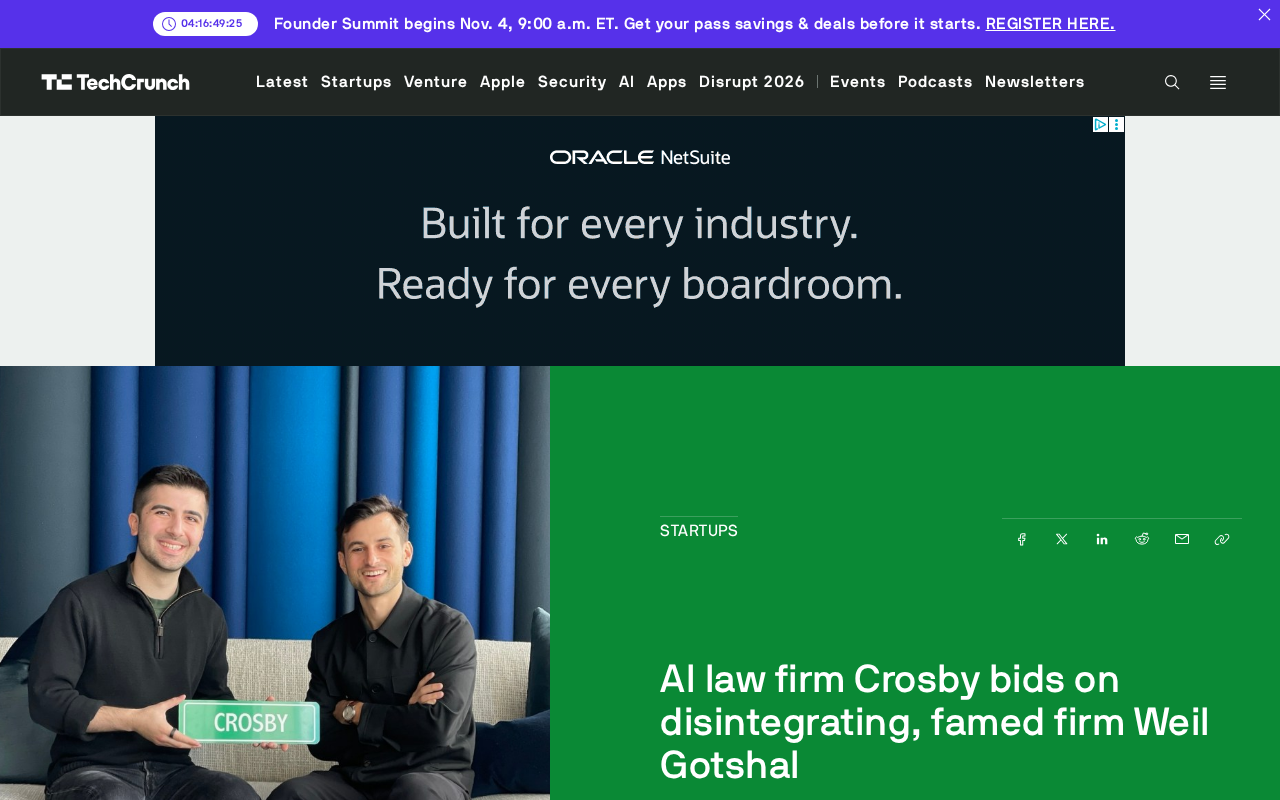
According to RSS source reports, AI law firm Crosby has made a bid for the crumbling Weil Gotshal. The news reads like a real-life version of Suits, except the protagonists have shifted from suited lawyers to algorithm-driven AI companies.
Dusk for Traditional Firms, Dawn for AI
Weil Gotshal was once a representative of Wall Street's "white-shoe law firms," and its dissolution is itself a landmark event. Traditional law firms have long built their moats on the partnership system and labor-intensive services, but their high-cost structures and vulnerability to talent attrition have become increasingly evident in recent years.
Crosby's bid sends a signal: AI is no longer just an efficiency tool inside law firms — it is beginning to participate directly in restructuring ownership of legal services. An AI company attempting to acquire the assets of a legendary law firm was almost unimaginable just a few years ago.
The term "white-shoe law firm" originated in the early 20th-century United States, initially referring to top New York firms that hired only Ivy League graduates and served established enterprises and Protestant elite circles, later broadly denoting elite legal institutions with outstanding reputations and high fees. Weil Gotshal, alongside Cravath and Sullivan & Cromwell, belonged to this tier, long dominating Wall Street's M&A, bankruptcy, and litigation practices. The white-shoe moat was built on lifetime partner tenure, the billable-hour model, and alumni networks — but this also meant high fixed costs and heavy dependence on star partners: once core partners leave en masse, client relationships follow, and the institution itself can rapidly hollow out.
The Industry Logic Behind the Bid
Crosby's motives are not hard to understand. A law firm's core assets include client relationships, case databases, and professional reputation — precisely the training material and trust endorsement that AI legal products most lack. By acquiring a legacy firm in the midst of dissolution, an AI company can quickly obtain decades of accumulated legal knowledge assets and brand heritage.
This "come-from-behind" path mirrors a common acquisition strategy in the tech industry: trade capital for time, trade acquisitions for data. What makes the legal industry special is the extremely high barrier to professional judgment — pure tech companies find it very hard to build trust from scratch. Acquiring a firm with history is equivalent to directly purchasing a ticket into the high-end legal services market.
Law firms differ from ordinary companies: their ownership structure is typically a partnership and cannot be directly acquired by outside capital the way a joint-stock company can. What is tradeable when a firm "dissolves" is often not equity but assets and business units — client contracts, case files, trademarks and firm names, IP libraries, and the lateral transfer of some teams as a whole. So a so-called "bid for a law firm" is legally closer to an asset purchase or business takeover, requiring navigation of partnership agreements, conflicts-of-interest review, and client consent. This also explains why such transactions are rare — the buyer must not only bid but also persuade clients and partners to migrate along with the assets.
Legal AI's Trust Problem Has Not Disappeared
Even if Crosby succeeds in its bid, the challenges will not vanish automatically. The core of legal services is accountability and ethical judgment, and AI systems remain unable to replace human lawyers at these levels. Whether clients are willing to entrust critical litigation or M&A transactions to an AI-led institution remains an open question.
The dissolution of Weil Gotshal itself may also erode the value of its assets. For a firm losing partners and clients, the appeal of its remaining assets must be discounted. Whether Crosby's bid can close, and how it integrates afterward, is full of uncertainty.
One of the core risks of legal AI is "hallucination": large language models may generate plausible but fabricated case law, statutes, or citations. Lawyers in the United States have already been sanctioned for citing AI-fabricated cases in court filings, which directly touches on lawyers' professional liability and ethics rules. In most jurisdictions, legal services and courtroom representation are subject to licensing regimes; non-lawyer entities cannot directly provide legal advice or share legal fees, which constitutes a regulatory boundary AI law firms cannot avoid. Even if technically viable, liability allocation — who bears the loss when AI-generated advice harms a client — remains a gap that the current professional liability insurance system struggles to cover.
Long-Term Impact on the Legal Industry
Regardless of whether the deal succeeds, it marks a turning point: AI legal companies are shifting identity from "tool providers" to "service entities." If AI can deliver legal services of equal quality at lower cost, the traditional law firm business model will face a fundamental shock.
For legal practitioners, the signal is clear enough. AI will not replace lawyers overnight, but it is changing the industry's power structure and value distribution. Weil Gotshal's fate may be only the beginning.
Related articles

Non-Coding Dad Builds 3D Earth Toy with Claude Code, Unexpectedly Goes Viral in Classrooms
A non-coding father used Claude Code to build My Earth Toy, a 3D interactive Earth with 830+ landmarks, 470+ animals, and 180+ vehicles—now used in classrooms worldwide. Discover how AI coding lowers the barrier to creation.

Meta, Google, and TikTok Sue California Attorney General: The Battle Over Youth Social Media Law
Meta, Google, and TikTok jointly sue the California Attorney General to block a state law restricting social media use by minors under 16. This article analyzes the lawsuit's background, the law's core provisions, and its potential impact on tech industry regulation.

T-Mobile Parent Company CEO on Musk's Telecom Ambitions: Welcome, But You'll Need $200 Billion
Deutsche Telekom CEO Tim Höettges responds to Musk's SpaceX Starlink Mobile plan, saying "welcome to the party" but questioning feasibility—estimating at least $200 billion needed to become a major U.S. carrier.