AI Lies in Werewolf: Analyzing Role-Based Language Strategies

Chinese Werewolf study finds werewolf utterances score higher on certainty and uncertainty, and identity prompts alone trigger language strategy shifts.
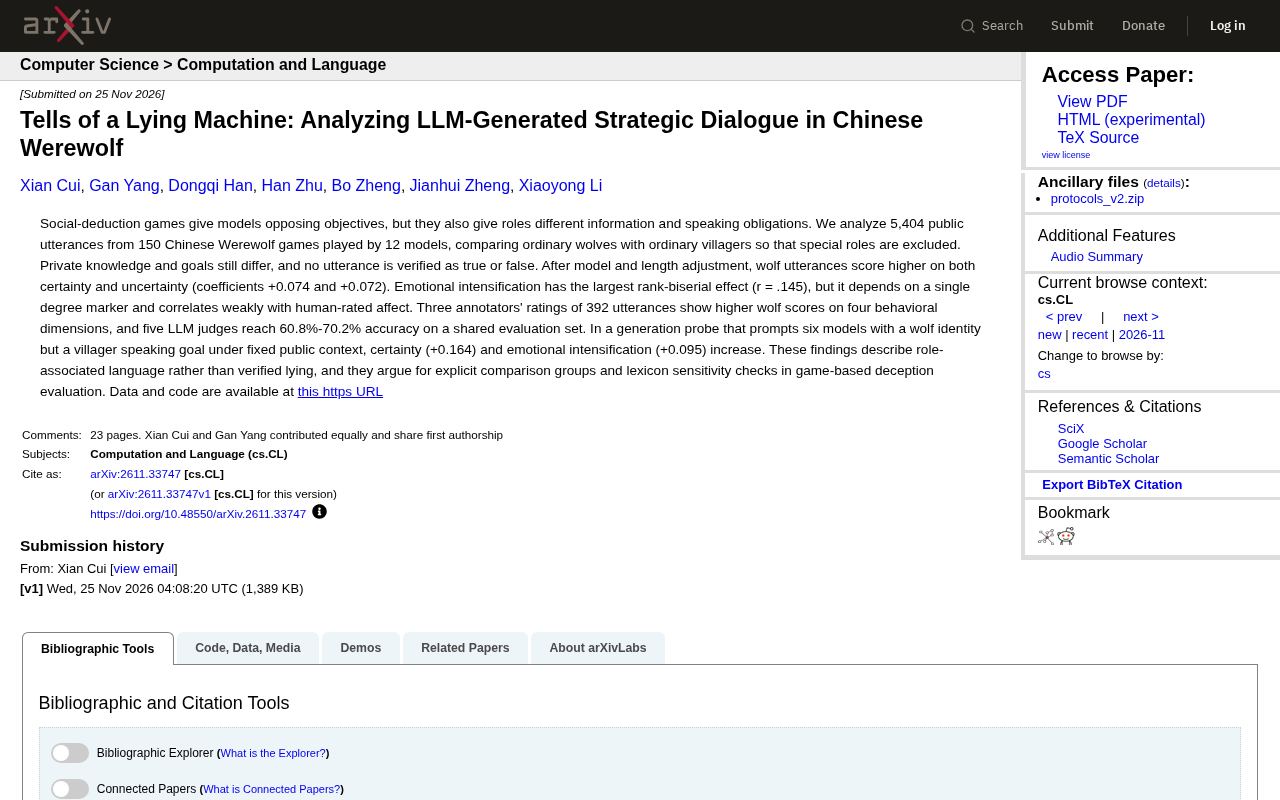
The study analyzed 5,404 public utterances from 12 models across 150 Chinese Werewolf games, comparing ordinary werewolves and villagers. Werewolf utterances scored higher on both certainty and uncertainty, with the largest effect on emotion intensification but dependent on a single marker word. Human annotation and five LLM judges both showed werewolves scoring higher on four behavioral dimensions, but accuracy was only 60.8%–70.2%. A generation probe showed that prompting werewolf identity alone, without requiring genuine deception, raised certainty scores by 0.164, indicating identity prompts suffice to trigger language strategy adjustments. The authors stress these are role-associated language patterns, not verified lies, and call for control groups and dictionary sensitivity checks in game-based deception evaluation.
Social deduction games provide large language models (LLMs) with adversarial scenarios featuring opposing objectives, but different roles differ not only in the amount of information they hold—they also carry distinct speaking obligations. A study on Chinese Werewolf analyzed 5,404 public utterances across 150 games involving 12 models, comparing ordinary werewolves with ordinary villagers (excluding special roles) to reveal role-associated linguistic features.
Role-Based Language Differences: Dual Signals of Certainty and Emotion
After controlling for model and utterance length, the research team found that werewolf utterances scored higher than villagers on both the "certainty" and "uncertainty" dimensions, with coefficients of +0.074 and +0.072, respectively. This seemingly contradictory pattern suggests that werewolves may manipulate conversation by expressing both firm stances and hesitation. The emotion intensification dimension showed the largest effect size (rank-biserial correlation r=0.145), but this effect depends on a single intensity marker word and correlates weakly with human-rated sentiment.
Cross-Validation Between Human and LLM Judgments
Scores from three annotators on 392 utterances showed that werewolves scored higher across four behavioral dimensions. On the shared evaluation set, five LLM judges achieved accuracy between 60.8% and 70.2%. This result indicates that while role-based linguistic features can be detected, they are not a simple true/false determination.
Rank-biserial correlation is a non-parametric effect size measure used to quantify the strength of association between a binary categorical variable and an ordinal continuous variable, with values ranging from [-1, 1]. In this study, it links "role identity" (werewolf/villager) with behavioral dimension scores (ordinal variables) assigned by LLM judges; r=0.145 means there is a weak-to-moderate monotonic association between role identity and emotion intensification scores. Compared with the Pearson correlation coefficient, rank-biserial correlation does not require variables to follow a normal distribution and does not assume linearity, making it better suited to the skewed distributions and ordinal characteristics common in rating data. The researchers used this metric rather than simple mean differences to provide a standardized effect size that facilitates comparability across behavioral dimensions and models.
LLM-as-judge is an evaluation paradigm widely adopted in recent years: using large language models to score, classify, or rank text or behavior as a substitute for or supplement to human annotation. Its advantages include low cost, strong scalability, and the ability to perform batch evaluations along consistent dimensions across thousands of utterances. However, this paradigm has known biases, such as position bias (tending to choose earlier options), verbosity bias (tending to give higher scores to longer responses), and self-preference bias (tending to favor text similar to its own generation style). In this study, the accuracy of five LLM judges on the shared evaluation set was compared with scores from three human annotators, yielding accuracy between 60.8% and 70.2%, indicating that while LLM judging has some discriminative ability, it has not yet reached a level where it can reliably replace human judgment—especially for subtle semantics involving deceptive intent, where interpretation requires caution.
Generation Probe: The Separation Cost of Identity and Goal
The study also designed a generation probe experiment: six models were prompted with "werewolf identity" but instructed to "speak with a villager's goal," with the public context held fixed. Results showed that certainty (+0.164) and emotion intensification (+0.095) scores also increased. This indicates that an identity prompt alone is sufficient to trigger adjustments in language strategy, without requiring genuine deceptive intent.
Generation probe is a controlled experimental design that injects specific minimal prompts (such as identity labels or goal instructions) into a model and observes changes in output linguistic features, thereby isolating the independent influence of different factors. In this study, the probe's design logic was: keep the public dialogue context unchanged, prompt the model only with "you are a werewolf," but require it to express itself with "a villager's speaking goal." If linguistic features still shift, this indicates that the identity label itself can trigger strategic language adjustment, without requiring genuine deceptive motivation or a complete game state. The value of this design lies in decoupling "identity awareness" from "goal-directed deceptive behavior," helping researchers determine whether role-based linguistic features in model outputs stem from strategic reasoning or merely from superficial imitation of role labels. Similar methods are known as the priming paradigm in psychology experiments and cognitive science, and here they are transferred to LLM behavior analysis.
Methodological Implications: An Evaluation Framework Beyond "Lie Detection"
The authors emphasize that these findings describe role-associated language patterns, not verified lies. They call for introducing explicit control groups and dictionary sensitivity checks in game-based deception evaluation to avoid misclassifying role language as deceptive behavior. The relevant data and code have been made public on GitHub.
Practical Implications for AI Evaluation
This study offers a new perspective on evaluating LLMs' social behavior: in game scenarios, model performance depends not only on their "honesty" but is also strongly influenced by role settings and speaking goals. Future evaluation designs need to more finely separate these factors to more accurately measure models' strategic communication abilities.
One-line Summary
A Chinese Werewolf study finds that werewolf utterances score higher on both certainty and uncertainty, and that an identity prompt alone can trigger language strategy adjustments.
Paragraph Summary
This study analyzed 5,404 public utterances from 12 models across 150 games of Chinese Werewolf, comparing the linguistic features of ordinary werewolves and ordinary villagers. Results show that werewolf utterances score higher on both certainty and uncertainty dimensions, with the largest effect size for emotion intensification but dependent on a single marker word. Both human annotation and five LLM judges showed werewolves scoring higher on four behavioral dimensions, but accuracy was only 60.8% to 70.2%. A generation probe experiment showed that merely prompting werewolf identity without requiring genuine deception raised certainty scores by 0.164, indicating that an identity prompt alone is sufficient to trigger language strategy adjustments. The authors emphasize that these are role-associated language patterns rather than verified lies, and call for introducing control groups and dictionary sensitivity checks in game-based deception evaluation.
Related articles

Unkernel: Compiling the Linux Kernel to WebAssembly
The Unkernel project compiles a real Linux kernel to WebAssembly, making it possible to run a complete kernel in the browser. This article covers its technical principles, challenges, and prospects.
New Claude Sonnet Model Tested: Performance Approaches Opus with Less Thinking
Anthropic quietly tests a new Sonnet model in Claude Code—performance approaches Opus 5.5 with far fewer thinking tokens, plus Codex transfer optimization, xAI's low-level rewrite, Google Antigravity updates, and the AI science understanding gap.
Building a Reasoning Model from Scratch: Making Complex AI Algorithms Accessible
Mike Finley, author of Build a Reasoning Model from Scratch, shows how a few hundred lines of code, single-sample training, and code reuse make complex AI algorithms like RL and verifiers accessible to all.