Unkernel: Compiling the Linux Kernel to WebAssembly

Unkernel compiles the Linux kernel to WebAssembly, enabling a complete kernel to run in the browser.
Unkernel is an experimental project that compiles Linux kernel source code into WebAssembly bytecode so it can run in browsers or any WASM runtime, earning 226 upvotes and 43 comments on Hacker News. It faces challenges in hardware abstraction, system call adaptation, virtual memory emulation, and interrupt handling, requiring software-layer MMU emulation and event injection. Potential uses include OS education, rapid kernel debugging, edge cloud lightweight virtualization, and an extra security isolation layer. Community reaction is mixed.
Introduction
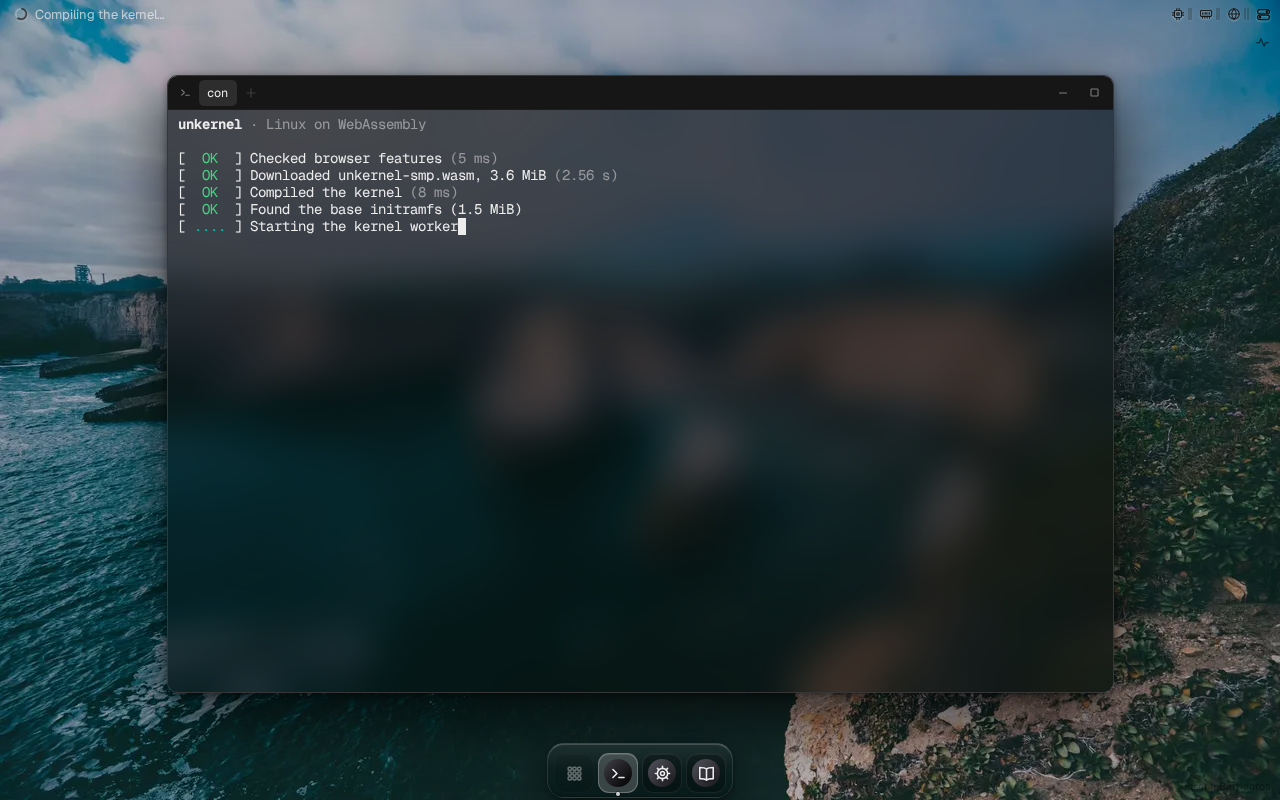
On Hacker News, a project called Unkernel has attracted widespread attention. The project has achieved compiling a real Linux kernel into WebAssembly (WASM), which means users can run a complete Linux kernel directly in the browser. The post received 226 upvotes and 43 comments, reflecting the developer community's strong interest in this technology.
Unkernel not only demonstrates the potential of WebAssembly as a general-purpose runtime environment, but also brings new possibilities for operating system education, kernel debugging, and cloud computing.
What Is Unkernel?
Unkernel is an experimental project whose core goal is to compile Linux kernel source code into WebAssembly bytecode, enabling the kernel to execute in a browser or any runtime that supports WASM. Traditionally, the Linux kernel needs to run directly on hardware or through a virtualization layer, but Unkernel breaks this limitation by abstracting the kernel into a portable WASM module.
From a technical perspective, WebAssembly is a low-level, portable bytecode format designed for efficient execution and cross-platform compatibility. Compiling the Linux kernel to WASM means the kernel code must be transformed through a specific toolchain and adapted to WASM's memory model and system call interfaces. This is undoubtedly a complex engineering effort involving compiler backends, runtime support, and architectural adjustments to the kernel.
Although the project is still in its early stages, Unkernel has already demonstrated the feasibility of booting the Linux kernel in a browser, laying the foundation for further exploration.
WebAssembly (WASM) was originally a binary instruction format designed for browsers, with goals including fast loading, near-native execution speed, and strict memory safety and sandbox isolation. WASM modules run in a linear memory space and can interact with the host environment only through import/export tables; they cannot directly execute privileged instructions or access arbitrary memory. This characteristic makes WASM naturally suitable for hosting untrusted code, but it also means that any software relying on hardware privileges or complex memory layouts (such as an operating system kernel) must undergo extensive adaptation when ported. The emergence of standards such as WASI (WebAssembly System Interface) has further provided WASM with system-level abstractions for files, networking, and more, gradually moving it from browsers into server-side and edge computing scenarios.
Technical Implementation and Challenges
Compiling the Linux kernel to WebAssembly faces many challenges. First, the Linux kernel depends on a large number of hardware-specific instructions and privileged operations, while WASM runs in a sandbox environment and cannot directly access hardware. Therefore, Unkernel needs to modify the kernel by replacing hardware-related parts with WASM-compatible abstraction layers. Second, the kernel's system call interface needs to be reimplemented to adapt to WASM's import/export mechanism.
In addition, WASM's memory model is linear, whereas the Linux kernel uses virtual memory management, which requires additional mapping and emulation. Unkernel may approximate this by emulating the MMU or using WASM's memory growth features. Another difficulty is interrupt and exception handling; WASM itself does not provide hardware interrupts, so the kernel needs to poll or have events injected through the host environment.
Despite the difficulties, the Unkernel project has successfully compiled kernel code to WASM and run it in a browser through a carefully designed toolchain and runtime support. This provides a reference for running more complex system software on WASM in the future.
In traditional architectures, the Linux kernel uses the MMU (memory management unit) to translate virtual addresses to physical addresses and relies on page tables, the TLB, and page fault mechanisms to manage memory. WASM's linear memory model has no hardware MMU; memory growth is achieved through the memory.grow instruction, and all addresses are offsets relative to the module's memory base. Therefore, when porting the kernel to WASM, it is usually necessary to establish a software-emulated address translation mechanism between the kernel and WASM linear memory, for example by using callbacks provided by the host environment to emulate page table walks and page fault handling. Although this software emulation is feasible, it introduces significant performance overhead, which is also one of the important reasons why the community questions its practicality.
Application Scenarios and Significance
Unkernel has a wide range of potential application scenarios. In education, students can directly experience the Linux kernel boot process through a browser without installing a virtual machine or configuring hardware, lowering the learning barrier. In development and debugging, developers can quickly deploy and test kernel modifications and use browser developer tools for performance analysis and error tracking.
In cloud computing, Unkernel may provide new ideas for lightweight virtualization, for example by running the kernel as a WASM module for rapid startup on edge nodes. In addition, WebAssembly's secure sandbox characteristics can provide an additional isolation layer for kernel execution, enhancing security.
From a broader perspective, Unkernel represents the trend of WebAssembly expanding into the system software domain. As the WASM ecosystem matures, more traditional system software may be ported to run on WASM in the future.
WebAssembly's security model is based on capability-based sandboxing: modules by default cannot access the host file system, network, or hardware, and all external capabilities must be obtained through explicit imports. This isolation mechanism differs from traditional virtual machine or container security boundaries; it works at the language runtime level, has a smaller attack surface, and can be stacked with other security mechanisms. When the kernel runs as a WASM module, even if there are vulnerabilities in the kernel code, an attacker must first break through the WASM runtime sandbox to affect the host system. However, this additional isolation layer also comes with compatibility costs—the kernel must rely on virtual devices and events injected by the host rather than directly controlling hardware, which limits its applicability to real hardware scenarios.
Community Reaction and Future Outlook
In the Hacker News discussion, the community's reaction to Unkernel was mixed. Some commenters praised its innovativeness, considering it a bold attempt in WebAssembly applications; others questioned its practicality, pointing out that performance overhead and compatibility issues may limit its application.
Regardless, the Unkernel project provides a new perspective for operating system research and WebAssembly technology exploration. As the project iterates and the WASM standard evolves, we may see more mature approaches to kernel WASM-ization. Technical enthusiasts who are interested can visit Unkernel's official website for more information.
Conclusion
The Unkernel project demonstrates the feasibility of compiling the Linux kernel to WebAssembly. Although it is still in its early stages, it brings new imaginative space for the portability of system software and the application boundaries of WebAssembly. As technology continues to develop, we look forward to seeing more similar innovations.
One-line Summary
Unkernel compiles the Linux kernel to WebAssembly, enabling a complete kernel to run in the browser.
Paragraph Summary
Unkernel is an experimental project that successfully compiles Linux kernel source code into WebAssembly bytecode, enabling it to execute in a browser or any runtime that supports WASM, and it received 226 upvotes and 43 comments on Hacker News. The project faces multiple technical challenges, including hardware abstraction, system call adaptation, virtual memory emulation, and interrupt handling, and must bypass WASM's sandbox limitations through software-layer MMU emulation and event injection. Its potential applications cover operating system education, rapid kernel debugging, lightweight virtualization in edge cloud computing, and an additional security isolation layer. Community reactions are mixed, praising its innovativeness while questioning its performance overhead and practicality. The project represents the trend of WebAssembly expanding into the system software domain.
Related articles
New Claude Sonnet Model Tested: Performance Approaches Opus with Less Thinking
Anthropic quietly tests a new Sonnet model in Claude Code—performance approaches Opus 5.5 with far fewer thinking tokens, plus Codex transfer optimization, xAI's low-level rewrite, Google Antigravity updates, and the AI science understanding gap.

Building a Reasoning Model from Scratch: Making Complex AI Algorithms Accessible
Mike Finley, author of Build a Reasoning Model from Scratch, shows how a few hundred lines of code, single-sample training, and code reuse make complex AI algorithms like RL and verifiers accessible to all.
11-Hour Free Course: Build a Reasoning AI from Scratch, Runs on an Ordinary Laptop
Sebastian Raschka released an 11-hour free video course teaching you to build a reasoning AI from scratch in Python. Covers verifiers, sampling, self-refinement, RL, and distillation; early chapters run on a laptop.