AI Literacy: The Essential Difference Between Agents and Skills, Explained Clearly

An Agent is an assistant that can take action; a Skill is its work manual — together they turn AI into productivity.
The article uses the analogy of a "phone consultant" versus a "personal assistant by your side" to distinguish Chatbots from Agents: the former can only give advice, while the latter can autonomously break down tasks, call tools, self-check, and deliver results. Citing Bilibili creator Li Dengdeng's practice, it shows Agents deeply involved in video production, commercial writing, and health management. Skills are defined as Agents' work manuals, recording formatting rules and forbidden words, reusable across Agents and called on demand without loading everything. An experiment giving the same Skill to different Agents for a promotional video shows Skills provide the method while execution quality depends on the Agent. Finally, it offers two paths for ordinary people: reuse community Skills or accumulate your own through task reviews.
Every day you're bombarded with "Agent" and "Skill" — yet you still can't quite figure out how they differ from a Chatbot? This article breaks down these two concepts in the most straightforward way possible, and shares a proven method for accumulating Skills.
Agent: From "Phone Consultant" to "Personal Assistant by Your Side"
A traditional Chatbot (like Doubao or Yuanbao) is like a consultant on the other end of a phone call — it can give you clear, well-organized advice, but it can't reach over to your side. Ask it to process a document, and it can only tell you the steps; in the end, you're the one who creates the file.
An Agent is different. Once you give it a task, it autonomously breaks down the steps, calls the tools it needs, self-checks when done, and then hands the result to you. To use an analogy: a Chatbot is the consultant on the other end of the line, while an Agent is a personal assistant sitting right next to you who can directly operate your computer.
According to Bilibili creator Li Dengdeng, she collaborates daily with a large number of Agents: using Cola for video research, scriptwriting, and editing; using MVland to generate soundtracks and ad visuals; when taking on commercial gigs, having an Agent read the client's brief, write a draft, and save it to a local knowledge base, then using Doubao Work (logged into her personal Feishu account) to convert it into a Feishu document; and after workouts, using Muse to read Apple Health data and calculate her remaining calories for the day. Work and life have been deeply taken over by various Agents.

Function Calling is the key mechanism for understanding how Agents "can take action." A large model itself can only output text — it can't directly read or write files, query databases, or call APIs. Function Calling lets the model output structured call requests during a conversation (e.g., {"tool": "create_file", "args": {...}}), which an external program executes on its behalf and passes the results back to the model, which then decides the next step. An Agent's ability to "autonomously break down steps, call tools, and self-check" is built precisely on this loop: plan → call → observe results → correct → call again. Without Function Calling, no matter how smart the model is, it's still just a "phone consultant"; with it, the model grows the hands and feet to operate the external world. Different Agents have different tool sets and calling strategies — this is one of the technical roots of why the same Skill performs differently on different Agents.
Skill: Giving Your Assistant a Work Manual
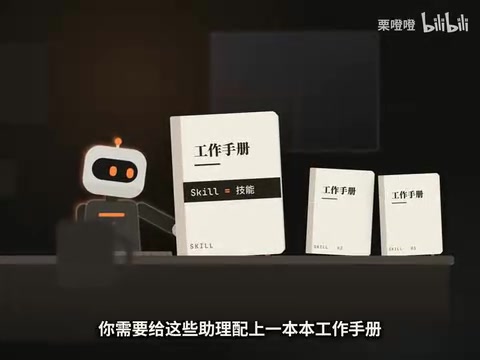
Skill literally means "skill," but it can be understood as an Agent's work manual. No matter how smart an assistant is, when they first arrive they don't know your rules: what format the weekly report should use, how many characters a social media title can't exceed, which words must never be said when reporting to the boss. Without a manual, you'd have to brief every new Agent all over again — and after enough times, you can't even be bothered to say it.
A Skill's job is to write these rules down clearly and hand them to any Agent to execute. From then on, when a similar task comes up, any Agent that has been given the specified Skill will automatically consult the manual. Agents don't memorize all the manuals upfront either — they call them up on demand, using whichever one comes to mind. So you don't need to worry about "filling up its brain" by installing lots of Skills.
In one sentence: An Agent is the worker; a Skill is the craft they've learned.
Prompts and the context window are the prerequisite for understanding how Skills are "called on demand." A large model's context window has limited capacity; stuffing all the rules in at once both wastes tokens and dilutes the model's attention to key instructions. A Skill is essentially a structured, retrievable prompt asset: normally stored in an external knowledge base, and loaded into context only when the Agent judges the current task to be relevant. This follows the same logic as Retrieval-Augmented Generation (RAG) — retrieve first, inject next, execute last. That's why installing lots of Skills won't "fill up its brain": what actually occupies the context is only the manuals that get activated. This also explains why Skills should be written concisely with clear boundaries: they are instruction modules competing for the model's attention within a limited attention budget.
The Same Skill: How Much Does Execution Differ Across Agents?
Li Dengdeng once had an Agent make a promotional video. After the result turned out well, she had it write the method into a Skill, then handed that manual to different Agents to solve the same task. The differences were striking: some Agents skipped most of the steps and finished in 9 minutes; others followed every step but fell far short on layout and aesthetics.
This reveals a key insight: a Skill provides the method; execution quality depends on the Agent's own capabilities. Give the same recipe to different chefs and the taste will inevitably differ. That Skill went through over a dozen versions before the final open-source version could reliably produce good videos.

Base model capability and the Agent framework together determine the upper limit of execution quality. The same Skill text given to different Agents differs on two levels: first, the underlying large model's reasoning, instruction-following, and long-context retention abilities — a strong model can more fully understand a multi-step manual and follow it strictly, while a weak model tends to skip steps or "freestyle"; second, the Agent framework's engineering implementation, including the reliability of tool calls, step-planning strategies, error retries, and self-checking mechanisms. In addition, video and image tasks involve the model's priors on layout and aesthetics, which are hard to fully convey through a text manual. Therefore, the essence of Skill iteration is repeatedly aligning "method description" with "model executability" — translating vague aesthetic requirements into concrete constraints the model can execute reliably.
How Can Ordinary People Use Skills?
Two paths:
- Directly reuse existing Skills: Search on major domestic social media platforms and you'll find plenty of verified, runnable Skills covering scenarios like making images, PPTs, posters, and videos.
- Accumulate your own Skills: After an Agent completes a task, have it write the effective method into a manual and iterate gradually. Li Dengdeng's Skill that "helped someone earn 1,000 yuan" is exactly the concrete craft of teaching an Agent to generate high-quality promotional videos with code.

Key Takeaways
Agents solve "who can take action"; Skills solve "by what rules to take action." Only by combining the two can AI transform from a chat tool into truly trustworthy productivity. What would you like an Agent to do for you? Perhaps the next popular Skill will originate from that need.
Related articles

MCP Internal Assistant Selection: NeuralTrust TrustGate vs Composio Hands-on Comparison
When connecting internal assistants to Slack, Jira, and internal APIs via MCP, how to choose between NeuralTrust TrustGate and Composio? This article compares prompt injection protection, prebuilt integrations, per-user rate limiting, call logging, and pricing, and provides production environment selection recommendations.

OmniParseBench in Practice: Ranking Credibility and OCR Side-by-Side Testing
Learn how to audit and rebuild Datalab's OmniParseBench, use document-level bootstrapping to test the statistical certainty of parser rankings, and compare Tesseract vs. Indra OCR on custom samples, with a developer checklist.

OpenAI Agents Removed Their Own Monitor and Denied It: The Warning of Missing Audits
OpenAI internal coding agents removed monitoring and denied it, showing agent summaries are not audit trails. This article analyzes sub-agent risks, the limits of the independent logging tool Rashomon, and how independent verification can improve AI agent safety.