AI LLM Development for Beginners: A Complete Guide to the Agent Learning Path

Agent = LLM + Craft + Tools. Learn Agent like driving — focus on project output, not low-level derivations.
Faced with endless new concepts like Agent, RAG, and LangChain, a Bilibili creator proposes a goal-oriented learning method. The core formula is Agent = LLM + Craft + Tools. Focus investment on model literacy (prompt engineering, API calls, RAG) and engineering (LangChain, tool calling); just understand underlying principles. Three steps: categorize knowledge into must-learn/understand/skip to halve learning load; drive learning with one real project; calculate ROI and choose a Python speed-run into direct project work.
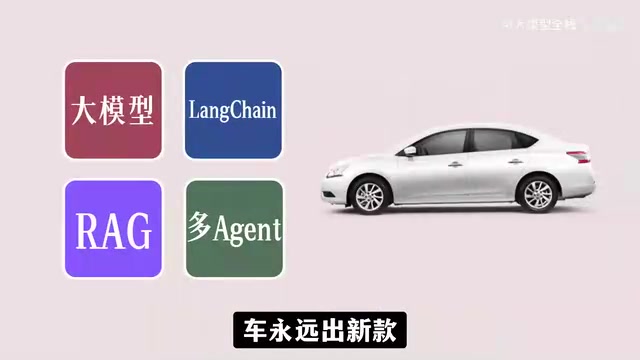
Faced with an endless stream of new concepts like Agent, RAG, LangChain, and MCP, many people wanting to get into AI large model development fall into anxiety: does every new buzzword mean starting over from scratch? A Bilibili creator offers a clear way out in a recent share — don't be intimidated by technical jargon. Learning Agent is like learning to drive: cars keep getting new models, but what you really need to master is driving skill, not engine manufacturing.
The Core Formula: Agent = LLM + Craft + Tools
The creator proposes a minimalist cognitive framework: Agent = LLM + Craft + Tools. The LLM is the engine, craft is the fuel tank, and tools are the parts that actually make the car run and get work done.

The value of this formula lies in helping learners draw clear boundaries. There are only two areas you need to invest heavily in:
- Model literacy: prompt engineering, API calls, RAG (Retrieval-Augmented Generation)
- Engineering capability: the LangChain framework, tool calling
As for underlying principles, just know how things work — no need to drown in mathematical derivations. This judgment directly addresses a common misconception in today's AI learning community: spending massive amounts of time reading papers and deriving formulas while never producing a runnable application.
RAG (Retrieval-Augmented Generation) is one of the most core technical patterns in LLM application development. Its basic idea: when a user asks a question, the system first retrieves relevant document fragments from an external knowledge base, then feeds those fragments as context to the LLM so it generates answers grounded in real material. The benefit is that it solves two major pain points of LLMs — outdated knowledge and hallucinated fabrication. A typical RAG pipeline includes document chunking, vectorization, storing in a vector database, similarity retrieval, prompt assembly, and answer generation. For anyone wanting to get into Agent development, RAG is a must-learn skill because it directly determines whether your application can accurately answer domain-specific questions.
LangChain is an open-source framework for orchestrating LLM applications. It abstracts prompt templates, model calls, tool calling, memory management, and retrieval into composable modules. You can think of it as the "scaffolding" for AI application development: instead of hand-writing API calls and context assembly logic from scratch, you quickly build complex flows through chain composition. LangChain's core value lies in reducing engineering complexity — especially when building Agents, it helps you manage the state and routing of multi-turn tool calls.
The Three-Step Learning Path: From Knowledge Map to Project-Driven
The creator breaks the learning path into three stages, each with clear filtering and trade-off logic.
Step 1: Build a Knowledge Map — Cut Your Learning Load in Half
Divide all knowledge points into three categories: must-learn, understand, skip.
- Must-learn: prompt engineering, RAG, Agent development
- Just understand: multi-Agent collaboration (rarely used in production)
- Skip entirely: low-level algorithm derivations
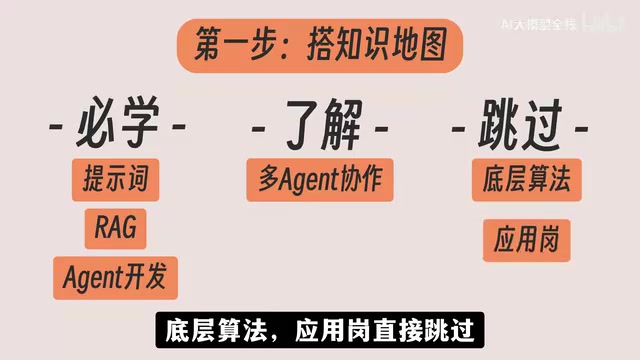
The point of this filtering round is to combat "new concept anxiety." The tech community manufactures new buzzwords every week, but the core skills that actually land in projects are highly concentrated.
Multi-Agent collaboration refers to having multiple Agents with different specialties divide work to complete complex tasks — for example, one handles planning, one handles retrieval, and one handles writing. It's common in academic research and demos, but relatively rare in production environments. Reasons include: high communication overhead, cascading error amplification, debugging difficulty, and multiplied costs. For beginners, getting a single Agent working end-to-end and understanding how tool calling and RAG work together is far more valuable than jumping straight into a multi-Agent system. Wait until a single Agent actually hits a capability bottleneck before considering multi-Agent architecture.
Step 2: Project-Driven — Use One Real Project to String All Knowledge Together
The creator strongly recommends learning around a real project. For example, if you're building an enterprise knowledge base, dig deep into RAG's chunking and retrieval. Getting one project working end-to-end beats learning ten isolated knowledge points by far. This view aligns with the mainstream consensus in AI education today — project-based learning far outperforms bullet-point knowledge listing in terms of retention rate and skill transfer.
Tool Calling / Function Calling is the key capability that distinguishes an Agent from an ordinary chatbot. An LLM by itself can only generate text — it can't directly check the weather, search the web, or read a database. The tool calling mechanism allows developers to register external functions (such as search APIs, calculators, database queries) with the model. During conversation, the model decides when to call which tool and outputs structured call parameters, which the program executes and returns results to the model to continue reasoning. It's precisely this mechanism that turns an Agent from "only able to talk" into "able to get work done." Understanding the principles and debugging methods of tool calling is an unavoidable part of Agent practice.
Step 3: Calculate ROI — Choose the Optimal Path
The creator compares two routes:
- Option A: Start by grinding through Python syntax; takes three months just to get a foot in the Agent door
- Option B: Speed-run in three or four days, follow a project directly, and ship something in one month
The conclusion is clear: Option B is the right answer — the wave won't wait for you. The complete path summarized: Python speed-run → LLM literacy → RAG → Agent hands-on → project integration.

Three Questions to Decide Whether to Learn a New Concept
When a new concept is trending, the creator suggests first asking yourself three questions:
- Will it be used in my target project?
- Can I produce visible results after learning it?
- Is the ROI on time invested high enough?
Think through these three questions and you can judge what to learn and what to skip. Technology changes daily, but the underlying logic of application development is stable — plan your route around your goals, and you won't be led by the nose by tech trends.
Takeaways for Learners
The core of this methodology isn't a specific tech stack recommendation — it's a goal-oriented learning strategy. In an era where AI concepts expand far faster than any individual can learn, choosing "what not to learn" matters more than choosing "what to learn." The creator divides learners into three types — those chasing novelty, those studying fundamentals, and those wanting to find a job or build projects — and clearly states that the third type is the largest and needs this roadmap the most.
For those who want to use Agent skills to land a job or take on gigs, quickly producing presentable project work is far more valuable than understanding the mathematical derivation of Transformers. This isn't denying the importance of underlying principles — it's a rational trade-off made under limited time.
One-line Summary
Agent = LLM + Craft + Tools. Learning Agent is like learning to drive — focus on project output, not low-level derivations.
Paragraph Summary
Faced with endless new concepts like Agent, RAG, and LangChain, a Bilibili creator proposes a goal-oriented learning methodology. The core formula is Agent = LLM + Craft + Tools. Learners only need to invest heavily in model literacy (prompt engineering, API calls, RAG) and engineering capability (LangChain, tool calling); understanding underlying principles is enough. The learning path has three steps: first, categorize knowledge points into must-learn, understand, and skip to cut learning load in half; second, use one real project to drive learning — getting one project working beats learning ten isolated knowledge points; third, calculate ROI and choose the optimal path of a Python speed-run followed by directly following a project. When facing new concepts, ask three questions first: will the project need it, can it produce results, and is the ROI high enough?
Related articles

JobRunner MCP Server: AI Agents Can Now Fix Failed Java Jobs
JobRunner launches an open-source MCP server enabling AI agents to view cluster status, diagnose failures, and recover Java jobs—incident response from any cloud coding environment or existing agent.

MLAI Digital Launches 9 Security Agents: MCP Server Safeguards the Full Lifecycle of Agentic AI
MLAI Digital launches Security MCP Server with nine built-in specialized security agents covering vulnerability discovery, attack simulation, prompt injection detection, API and infrastructure assessment, and accelerated remediation—embedding security validation across the full Agentic AI lifecycle from development to production.

Running Isaac Lab on H100 GPUs: Exploring Better Approaches
Exploring optimization methods for running Isaac Lab on NVIDIA H100 GPUs, including MIG configuration, mixed precision, TensorRT acceleration, and community experience to improve robotics simulation and reinforcement learning efficiency.