AI LLM Learning Roadmap for Beginners: A Four-Stage Path from Zero to Employment

A four-stage structured roadmap to take complete beginners from LLM basics to job-ready AI application development.
This article introduces a structured course designed for LLM application development, targeting beginners, experienced developers pivoting into AI, and heavy ChatGPT users. The course addresses the "too academic vs. too shallow" extremes in existing tutorials with four progressive stages: building awareness → core skills (Prompt engineering, RAG, Agent) → project delivery (fine-tuning and private deployment) → job search. Its core methodology is a top-down, framework-first learning path that emphasizes understanding capability boundaries before writing a line of code. The fine-tuning vs. RAG architecture decision is highlighted as both a critical practical judgment and a common sticking point for beginners.
For anyone looking to break into the AI large model space, the biggest challenge usually isn't a lack of tutorials — it's information overload with no clear starting point. One day you're reading a Transformer breakdown, the next day a new framework drops, and after two weeks of studying you still haven't built a coherent knowledge framework. One highly-viewed course on Bilibili attempts to solve this universal "learned but can't apply" problem through a structured four-stage roadmap.
Who This Course Is Actually For
The course author clearly identifies three target audiences, which happen to cover the main groups currently trying to enter the large model space.
The first group is complete beginners. They face the problem of "too much noise online" and lack a learning map they can actually follow. The second group is experienced developers looking to pivot — frontend, Java, QA, or DevOps engineers with three to five years of coding experience, who have the technical foundation but freeze up when asked about LLM-specific concepts like fine-tuning, RAG, or Agents. The third group consists of heavy users of ChatGPT or Kimi — people who've written plenty of prompts but are still far from truly "building applications with large models."

The course's core value proposition is this: by the end, your understanding of large models will shift from "I've heard it's popular" to "I have a roadmap I can actually follow." This positioning hits on a real condition many learners are in — they know the hype, but not the boundaries.
The Two Extremes of Existing Courses
The author is fairly blunt in criticizing existing large model tutorials, pointing out that most fall into one of two extremes.
One type is too academic — it leads with formulas and research papers, and you still don't know how to use anything after finishing. This kind of content may have value for researchers or those on an academic track, but for learners focused on practical applications, the barrier is too high and the payoff too slow.

The other type is too shallow — teaching a few "magic prompt" tricks that seem immediately usable but are miles away from real large model application development. This kind of content creates the illusion of competence, which collapses the moment you hit a real project.

This course aims to sit in the middle — enough conceptual grounding that new terminology won't faze you, and enough hands-on depth to actually build something. That balance is arguably the rarest thing in applied learning right now. According to the author, the entire curriculum wasn't dreamed up arbitrarily — it was distilled from learning from scratch and making hard-won mistakes while shipping real projects at work.
Breaking Down the Four-Stage Learning Path
The backbone of the course is four progressive stages, forming a complete loop from foundational awareness to job readiness.
Stage 1: Building Awareness
First, understand what large models actually are, how they fundamentally differ from traditional programs, and why they can "understand human language." More critically, internalize their capability boundaries — what they can do, what they can't, and what looks feasible but actually isn't. The author emphasizes that without this clarity, everything downstream — architecture decisions, solution design — is built on sand. This is a pragmatic insight: many projects fail not because of insufficient technology, but because developers forced large models into scenarios they're simply not suited for.
Stage 2: Three Core Technical Skills
This stage focuses on three areas that are both standard interview topics for large model roles and essential day-to-day tools:
- Prompt Engineering: The gap between "can write prompts" and "writes them well"
- RAG (Retrieval-Augmented Generation): From theory to production — why knowledge base accuracy stalls and how to tune retrieval strategies
- Agent Development: How to automate multi-step tasks, integrate tools, and wire up the execution chain
These three form the foundational skill set for application-layer developers and are the most credible things to demonstrate on a résumé.
RAG (Retrieval-Augmented Generation) is one of the most widely adopted technical approaches for enterprise large model deployments. The core idea: a model's parametric knowledge is frozen at training time, making it blind to real-time or proprietary data. RAG addresses this by retrieving relevant passages from an external knowledge base at inference time and injecting them into the prompt, so the model can "answer with the document in front of it" — reducing hallucinations and filling knowledge gaps. Typical use cases include internal enterprise document Q&A, customer service knowledge bases, and compliance review systems. The hard part of RAG engineering isn't calling an API — it's retrieval quality. Document chunking strategy, embedding model selection, similarity threshold tuning, and reranking mechanisms all collectively determine final accuracy. This is exactly why the course dedicates specific coverage to "how to tune retrieval strategies."
Agents represent the key paradigm shift from treating large models as "answerers" to making them "doers." By equipping models with tool-use capabilities, they can autonomously plan multi-step tasks and invoke external tools — search, code execution, database queries — to accomplish complex goals that a single conversation turn can't handle. Popular frameworks include LangChain, LlamaIndex, and AutoGen. ReAct (Reasoning + Acting) is the foundational operating pattern commonly asked about in interviews.
Stage 3: Project Delivery
With awareness and skills in place, the next step is building something you can actually show people. The path runs from calling APIs, to building a complete knowledge base Q&A system, to fine-tuning and private deployment. The author highlights one critical judgment call: why does some scenario call for fine-tuning while RAG is enough for another? How do you calculate cost, and how do you validate results?
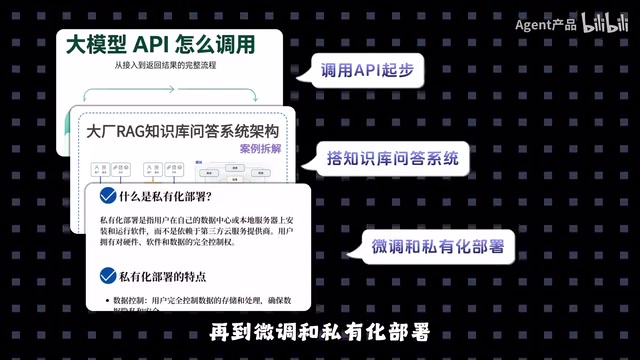
This "fine-tuning vs. RAG" architecture decision is exactly where many beginners get confused. Finishing this stage means your résumé reflects "real projects" — not the questionable "I've called an API before" type of experience.
The fine-tuning vs. RAG decision deserves its own explanation. RAG is the right fit when knowledge updates frequently, citations need to be traceable, or the data volume is large — its strengths are that model weights don't need to change, costs are low, and knowledge can be swapped out at any time. Fine-tuning is better suited for changing the model's output style, internalizing domain-specific language conventions (e.g., legal or medical terminology), or improving accuracy on a narrow class of fixed tasks — at the cost of labeled data, compute budget, and iteration cycles. The dominant fine-tuning approach today is LoRA (Low-Rank Adaptation), which trains only a small number of low-rank matrices, dramatically reducing VRAM requirements and making it feasible to fine-tune a 7B parameter model on consumer-grade GPUs. For private deployment, Ollama and vLLM are the most common local inference frameworks — Ollama is remarkably easy to get started with, while vLLM offers higher throughput for production environments. Understanding the cost-vs-performance tradeoffs behind these choices is the core dividing line between "can call an API" and "can design a solution."
Stage 4: Job Search in Practice
The final stage is directly employment-focused: how to write your résumé, how to present your project experience, how to answer high-frequency interview questions — end-to-end support from preparation to offer. For learners whose goal is career transition or entry, this stage is what ultimately determines whether the learning converts into professional payoff.
The "Framework First, Fill In Later" Learning Logic
The most transferable thing about this course isn't its specific content — it's the methodology. Many people trying to learn about large models start by reading papers and memorizing architecture diagrams, give up two weeks in with nothing to show for it.
This course takes the opposite approach: build the framework first. Get a clear picture of what the full landscape looks like, then fill in skill points one by one. At every step, you know what you're learning, why you're learning it, and what you'll be able to do with it.
This "top-down" learning approach is especially effective for technical onboarding in an age of information overload. It doesn't solve the problem of "are there learning materials" — materials are everywhere — it solves the problem of "knowing what to learn and in what order." For anyone looking to systematically enter the AI large model space, this four-stage roadmap offers a reliable set of coordinates to navigate by.
Related articles

Felix Rieseberg Personal Homepage
Felix Rieseberg's personal homepage sparks attention on Hacker News. This article covers the Slack engineer's technical background, the rise and fall of nativefier, and the value of a developer homepage as a tech calling card.

@ai-sdk/vue 3.0.306 Patch Release Syncs with [email protected] Update
@ai-sdk/vue 3.0.306 released, synced with [email protected]. A routine patch release for the Vercel AI SDK ecosystem with no public API changes; the Vue adapter layer stays version-aligned with the core package.

Gemini 4 Argon API Launches: The Era of Million-Token Output Begins
Google launches Gemini 4 Argon with sparse MoE architecture, up to 1M output tokens, and a 68.90% Vals Index score, available across API, AI Studio, and the Gemini app.