AI LLMs + Open-Source Hardware: Reimagining the Traditional Grass-Fed Ranch

Firecrawl's Cody proposes using LLMs and open-source GPS collars to automate grass-fed rotational grazing at scale.
At the AI Engineer conference, Firecrawl's Cody argued that 97% of cattle end up in feedlots not due to technology gaps but labor constraints — rotational grazing demands daily intuitive pasture assessments. He proposed combining satellite imagery, ground cameras, open-API GPS collars, and LLM-driven multi-variable reasoning to replace the farmer's eyes on the pasture. Three obstacles stand in the way: scattered grazing knowledge (he's building OpenPasture with Firecrawl), biomass/biodiversity visualization, and closed hardware ecosystems from Halter and No Fence. His core belief: LLMs excel at complex decisions with no deterministic algorithm, and AI engineers should think beyond the next SaaS tool.
At the AI Engineer conference, Cody from Firecrawl's growth team delivered a surprisingly unconventional talk. Instead of pitching another SaaS MCP plugin or a new framework, he steered the conversation toward a domain most engineers have never considered — raising cattle. More precisely, using AI large language models and open-source hardware to automate a "rotational grazing system for grass-fed livestock."
Cody's core argument comes down to one line: You're not thinking big enough. He believes the AI engineering community spends far too much time "writing software for people who write software, and then writing more software for those people," while a vast number of real-world physical problems worth solving with AI go ignored.
Why Livestock Belong on Pasture
Cody starts from a basic premise: livestock should live on pasture. He argues this is better for the animals, consumers, farmers, and the ecosystem. Yet the reality is that roughly 97% of cattle finish in feedlots, with only 3% truly raised on pasture.
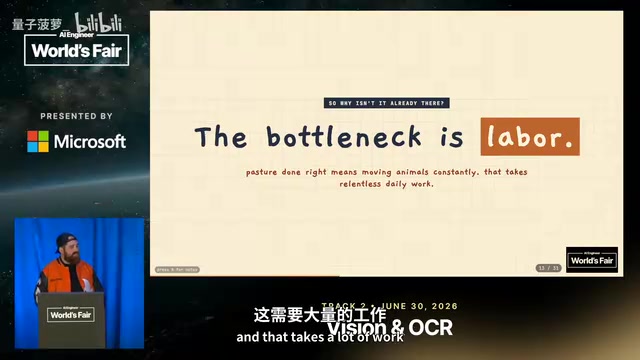
He's not opposed to confined farming, but he believes far more animals could be living on grass. So what's the real bottleneck? The answer is — labor.
Grass-fed farming is far more complex than most people imagine. Many assume you can just "put 100 cows on 100 acres and let them graze for a year," but that approach rapidly destroys pasture quality: cattle only eat the grasses they prefer, ignore what they should be eating, and repeatedly trample the same areas.
The Challenge of Rotational Grazing: Moving Every Single Day
The solution is rotational grazing — dividing the pasture into smaller paddocks, each sized to hold just enough forage for one day's grazing, and moving the herd daily. This allows some areas to rest and recover while others are actively grazed, improving long-term pasture productivity.
But this means farmers must move fences, animals, and water sources every single day while continuously tracking the status of every paddock. The workload is immense.
Some companies are already tackling this. Cody mentioned Halter, which recently received investment from Peter Thiel's fund at a $2 billion valuation, as well as No Fence. Both fit animals with GPS-connected collars, allowing farmers to remotely draw virtual boundaries and move herds without physical fences.
He thinks this is the right direction, but it still has a fundamental flaw: you still need to know where to move the animals. And that's not an exact science — grass doesn't grow uniformly every day, and drought, rainfall, and how much a given area has been trampled all influence the decision. Today, that judgment call requires farmers to walk the pasture in person, "look at the grass with their own eyes," and make the next move on intuition.
So the central question becomes: How do you replace the farmer's eyes on the pasture so they can make informed movement decisions remotely?
Halter was founded in New Zealand and in 2024 received a lead investment from Peter Thiel's Valar Ventures at an approximately $2 billion valuation, making it one of the most well-funded companies in the smart livestock collar space. Its core product is a cattle collar equipped with GPS, solar charging, and an audio-vibration module that "nudges" cattle in a desired direction or away from virtual boundaries by emitting an uncomfortable tone near the ear — no physical fencing required. No Fence is a Norwegian company with a similar technical approach, focused on sheep and mountainous terrain. Both companies have validated the commercial viability of "virtual fencing," but they both operate on a closed hardware + subscription software model. Farmers cannot plug their own algorithms or third-party software into the collar's control layer — which is the fundamental reason Cody criticizes their ecosystem lock-in.
Using LLMs for Multi-Variable Decision-Making
Cody outlined several technical approaches for "replacing the farmer's eyes":
- Drone orthomosaic imagery: Flying over the pasture to capture high-resolution grass maps. The downside is that it requires training farmers to operate drones, faces significant regulatory hurdles, and no jurisdiction in the world has yet approved autonomous drone operations of this kind.
- Satellite imagery: His preferred solution. A company called Planet photographs the entire Earth every day at roughly 1×1 meter resolution. The catch is that satellites are too far away to capture the fine-grained detail needed for grazing decisions.
- Low-cost ground reference: A friend of his in Missouri — a graduate research assistant at Lincoln University — uses a simple setup: an infrared camera and a measuring device placed near a tree, using a reference object to estimate grass height.
If the problems of grass height measurement and collar control can be solved, Cody envisions inserting an LLM into the full cycle to enable autonomous grazing operations.

This is fundamentally a multi-variable analysis problem. An LLM would need to synthesize a wide range of inputs: the animals' current GPS positions, where they were yesterday, where they might go tomorrow, local drought conditions, grass height across the entire operation. And decisions need to happen simultaneously at multiple levels — the optimal position for individual animals, the optimal position of the herd relative to the pasture, and the optimal position of the pasture relative to the broader ecosystem. These factors feed back into one another, and when optimized holistically, you can support more animals on less land — genuinely competing with the feedlot model.
Planet Labs is a US commercial satellite company operating the world's largest optical remote sensing satellite constellation. Its PlanetScope satellite fleet achieves complete daily global land coverage at roughly 3–5 meter resolution (Cody's reference to "1×1 meter" is approximate or represents an aspirational value). Compared to traditional government satellites with weekly or even monthly revisit cycles, Planet's "daily archive" capability offers unique value for agricultural monitoring — enabling tracking of vegetation index changes (such as NDVI, the Normalized Difference Vegetation Index) on a day-by-day basis to infer pasture growth rates and biomass distribution. NDVI quantifies vegetation health by comparing near-infrared and red-light reflectance; higher values indicate denser vegetation — precisely the key data input needed to determine "which paddock is ready for grazing and which needs to rest."
Three Unsolved Obstacles and a Call for Open Hardware
Cody identified three obstacles to making this system a reality:
1. A Knowledge Base
Knowledge about when to move, why to move, and how to move is scattered across YouTube videos and research papers — the hard-won practical experience of veteran farmers in Missouri, Tennessee, and Kentucky has never been structured. This is exactly what he's building with Firecrawl and his open-source project OpenPasture: using Firecrawl to scrape YouTube videos, arXiv papers, and other sources to build a knowledge base and make it freely available to farmers.
2. A Visualization Layer
Two things farmers currently assess by intuition need to be quantified: biomass (the total amount of vegetation available for grazing) and biodiversity. Overgrazing certain areas disrupts the balance of cool-season and warm-season grasses and legumes. An ideally diverse pasture allows cattle to obtain all their macro- and micronutrients from grass alone, reducing the need for artificial copper, aluminum, and other supplements — moving toward a nearly hands-off system.

3. Open Hardware (the Collar)
This is his most direct appeal to the audience. He respects the technology that Halter and No Fence have pioneered, but strongly opposes their closed ecosystems: using their software requires buying their collars, and you cannot integrate your own software.
"I want to innovate at the software layer — push GPS coordinates predicted by my LLM to the collar — without being locked into their software."
He's calling for someone to build a collar with open patents, an open API, and ideally assembled from off-the-shelf components. Given that farmers are traditionally hands-on and have long resented the closed ecosystem and "right to repair" issues around John Deere, open hardware would level the playing field at the software layer.
The "Right to Repair" issue Cody references has been a long-running controversy in agricultural machinery. Large farm equipment manufacturers like John Deere use software locks to prevent farmers from repairing their own equipment — even if you own the hardware, you need authorized diagnostic tools to reset fault codes or replace components, forcing farmers to rely on official dealerships with higher costs and longer wait times. Multiple US states have moved to legislate on this issue; in 2023, New York State passed the first agricultural equipment right-to-repair law in the country, and John Deere subsequently signed a voluntary agreement with the American Farm Bureau committing to opening up some repair data. This context gives the call for "open hardware collars" a natural emotional resonance with farmers — their wariness of closed ecosystems has been forged through years of experience on the land, not just technical preference.
Stacked Grazing: Ruminants + Chickens
Cody also teased the potential for this system to go beyond a single software application — multi-species stacked grazing.
Cattle, sheep, and goats are all ruminants capable of digesting grass. He mentioned a company called Pasture Bird that inspired him: they mount traditional chicken coops on large wheels and automate their movement, shifting the coop one body-length every 20 minutes, crawling slowly across the pasture around the clock. Because chickens are omnivores that get most of their nutrition from grain, they can be moved this precisely; their nitrogen-rich manure serves as natural fertilizer for the grass.

What makes stacked grazing especially powerful is the synergy: ruminants first "mow" the tops of the grass, then the chickens follow and peck parasites from the manure — reducing the overall parasite burden across the pasture and cutting medication costs. Over time, this builds hardier breeding stock that need nothing but grass, minimal intervention, and eventually become beef.
Ruminants have multi-chambered stomachs (cattle have four: the rumen, reticulum, omasum, and abomasum) that use microbial fermentation to break down cellulose into absorbable volatile fatty acids, allowing them to extract energy from high-fiber plants like grass. Monogastric animals (such as pigs and chickens) cannot efficiently digest grass. The ecological logic of stacked grazing is built on different species making "time-offset use" of the same pasture resources: cattle first graze the tops of the grass (preferring tender leaves), leaving stems and manure; chickens follow, pecking fly larvae and parasite eggs from the manure (breaking the parasite life cycle), while chicken manure rich in nitrogen promotes grass regrowth. This synergy not only reduces the use of antiparasitic drugs but also spreads the production costs of two livestock products (beef and chicken/eggs) across the same land — a classic paradigm in regenerative agriculture.
Three Takeaways from the Talk
Cody closed with three things he hoped the audience would walk away with:
- Go solve bigger, real, physical-world problems — problems that require multi-variable analysis rather than simple yes/no binary judgments. He pushed back on the idea of "turning LLMs into deterministic pipelines": many problems simply don't have deterministic algorithms. Rotational grazing is one of them — there is no "optimal next paddock," only "your best guess about where they should go."
- Hand these complex, multi-input systems to an LLM for reasoning, surface its recommendations for human approval or rejection, and you can break through the ceiling of any individual farmer's labor capacity and decision-making ability.
- And the hardest first challenge in all of this is collecting, packaging, and surfacing context for agents — which is exactly what Firecrawl does.
Cody admitted this talk was also a recruitment pitch aimed at engineers: whether to build that open collar, or to join Firecrawl and help turn web data into context for AI agents, he's open to both. This seemingly "off-the-wall" talk about cattle ultimately came back to a simple belief — the imagination of AI engineers shouldn't be confined to the next SaaS tool.
Related articles

macOS Is No Longer UNIX: Apple Didn't Renew Certification, But the Technology Is Unchanged
Apple did not renew macOS's UNIX certification, and the Open Group has removed Apple's entry. This article analyzes the technical reality behind the expiration, Apple's possible intentions, and the practical impact on developers.

Building Stateful Multi-Agent Systems with Azure Cosmos DB
Based on the official Azure Cosmos DB tutorial, this article explains how to use the Agent Memory Toolkit to add shared persistent memory to a multi-agent travel planner, covering short-term, long-term, episodic, and semantic memory plus cross-session state continuity.

Production AI Agent Operations: A Three-Step Framework for Observing, Evaluating, and Optimizing
Azure Cosmos DB team proposes a three-step framework for production AI Agent operations: observe trace tracking, evaluate with LLM as a judge and regression testing, optimize cost across RU, retrieval, memory, and LLM layers.