AI Math Is Surging—So Why Is the Job Market Still Calm?

AI math is surging yet disrupting few jobs—the root cause is the split between closed, verifiable tasks and open, entangled ones.
The article addresses a Reddit user's confusion: why is AI advancing rapidly in math while disrupting so few jobs? The author explains that math problems are verifiable and closed, providing clear reward signals for model training—making them an ideal showcase for AI and explaining why OpenAI may be investing heavily in math to build automated AI researchers. On the job market, Stanford research shows a 19% employment gap for workers aged 22–25 in high-AI-exposure occupations, but senior workers face no comparable impact; the effect is a narrowing of entry-level positions rather than occupational replacement. The author believes no disruptive shock will come in the short term, but the long-term impact of narrowing entry points for young workers warrants vigilance—the mismatch itself reveals the current shape of AI capabilities.
A Puzzling Mismatch: Shockwaves in Mathematics, Silence in the Job Market
Open any article about AI's math capabilities and you'll see staggering claims: a simple prompt can solve problems that take mathematicians half a year to crack. But shift your gaze to the job market and a different picture emerges—according to recent research from the Stanford Digital Economy Lab, employment rates for young workers aged 22–25 in occupations highly exposed to AI are about 19% lower than expected, yet experienced workers have seen almost no comparable impact. This stark contrast is precisely the core confusion raised by a Reddit user: why is AI advancing so rapidly in mathematics while disrupting so few jobs?
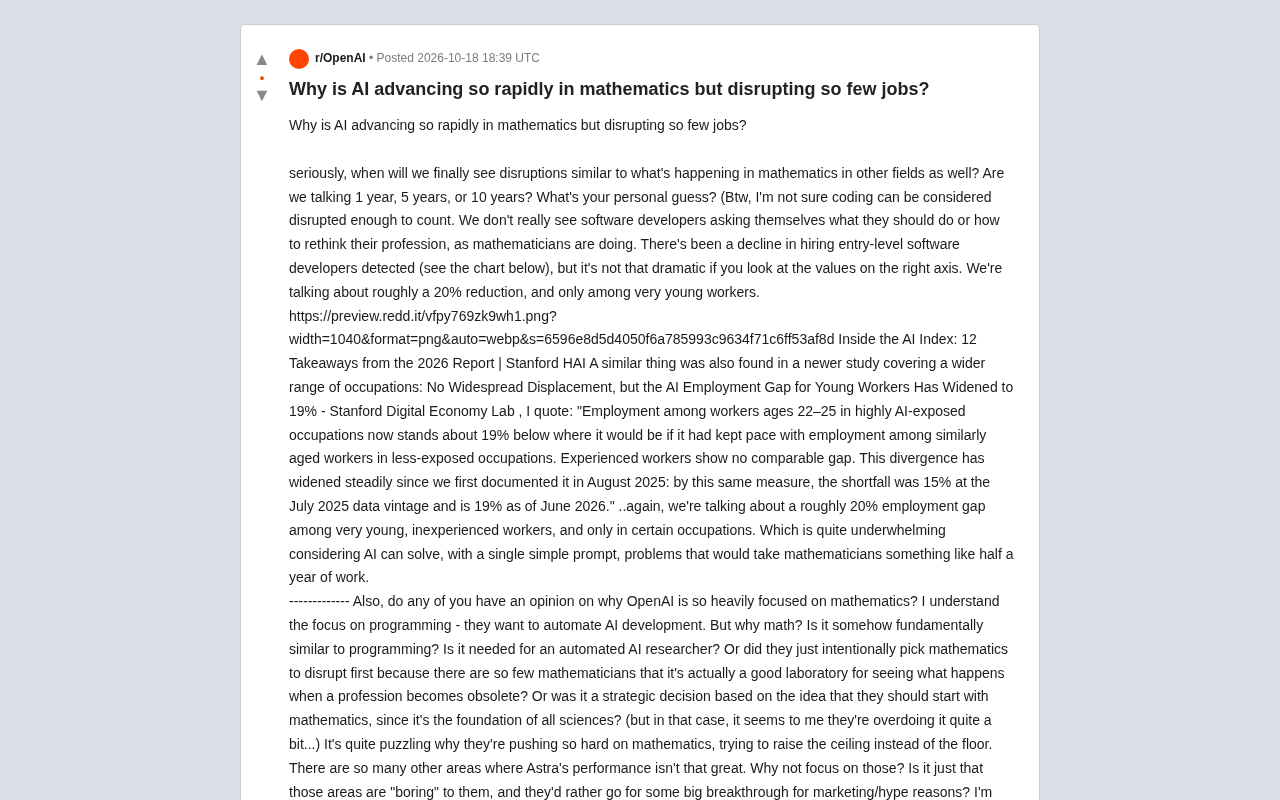
This question deserves serious attention because it strikes at the most fragile link in the current AI narrative. Tech companies constantly hint that artificial general intelligence is imminent, and breakthroughs in math are packaged as the prelude to an intelligence explosion—yet the daily experience of ordinary workers is far less dramatic. We need to unpack the structural reasons behind this mismatch rather than simply attributing it to "the time hasn't come yet."
Why Mathematics Became AI's "Showcase Window"
The Unique Nature of Math Problems
Mathematics became the preferred arena for demonstrating AI capabilities largely because of how its problems are structured. Mathematical proofs are verifiable—a proof either holds or it doesn't—which provides a clear reward signal for model training. By contrast, most occupational tasks lack such binary criteria. Writing a market analysis report, handling a customer complaint, designing a marketing plan—the "correctness" of this work is fuzzy and context-dependent, hard to evaluate automatically.
Equally important is the closed nature of math problems. All the necessary information for a math competition problem is contained in the problem statement; the model doesn't need to interact with the outside world to solve it. Real-world occupational problems are often open: information is incomplete, goals conflict, and stakeholders must negotiate. This closedness makes math an ideal "laboratory environment," but precisely limits how well its conclusions transfer to the real world.
Verifiability in the context of AI training specifically means: the system can automatically and objectively determine whether an output is correct, thereby providing a reward signal for reinforcement learning or self-play. Mathematical proofs, code unit tests, and Go wins and losses all fall into this category, while writing quality, consulting advice, and management decisions lack such a determination mechanism. A key driver behind the recent leaps in large model capabilities is precisely the scaling of verifiable tasks—with formal proof assistants (such as Lean and Isabelle) automatically checking every step of a derivation, models can improve themselves through massive trial and error. This also explains why math and programming have become the frontier of capability demonstrations, while equally important commonsense reasoning and social negotiation progress slowly: it's not that the models aren't smart, but that there's a lack of cheap, reliable "judges of right and wrong."
OpenAI's Strategic Choice: Raising the Ceiling Rather Than the Floor
The original Reddit post makes a sharp observation: OpenAI has invested heavily in math, "trying to raise the ceiling rather than the floor." This judgment deserves deeper analysis. One reasonable explanation is that math capability is the infrastructure for building an automated AI researcher. If AI can autonomously propose conjectures, prove theorems, and verify results, then it may be able to accelerate the process of AI research itself—a self-reinforcing flywheel.
Another explanation is more sociological: the math field has few practitioners, concentrated discourse power, and quantifiable outcomes, making it an ideal sample for observing "what happens when an occupation is hit by AI." Even if the math world were completely reshaped, its social impact would be relatively manageable. This "low-risk experimental ground" logic may explain the prioritization of resource allocation better than a purely scientific-fundamentals argument.
Automated AI researcher refers to an AI system capable of autonomously completing the components of machine learning research, including proposing hypotheses, designing experiments, writing and running code, analyzing results, and iterating for improvement. The core logic of this vision is recursive self-improvement: if AI can accelerate AI R&D itself, the pace of capability gains could break free from the productivity constraints of human researchers. Math is viewed as the cornerstone of this path because theorem proving provides the strictest verifiable feedback, capable of training a model's long-horizon reasoning and search abilities—abilities that can transfer to research components such as algorithm design and code optimization. It should be noted that this vision is still in an early experimental stage, with a clear gap remaining before end-to-end replacement of human researchers, but it does help explain why leading labs are willing to devote disproportionate resources to math benchmarks.
Why the Job Market Is "Unmoved": The Truth Behind the 19% Gap
The Data Itself Doesn't Support the "Massive Disruption" Narrative
The Stanford data cited in the original post deserves careful scrutiny: the employment gap for workers aged 22–25 in occupations highly exposed to AI widened from 15% in July 2025 to 19% in June 2026. That sounds significant, but it needs to be understood in context. First, it affects only very young, inexperienced workers; second, the gap is relative to "workers of the same age in low-exposure occupations," not an absolute decline in employment numbers.
More critically, experienced workers show no comparable employment gap. This suggests that AI's current impact on employment is more like squeezing entry-level positions than wholesale occupational replacement. Firms may reduce hiring of junior employees because AI can handle some basic work, but the value of senior employees—judgment, client relationships, organizational knowledge—has not been effectively replaced. This "narrowing entrance" effect has appeared in many historical technological transformations, but it has often been accompanied by the creation of new jobs, just with a time lag.
The Gap Between Math Capability and Occupational Tasks
Strong mathematical reasoning does not mean AI can handle the core tasks of most occupations. Take software development: the original poster astutely notes that programmers have not begun reflecting on the existential threat to their profession the way mathematicians have. Although junior developer hiring has declined (by about 20%), the core challenges of software development—understanding vague requirements, weighing architectural trade-offs, aligning team consensus—are precisely what current AI is worst at.
This gap stems from differences in task decomposability. Math problems can be cleanly decomposed into definitions, lemmas, and proof steps, with clear verification criteria for each subtask. Occupational tasks are often entangled: reviewing a legal contract involves fact-finding, risk assessment, client communication, and business judgment—these elements are interdependent and cannot be linearly decomposed like a mathematical proof. AI's progress in math reflects more the increased computability of specific task types than a breakthrough in general intelligence.
The Timeline Debate: 1 Year, 5 Years, or 10 Years?
Back to the original post's most direct question: how long until substantial job disruption? Based on the available evidence, an honest answer is: there will be no disruptive shock like that in math in the short term (1–2 years); structural changes may emerge in the medium term (3–5 years), but the threshold for full disruption is far from being reached.
There are three reasons for this judgment. First, AI's breakthroughs in math rely heavily on verifiable reward signals and closed problem spaces, conditions that are hard to replicate in most occupations. Second, institutional inertia—hiring processes, professional certification, legal liability, organizational culture—significantly slows the pace of technological replacement. Third, historical experience shows that the employment impact of general-purpose technologies often takes decades to fully manifest; electricity and computers both went through similar time spans.
But this doesn't mean we can rest easy. The 19% employment gap among young workers is already a warning signal worth heeding: disruption may not appear in the form of "occupations disappearing" but rather quietly through "closing entrances." If the younger generation cannot accumulate experience through entry-level positions, the long-term talent pipeline will be eroded—an impact far deeper than short-term unemployment figures.
Conclusion: The Mismatch Itself Is the Most Important Signal
The mismatch between AI progress in math and the relative calm of the job market should not be simplistically read as "AI is overhyped" or "disruption is imminent." It more accurately reveals the shape of current AI capabilities: excellent in closed, verifiable, well-defined domains; slow in open, ambiguous, negotiation-heavy domains. Understanding this shape is more valuable than debating timelines.
For practitioners, a meaningful response strategy is not to wait for disruption to arrive, but to identify which parts of their work are "math-like" verifiable tasks and which are "occupational" entangled tasks, and to shift effort toward the latter. For policymakers, focusing on the narrowing of entry points for young workers may be more urgent than responding to imagined mass unemployment. The tremors in mathematics deserve attention, but the silence of the job market is also telling an important story.
One-line Summary
AI math capabilities are soaring yet haven't disrupted jobs—the root cause lies in the difference between closed, verifiable tasks and open, entangled ones.
Paragraph Summary
The article responds to a core confusion on Reddit: why is AI advancing so rapidly in mathematics while disrupting so few jobs? The author points out that math problems have verifiability and closedness, providing clear reward signals for model training, which makes them an ideal showcase window for AI capabilities—and also explains why OpenAI's heavy bet on math may be aimed at building an automated AI researcher. On the job market side, Stanford research shows a 19% employment gap for workers aged 22–25 in occupations highly exposed to AI, but senior workers have not seen a comparable impact, with the effect appearing as a narrowing of entry-level positions rather than occupational replacement. The author argues that no disruptive shock will occur in the short term, but the long-term impact of narrowing entry points for young workers deserves vigilance—the mismatch itself reveals the shape of current AI capabilities.
Related articles

Amphibious Transforming Drone: Beyond 100x Power Savings, What Are the Real Needs?
Is the amphibious transforming drone just a gimmick? Starting from the 100x power difference of the M4 Morphobot, explore real application scenarios and thesis topic ideas, analyzing boundary conditions where pure drones and pure ground robots both fail.

Warhound Raises $200 Million: Genetically Engineered "War Dogs" Paired with Anduril Gear
Warhound raises $200M, backed by Ben Lamm and Palmer Luckey, to genetically engineer dogs for military and law enforcement use and equip them with Anduril gear. This article analyzes its technology direction, funding logic, and ethical controversy.

Claude API Comes to Google Cloud: IAM Integration and SDK Access Guide
Anthropic hosts the full Claude API on Google Cloud with IAM-controlled permissions and unified billing. This guide covers the Vertex AI and Anthropic-hosted entry points, IAM role configuration, and SDK access.