AI Model Delayed Two Months and Still Can't Beat Opus? The Battle Between Release Cadence and User Expectations

Why AI model delays are high-stakes gambles when benchmarks keep moving faster than development cycles.
A Reddit discussion about an AI model delayed by two months yet still unable to match Claude Opus highlights key industry challenges: the benchmark drift effect where competitors advance during delays, diminishing marginal returns in model performance improvement, and the critical importance of user expectation management. The piece explores why delays amplify risk in AI's rapid iteration environment.
The AI Community's Anxiety: Expectations and Disappointment Behind Delays
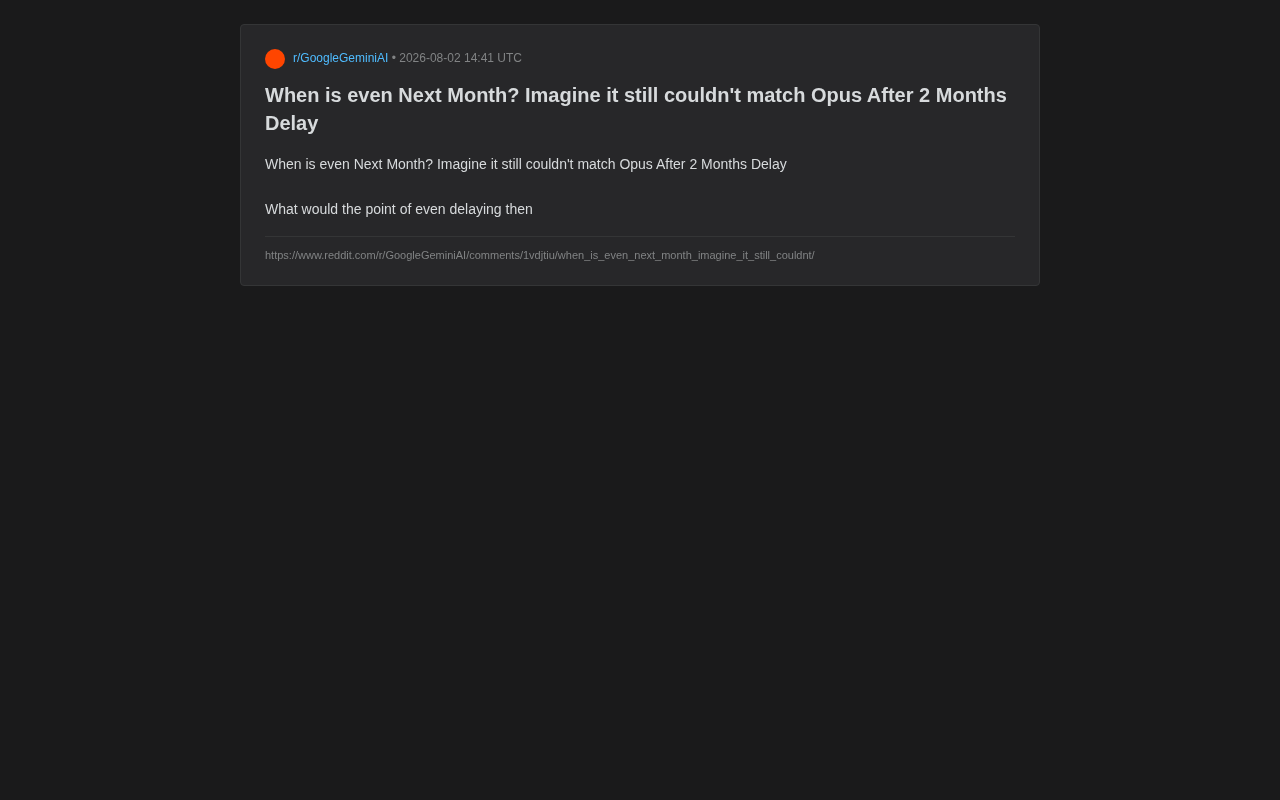
Recently, a Reddit discussion about AI model release delays sparked widespread attention. The poster asked with a somewhat sarcastic tone: "When exactly is 'next month'? If it still can't match Opus after a two-month delay, what's the point of delaying?"
This brief yet pointed comment reflects a prevalent sentiment in the current AI community: anxiety over model release cadence and ever-escalating performance expectations. When industry-leading models (such as Anthropic's Claude Opus series) continuously raise the bar, any delayed model faces even harsher scrutiny.
Why "Delay" Has Become a Sensitive Word in the AI Industry
Delays Should Mean Higher Quality
In traditional software development logic, delayed releases are often seen as a sign of responsibility — developers choosing to spend more time polishing a product rather than rushing out a half-baked version. Legendary Nintendo producer Shigeru Miyamoto once said, "A delayed game is eventually good, but a rushed game is forever bad," a philosophy long upheld as gospel in the tech industry. However, in the realm of large AI models, this logic is facing unprecedented challenges.
The poster's core challenge lies precisely here: if a model is delayed by two months and the final delivered performance still can't surpass an existing competitor (like Claude Opus), then that extra waiting time loses its meaning. The implicit user expectation is that delays should result in a qualitative leap, not merely catching up or still falling behind.
The "Benchmark Drift" Effect from Rapid Iteration
The most unique challenge in the AI industry is that the benchmark itself is rapidly moving. When one company announces a delay of several months to refine its model, competitors may have already completed a new round of iteration. This means the delayed model, upon release, may no longer face the competitor it was originally benchmarked against, but rather a more powerful new version.
This "benchmark drift" effect is particularly pronounced in AI. Taking the 2023-2024 industry development as an example, less than a year after GPT-4's release, Claude 3, Gemini Ultra, and other models launched in succession, with new capability boundaries being broken every few months. While Moore's Law in traditional hardware operates on roughly an 18-month cycle, the current capability iteration cycle for large AI models has shortened to 3-6 months. This means if a model is delayed by half a year, the competitive landscape it faces may have already undergone 1-2 major update cycles — equivalent to having to prove itself in an entirely different arena.
This effect significantly amplifies the risk of delayed releases. The longer you wait, the further away the target becomes, ultimately falling into the awkward position of being "perpetually half a step behind." For any team hoping to stay competitive in the AI race, this is a strategic risk that cannot be ignored.
Understanding AI Model Competition Through Community Sentiment
Why Claude Opus Has Become the Performance Reference Point
Here's a telling detail: the poster used Opus as the measuring stick, which in itself speaks volumes. Anthropic's Claude Opus is the flagship version of its model family, positioned to handle the most complex reasoning, analysis, and creative tasks. Anthropic was founded in 2021 by former OpenAI Research VP Dario Amodei and others, with "AI safety" as its core research philosophy. Its model naming system borrows from musical terminology — Haiku (lightweight and fast), Sonnet (balancing performance and speed), Opus (large-scale work, highest performance) — a clearly tiered product line that reflects precise positioning for different use cases.
The Claude Opus series has built a strong reputation in reasoning ability, code generation, and complex task handling, with particularly outstanding performance in long-context understanding, multi-step reasoning, and code generation. It has become the performance baseline in the minds of many developers and researchers. When a model is compared against Opus and deemed "still unable to match it," this reflects the community's clear recognition of first-tier models. In this highly competitive market, "being able to stand alongside top models" has become the minimum passing grade, not an achievement to be proud of.
The Importance of Expectation Management
This discussion also reveals the dilemma AI companies face in expectation management. Once a delay is publicly announced, it signals to the community that "we're working on something better," thereby raising users' psychological expectations. If the final delivery fails to meet these elevated expectations, the backlash of disappointment will be more intense than if a mediocre product had been released on time.
Failed expectation management is not an isolated case in the AI industry. Since 2023, multiple companies have faced community backlash from over-hyping before model releases — such as Google Gemini's early demo video being questioned for exaggerating actual capabilities, and several companies' implied next-generation model progress being severely misaligned with actual release timelines. The psychological "anchoring effect" plays a key role here: when users are told "we need more time to make it better," they automatically anchor their expectations at "far exceeding the current best." Any result below this anchor point will be perceived as failure, even if the product has objectively made significant progress.
This is why more and more AI companies are becoming cautious with their release strategies — over-promising and frequent delays can both damage brand credibility and user trust. Some companies have begun adopting a "silent development, surprise release" strategy to avoid the expectation inflation that comes with prolonged hype periods.
The Delay Dilemma: Deeper Challenges in AI R&D
Diminishing Marginal Returns in Large Model Performance
From a technical perspective, behind the poster's complaint may lie a deeper reality: large model performance improvement is encountering diminishing marginal returns. This phenomenon is closely related to Scaling Laws. OpenAI's groundbreaking 2020 paper revealed that model performance follows a power-law relationship with parameter count, data volume, and compute — achieving linear performance gains requires exponentially more resources. For example, the capability leap from GPT-3 to GPT-4 required more than 10x the computational resources.
In the early stages, scaling up model size and data could bring significant capability leaps; but as models mature and reach trillion-parameter scales, simply "throwing more resources at it" can no longer achieve qualitative breakthroughs. Researchers need to explore new architectural designs, training methods (such as RLHF — Reinforcement Learning from Human Feedback, DPO — Direct Preference Optimization), or data strategies (such as high-quality synthetic data) to find incremental improvements. This makes each step of improvement more time-consuming and uncertain.
This means that even if a company sincerely invests two months in optimization, it may not yield the "crushing" improvement users expect. This gap between R&D realities and user expectations is the real dilemma facing many AI teams today.
The Value of Transparent Communication
Facing such challenges, AI companies may need to communicate more transparently with the community. Rather than simply promising "release next month" or "delaying for perfection," it would be better to clearly explain the specific reasons for delays, current progress, and reasonable performance expectations. Vague timelines ("when exactly is 'next month'?") only exacerbate community speculation and dissatisfaction.
In fact, some AI research institutions have already begun experimenting with more open development models — building trust through regular technical reports, public benchmark results, and even inviting community participation in testing. Meta's LLaMA series chose the open-source path, and while it faces different challenges, it has set a certain standard in transparency. While this approach may expose short-term shortcomings, in the long run it helps build healthier developer-user relationships.
Conclusion: The Art of Waiting and Rebuilding Trust
Though brief, this Reddit post precisely captures a pain point in the current AI industry: in an environment of rapid iteration and fierce competition, any delay is a high-stakes gamble.
For AI developers, the lesson is clear — the delay itself isn't the problem; the problem is whether the delay can deliver higher value. If not, frequent timeline adjustments will only continuously erode user patience and trust.
In this ever-changing AI landscape, the balance between "faster" and "better" will continue to test the strategic wisdom of every participant. And for the broader user community, maintaining rational expectations may be a rare form of clarity in this era of breakneck progress. When we understand the objective limitations imposed by Scaling Laws and the harsh reality of benchmark drift, perhaps we can view each delay more rationally — it's neither an excuse for complacency, nor should it be burdened with excessive expectations.
Related articles

Workbuddy for Absolute Beginners: How a Desktop AI Agent Fits Into Real Workflows
A beginner's guide to the Workbuddy desktop AI agent: installation, claiming credits, file management, and building automated workflows—compared with CodeX for fit and cost, helping professionals shift from AI question-askers to AI managers.

OpenAI's New Agent Stack: Computer Use, Decisions API, and Ultra-Fast Workflows
OpenAI Dev Day unveiled a new agent stack: Computer Use outperforms humans, Decisions API delivers ultra-low-latency classification via Luna, Agents API opens the same Computer Use capabilities, and GPT-6.1 Sol costs only one-seventh of Astra. Core updates, benchmark data, and developer insights.

Liang Wenfeng Open-Sources DeepInfo Inference Framework, Takes On U.S. Ban
DeepSeek open-sources its DeepInfo inference framework after its models, featuring GPU/CPU cross-pipelining, small-model prediction with large-model verification, and full Huawei Ascend and NVIDIA chip support—facing the U.S. federal ban head-on. This article analyzes its significance for AI deployment and open-source strategy.