AI-Native Design in Practice: Lessons from NVIDIA's TensorRT Model Connect

NVIDIA's four AI-native engineering principles for building codebases designed for coding agents.
NVIDIA has shared engineering lessons from its open-source TensorRT Model Connect project, which was designed from the start with coding agents as first-class users. Rather than organizing code around human readability, this AI-native approach treats an agent's ability to operate safely within a limited context window as the core constraint. The four guiding principles are: parallel work through well-defined task boundaries; model-family isolation to shrink agent context; reversible changes to lower the cost of AI mistakes; and GPU-backed validation to confirm that generated optimizations work on real hardware.
NVIDIA recently shared a series of lessons learned from building the open-source project TensorRT Model Connect. What makes this project distinctive is that it was designed from the ground up for coding agents — not the traditional software engineering model where human developers are the sole users. This "AI Native by Design" philosophy is reshaping how large engineering teams organize codebases, validate changes, and manage collaboration.
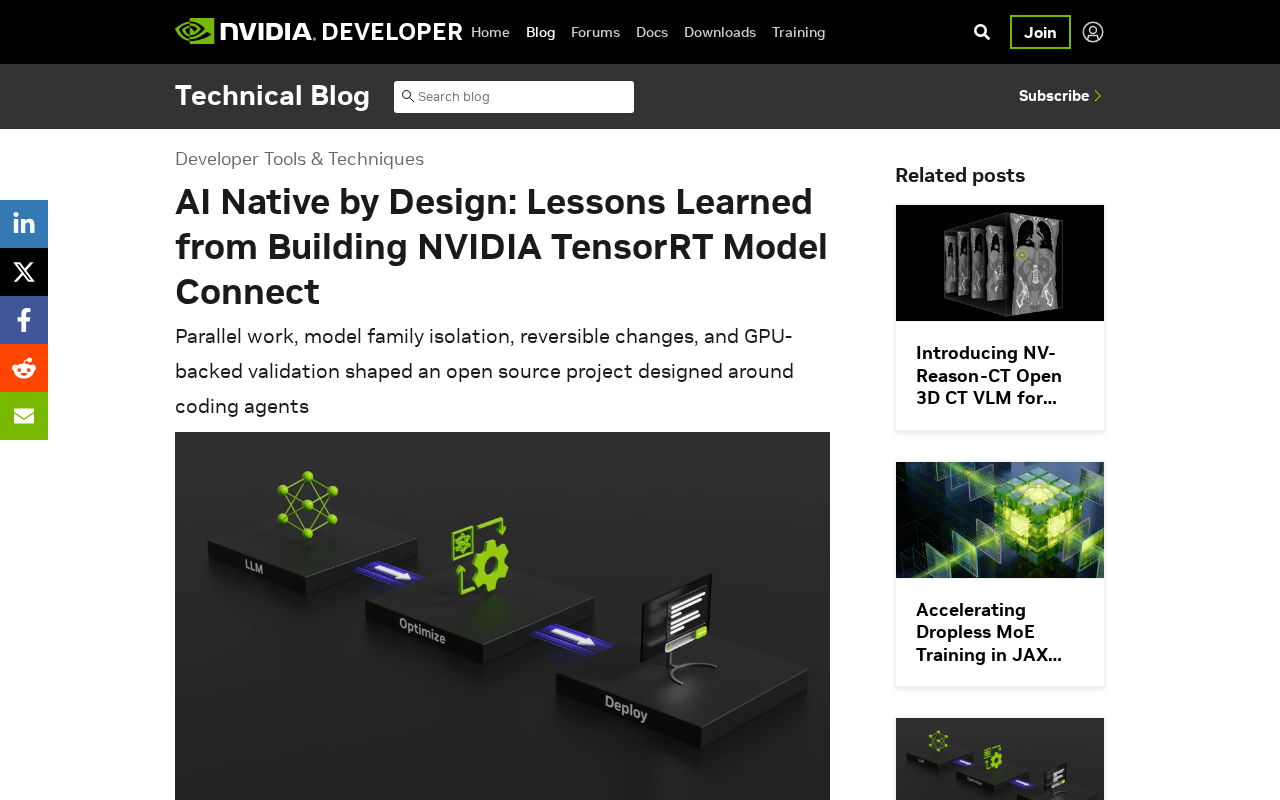
What Is "AI-Native Design"?
Traditional software project structures are primarily designed to make code easier for human engineers to read, understand, and maintain. As more day-to-day coding work is handed off to AI agents, however, the way codebases are organized needs to be rethought.
At its core, AI-native design treats "whether an agent can operate on code efficiently and safely" as a first-class constraint. In other words, directory structure, module boundaries, and change workflows are all designed around helping AI make correct decisions within a limited context window — not just accommodating human reading habits.
In NVIDIA's work on TensorRT Model Connect, this philosophy was distilled into four concrete engineering principles: parallel work, model-family isolation, reversible changes, and GPU-backed validation.
A "coding agent" refers to an AI system capable of autonomously understanding task descriptions, generating or modifying code, invoking tools, and performing multi-step reasoning. Notable examples include GitHub Copilot Workspace, Devin, and Claude Code. Unlike traditional code completion tools, coding agents can independently handle complete units of work — from requirements analysis to code commits. However, mainstream large language models are subject to "context window" limits: the maximum amount of text a model can process in a single inference pass (ranging from tens of thousands to hundreds of thousands of tokens). Once a codebase exceeds this limit, the agent can only see a partial view and is prone to making mistakes based on incomplete context. Managing how much information an agent needs to perceive at any one time is therefore one of the central challenges of AI-native design.
Four Core Engineering Principles
Parallel Work
TensorRT Model Connect needs to support a large number of different models. If all changes had to be made serially, throughput would become a bottleneck. By carefully defining task boundaries, the project enables multiple coding agents (and human developers) to work simultaneously on different parts of the codebase without interfering with each other.
Parallel capability is especially critical for AI agents — they excel at rapid iteration within well-defined, independent scopes. The moment tasks are implicitly coupled, conflicts and hard-to-trace bugs become far more likely.
Model-Family Isolation
Different model families often have vastly different optimization and deployment logic. The project enforces strict model-family isolation, confining each family's code and configuration within clearly defined boundaries.
This isolation delivers two benefits: it reduces the risk of an agent accidentally modifying one model while working on another, and it shrinks the context an agent needs to understand — allowing it to make more reliable changes within a more focused scope. For large language models with limited context windows, reducing the problem domain is itself a key lever for improving accuracy.
Reversible Changes
AI agents will inevitably make mistakes. TensorRT Model Connect is designed to make every change as "reversible" as possible — so that when a modification turns out to be problematic, it can be rolled back quickly and cleanly without leaving behind hard-to-clean side effects.
Reversibility is essentially a safety net for AI-generated code. It acknowledges the inherent uncertainty in agent output and uses engineering design to keep the cost of mistakes within acceptable bounds. This contrasts with the traditional model of relying on manual code review as the primary safety backstop.
GPU-Backed Validation
For a deep learning inference optimization project, unit tests and static analysis alone are nowhere near sufficient. TensorRT Model Connect incorporates a validation step that runs on real GPUs, ensuring that the optimization changes made by agents actually work on physical hardware and don't cause performance regressions.
This is especially important: AI agents can generate code that looks perfectly reasonable, but only by running it on a real GPU and meeting expected performance targets can you confirm a change is actually correct. GPU-backed validation provides the ultimate "source of truth" for the entire AI-native workflow.
TensorRT is NVIDIA's deep learning inference optimization library. Its core function is to convert trained neural network models into highly optimized inference engines for NVIDIA GPUs, dramatically boosting inference speed and reducing memory usage through techniques like operator fusion, precision calibration (e.g., FP16/INT8 quantization), and automatic kernel tuning. Because TensorRT's optimization process is deeply tied to specific GPU architectures (such as Ampere and Hopper), the same optimization code can behave very differently across hardware configurations or precision settings. This means that for projects like this, static analysis or CPU-side logic verification simply cannot catch real-world performance regressions or numerical precision issues. GPU-backed validation is therefore not a nice-to-have — it is a necessary condition for ensuring that AI-generated optimization code actually works in production.
Why These Lessons Matter
The significance of this approach extends well beyond TensorRT itself. It sketches out a new software engineering paradigm for the AI era:
- Context management becomes an architectural concern: Model-family isolation is fundamentally about managing the scale of an agent's context, enabling AI to make correct decisions from limited information.
- Fault tolerance over perfection: Reversible change design acknowledges that AI will make mistakes, and focuses instead on lowering the cost of those mistakes to keep the system robust.
- Validation must be grounded in reality: GPU-backed validation reminds us that AI-generated code needs to be tested in real environments — not just reasoned about on paper.
For engineering organizations hoping to introduce coding agents into their teams, NVIDIA's principles offer a practical reference framework — not for bolting AI onto existing processes as an add-on tool, but for redesigning at the architectural level so that codebases are naturally suited to human-AI collaboration.
Closing Thoughts
The value of TensorRT Model Connect lies not only in its ability to optimize and deploy large models, but in what it demonstrates about how to "design for AI." As coding agents become routine participants in software development, the four principles — parallel, isolated, reversible, and verifiable — may well become foundational vocabulary for the next generation of engineering practice.
Related articles

Random Pruning of the DPO Computation Graph: 1.4x Training Speedup and Lower Peak Memory
DPO training too slow and memory-hungry? This paper proposes a random pruning framework for the DPO computation graph, sampling independently across position, sequence, and branch dimensions; branch pruning achieves a 1.426x step-time speedup and cuts training time by about 30%, with in-depth attribution of memory and time gains.

Why Does JEPA Underperform MLM in Longitudinal EHR Representation Learning?
New study compares JEPA and MLM for longitudinal EHR representation learning on MIMIC-IV: three JEPA variants train stably without collapse but underperform MLM; target size, not heterogeneity, drives prediction error.

Transfer Learning + Visible Light Communication: A New Approach to Energy-Efficient Indoor Positioning
A study proposes a transfer learning-based visible light communication indoor positioning method, achieving 47% accuracy improvement on the BOSCH factory dataset, 67.5% model efficiency under high noise, and introducing the ME composite metric for energy-efficient positioning in energy-constrained industrial IoT scenarios.