AI-Native IDE Incognide Hits 500 Stars: A New Approach to Tools for Research Scenarios

Niche AI-native IDE Incognide hits 500 stars; its R&D-scenario positioning is worth unpacking.
The article discusses Incognide, an AI-native IDE that has reached 500 stars on GitHub, noting its explicit positioning for research and development rather than as a general-purpose coding assistant. It distinguishes the "AI-native" approach—designing AI as a foundational assumption of the editor—from the plug-in approach of layering capabilities onto mature editors. The author argues that R&D's process uncertainty, frequent context switching, and needs for traceability and information compression create differentiation space for a vertical IDE. However, the author cautions that the Hacker News post has only 3 points and 1 comment, so 500 stars is merely an early signal of usage and should not be overinterpreted; the material also lacks feature and architecture details, limiting judgments to the positioning level.
Starting from 500 stars: a niche but noteworthy AI-native IDE
On Hacker News, a project called Incognide announced that its GitHub repository had reached 500 stars. The post itself didn't generate much heat (3 points, 1 comment), but the positioning of "AI-native IDE for research and development" is worth unpacking—it doesn't package itself as a general-purpose coding assistant, but explicitly targets research and development scenarios.
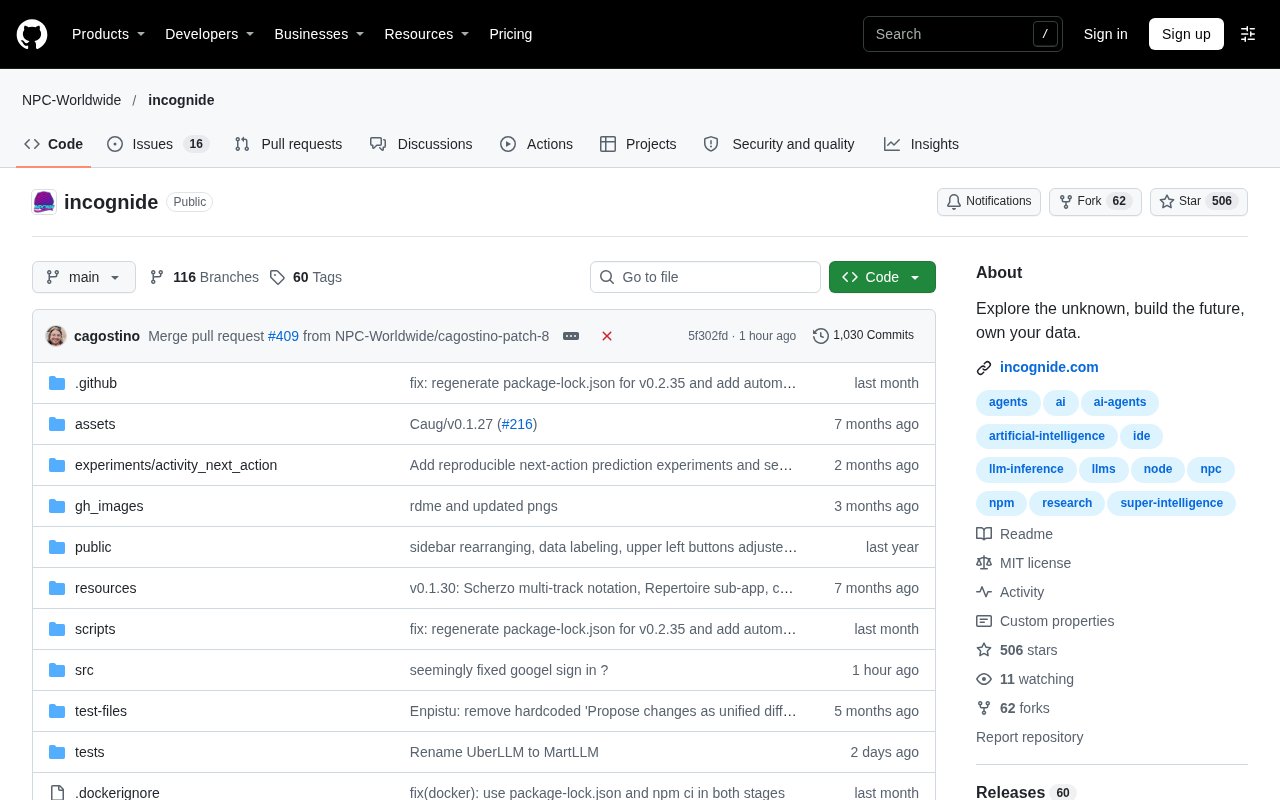
500 stars isn't an impressive number on GitHub, but for a vertically positioned tool, it represents initial validation of an early user base. The real question is: at a time when VS Code + Copilot, Cursor, JetBrains AI and other products have already occupied the "AI coding" mindshare, what differentiation can an AI-native IDE focused on research scenarios carve out?
What "AI-native" actually means
Most AI coding tools on the market take a "plug-in" approach: layering completion, chat, and refactoring capabilities on top of mature editors. Users keep their existing workflows, and AI is an add-on.
Incognide's "AI-native" phrasing suggests a different approach—designing with AI capabilities as a foundational assumption of the editor rather than an afterthought. For research and development scenarios, this distinction has practical significance: R&D work often involves experimental scripts, data analysis, and alternating output of documents and code, rather than pure feature implementation. If an IDE is architecturally premised on "human-AI collaboration to complete exploratory tasks," its interaction patterns may differ markedly from traditional code editors.
It should be noted that the original material only provides the project's positioning description, without disclosing specific feature lists, model integration methods, or architectural details. Therefore, what's discussed here is differentiation at the positioning level, not proven product capabilities.
Plug-in vs. AI-native
Plug-in architecture refers to mounting functional modules on top of an existing editor core through public extension APIs, typically as separate processes or sandboxes—VS Code's Extension Marketplace being a classic example. Its advantages are a thriving ecosystem and decoupled iteration; the cost is that AI capabilities are constrained by the interfaces the host exposes, making it difficult to deeply介入 cursor context, buffer scheduling, multi-file semantic indexing, and other low-level aspects. AI-native is the opposite: model invocation, context assembly, and session state are built in as first-class citizens, and the editor architecturally assumes that "every operation may be initiated by a human or a model." This distinction manifests in engineering terms as: AI-native IDEs can directly control retrieval granularity, tool-call chains, and undo/replay mechanisms, while plug-ins can often only "observe" edit events. For R&D scenarios, this means AI can proactively organize experimental context rather than passively waiting for user questions.
Why "research scenarios" deserve a dedicated IDE
Research and development share a common characteristic: the process is uncertain—requirements take shape through exploration, and code is the vehicle of experimentation rather than the deliverable itself. This kind of work has different tool requirements from product-grade software development:
- More frequent context switching: jumping between notebooks, scripts, literature, and data
- Greater emphasis on traceability: the experimental process needs to record "why this was tried"
- Greater reliance on AI for information compression: quickly understanding unfamiliar libraries, papers, or datasets
General-purpose IDEs cover these needs in a fragmented way, usually pieced together with plug-ins. An AI-native environment designed from the ground up for research scenarios could theoretically converge these aspects into a unified interface. This is also the reasonableness of Incognide's positioning—not competing head-on with general-purpose IDEs, but capturing a niche scenario.
Provenance and experiment records
In scientific research and data exploration, provenance refers to fully recording "where a result came from": which dataset was used, which version of the script, which parameters, and at which step human judgment was applied. It differs from version control in software engineering—Git records code snapshots, whereas the R&D process also needs to record intent, hypotheses, and abandoned branches. The chaotic cell execution order and hard-to-reproduce hidden state of Jupyter Notebook are typical manifestations of this unmet need. Ideal support would include: automatically capturing the environment and dependencies of each run, associating natural-language hypotheses with code changes, and supporting "fork and rerun from any step." This is precisely the area that general-purpose IDEs struggle to fill with plug-ins, and where vertically focused AI-native environments may differentiate themselves.
The signal and noise behind 500 stars
A Hacker News post with 3 points hardly constitutes community heat, and 1 comment cannot reflect real discussion. Treating 500 stars as "success" is clearly overinterpretation; but treating it as a signal that "someone is using it" is reasonable.
For developers, such early-stage projects are worth watching but not worth hastily migrating one's primary workflow—the survival risk of tool projects, data migration costs, and ecosystem maturity are all practical factors. For teams building tool products, Incognide's positioning strategy offers an observational sample: at a stage where the AI coding track is highly crowded, segmenting the market by work scenario rather than by programming language or editor form may still leave room.
The material does not provide feature details, tech stack, or future roadmap of the project, so the judgments in this article are limited to the positioning level. Whether the project can turn "AI-native" from a slogan into an experiential difference remains to be seen with more complete product information.
One-line Summary
Niche AI-native IDE Incognide reaches 500 stars; its research-scenario positioning is worth unpacking.
Paragraph Summary
The article centers on Incognide, an AI-native IDE that has reached 500 stars on GitHub, noting that its positioning explicitly targets research and development scenarios rather than being a general-purpose coding assistant. The author distinguishes between the "AI-native" and plug-in approaches: the former designs AI as a foundational assumption of the editor, while the latter merely layers capabilities onto mature editors. The article argues that the process uncertainty of R&D work, frequent context switching, and needs for traceability and information compression constitute the differentiation space for a vertical IDE. At the same time, the author cautions that the Hacker News post has only 3 points and 1 comment, so 500 stars is merely an early signal that "someone is using it" and should not be overinterpreted; moreover, the material lacks feature and architecture details, so judgments are limited to the positioning level.
Related articles

A 19-Year-Old's Rental Horror Story: Ceiling Collapse, Bug Infestation, and the Lessons It Taught Me
At 19, my first off-campus rental brought bug infestations, no heat, a collapsed ceiling, and a ruined laptop with no renter's insurance. Here are the hard-won lessons for first-time student renters.

Veda Nurse's Cranial Nerve Exam: Why ASMR Role-Play Is Going Viral
Bilibili creator Veda's cranial nerve exam ASMR video goes viral, blending humor and sensory triggers through nurse role-play. This article analyzes its unique appeal and the audience psychology behind ASMR role-play.

LG Cinebeam AI Review: 120-Inch Giant Screen + 3000 Lumens, a New Choice for the Living Room Theater
LG Cinebeam AI projector review: 3000 ANSI lumens, 4K, 100 inches from about 8 cm and 120 inches from about 18 cm. Built-in webOS, AI Concierge voice recommendations, AI Sound Pro 11.1.2 virtual surround, and Game Optimizer—positioned for fixed living room installation, complementing the portable Cinebeam S.