AI News Roundup: DeepSeek Desktop App, Claude Sonnet 5.5 Secret Testing, OpenAI's $500 Pro Plan

Model iteration, pricing overhauls, and space compute converge in a packed week for AI.
A busy week across the AI industry: Claude Sonnet 5.5 entered closed partner testing with impressive code and creative generation demos, MiniMax M3.1 completed public testing under the "Space Bunny" stealth alias on OpenRouter, and Opus 5.5 topped the Web Dev leaderboard at a 60% lower price than GPT-6. On the business side, a $500/month OpenAI Pro tier appeared, signaling a product line restructure. Infrastructure-wise, Google is set to launch its first orbital AI data center satellite, SoftBank closed a record $11.1B high-yield bond, and DeepSeek shipped a Node.js-free desktop app preview. A large-scale AI disinformation campaign targeting 374 major brands was also exposed.
The pace of updates in the AI industry is now being measured in weeks. From model releases to subscription tiers and infrastructure investments, this latest wave of developments sketches out a new competitive landscape among major players. Here's a breakdown of the key stories worth following.
DeepSeek Harness Desktop App Quietly Launches
DeepSeekAd Harness has released a developer preview of its official desktop app, version V0.17 RC2. Compared to the previous workflow — which required a Node.js environment and manually running NPX commands in a terminal — the desktop version eliminates those prerequisites and significantly lowers the barrier to entry.
The current release supports Windows X64 and macOS on Apple Silicon (M-series chips). Note that this is not yet an official release; it remains an early preview aimed at developers who want to try it early, and stability may vary.
OpenAI's $500/Month Pro Plan Spotted
A new $500-per-month Pro tier has been spotted on OpenAI's subscription page, with the tagline "Fastest Work and Codex." The phrasing suggests this tier is focused on speed and Codex coding capabilities.
It's currently unclear whether this plan offers meaningfully different usage limits compared to the existing $200/month plan — the only confirmed difference is faster response times. Interestingly, the $200 Pro plan appears to be unavailable for new subscriptions at the moment, suggesting OpenAI may be restructuring its premium product lineup.
Claude Sonnet 5.5 Enters Secret Testing
According to leaker Lira, Claude Sonnet 5.5 has entered closed testing with select partners, with 24-hour access granted. Its specs and pricing are said to be positioned against the recently released GPT-6, and Haiku 5.5 is expected to launch alongside Sonnet 5.5.
Leaked test outputs show Sonnet 5.5 generating a doodle-style FPS shooter game and a pixel-art cherry blossom pagoda, suggesting strong code and creative generation capabilities.
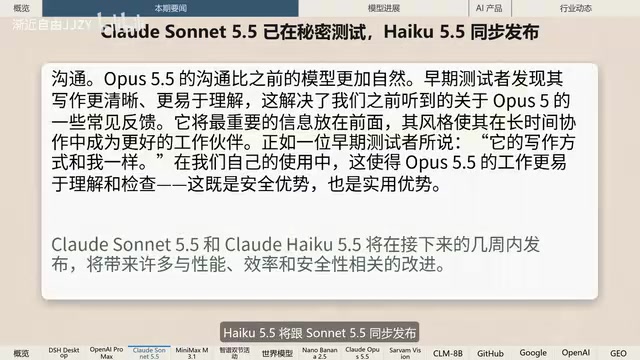
Beyond the gaming demos, tests also included a 60-second animation explaining "why the area of a circle is πr²" — a task that requires combining mathematical reasoning with visualization, hinting at notable improvements in complex multi-step generation.

MiniMax M3.1 Surfaces as a Stealth Model
The community has largely confirmed that the stealth model made available for free under the codename "Space Bunny" on OpenCode and OpenRouter for one week is in fact MiniMax M3.1. Related repositories and test configurations have been discovered, the model name has been confirmed as MiniMax M3.1, it supports ultra-long context, its reasoning tier is Max Reasoning, and references to it appear throughout MiniMax Code.
Given the pace of the stealth testing period, a formal launch is likely imminent once the stealth phase ends. M3.1 has demonstrated strong multimodal understanding across a broad range of test cases, including building a GPU fluid simulation in a single HTML file, recreating Minecraft in a single HTML file, mirrorless 3D dissection, photo-to-3D model generation, and building a playable 3D game with three.js.
What is a "Stealth Model"? A stealth model is a pre-release testing strategy that has emerged in the AI industry in recent years. Vendors anonymously or pseudonymously deploy their models on third-party platforms (such as OpenRouter or LMSYS Chatbot Arena), allowing users to interact with them without knowing the model's identity. This generates unbiased performance feedback and usage data, avoids public pressure before an official release, and surfaces edge cases through large-scale real-world usage — a broader testing surface than traditional internal A/B testing. OpenRouter, as a unified multi-model API platform with high traffic and a technically sophisticated user base, has become a popular channel for stealth testing.
Other Notable Model and Product Updates
Claude Opus 5.5 tops the Web Dev leaderboard. Opus 5.5 has claimed the top spot on Code Arena's Web Dev leaderboard with a score of 1818, reshaping the Pareto frontier with a 126-point improvement over Opus 5 — and at approximately 60% lower cost than the second-place GPT-6, making it a compelling value proposition.
Odyssey releases Agora 2. This next-generation multi-agent world model supports real-time interaction among up to 20 humans and agents in a shared environment, with no game engine underneath — everything is simulated in real time by the model, placing significant demands on real-time inference capabilities.
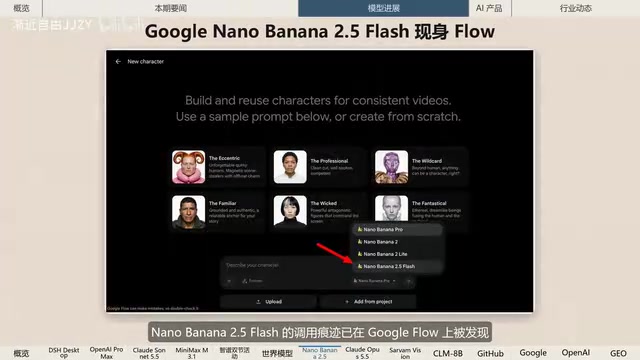
Nano Banana 2.5 Flash is close to launch. API call traces have been spotted on Google Flow, suggesting an official release is not far off.
Other model updates: Savam Vision 2.1 achieved an overall score of 87.3 on OmniOCR Bench, surpassing comparable competitors. The contrastive learning-driven CLM (Contrastive Language Model) has been released, with CLM 8B delivering inference speeds up to 9x faster than comparable models while maintaining competitive performance on computer use, gaming, and tool-calling tasks. Additionally, Zhipu GLM's Coding Plan double-holiday promotion has been extended to October 7, during which GLM 5.3 Flash is free with unlimited usage in select scenarios and Agent quotas are doubled.
Open Source & Infrastructure: Fuzzing Automation and Space Data Centers
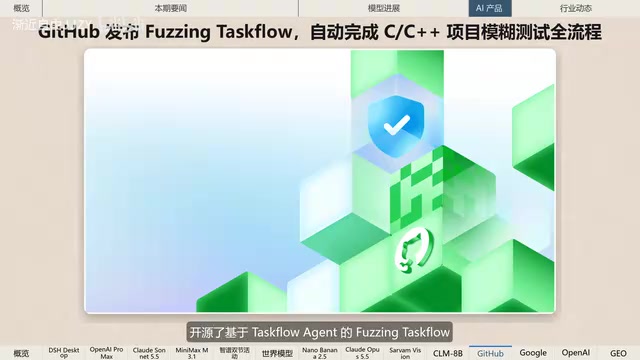
Antonio Morales from GitHub Security Lab has open-sourced a Fuzzing tool built on Taskflow Agent. Users simply point it at a GitHub repository, and it automatically identifies entry points, writes Harnesses, runs AFL++, reads coverage reports, and analyzes crashes — turning a previously tedious manual fuzzing workflow into an automated agent pipeline.
There are also major moves on the infrastructure side. Google will launch its first Project Suncatcher experimental satellite on October 1 via a rideshare on SpaceX's Falcon 9 Transporter 18 mission, with the goal of validating the feasibility of an orbital AI data center — the idea of moving compute into space is entering the engineering validation phase. On the funding side, SoftBank has completed an $11.1 billion bond issuance denominated in both USD and EUR, setting a record as the largest high-yield corporate bond issuance globally, with proceeds earmarked to support its investment in OpenAI.
What is Fuzzing? Fuzzing (fuzz testing) is an automated software security testing technique that feeds a program large volumes of random or semi-random inputs to trigger crashes, memory errors, or undefined behavior, thereby uncovering potential vulnerabilities. AFL++ (American Fuzzy Lop Plus Plus) is the most widely used coverage-guided fuzzing tool today; it uses instrumentation to track code execution paths and intelligently mutates input samples to maximize code coverage. Traditional fuzzing workflows require security researchers to manually write "Harnesses" (test driver programs that feed fuzz inputs to target functions) — a step that is time-consuming and requires deep knowledge of the target codebase. Introducing an AI Agent into the fuzzing pipeline automates the "identify attack surface → write Harness → analyze crash" chain that previously required manual intervention, significantly lowering the barrier to security auditing of open-source projects.
Security Alert: Disinformation Attacks Targeting AI
Security researchers have uncovered a large-scale AI disinformation attack targeting ChatGPT, Gemini, and Google AI Overview, with 374 affected companies identified — including well-known brands such as Delta, Lufthansa, Bank of America, and Airbnb. The effect of these attacks is causing AI systems to serve users with scam phone numbers and phishing links. As AI search and summarization becomes the primary way users access information, the impact of these "poisoning" attacks is being amplified, and developers and platforms should take them very seriously.
How these attacks work: This type of attack is generally known as "AI SEO Poisoning" or a variant of "Indirect Prompt Injection." Attackers create or tamper with large numbers of web pages to inject malicious content — fake customer service numbers, phishing links, etc. — into AI training data or real-time retrieval indexes, causing language models to output attacker-controlled content when answering queries like "What is XX company's customer service number?" Unlike traditional phishing, these attacks exploit the perceived authority of AI to lower users' guard — people are more inclined to trust "an answer from AI" than to click a suspicious link directly. As AI search summaries (such as Google AI Overview and ChatGPT Search) replace traditional blue-link results as the primary information entry point, a single successful poisoning attempt can influence millions of downstream queries, with a reach far exceeding traditional black-hat SEO tactics.
Summary
This batch of news centers on three main threads: rapid model capability iteration (Sonnet 5.5, MiniMax M3.1, Opus 5.5), repricing and restructuring of subscription and commercial models (OpenAI's $500 tier, GLM promotions), and deep changes at the infrastructure and security layers (space data centers, SoftBank's record bond issuance, AI disinformation attacks). Competition is no longer just about benchmark scores — it has expanded into a full-spectrum contest over cost, deployment accessibility, and security trust.
Related articles

"Black October": Did AI Uncover 3% of All Critical Vulnerabilities Ever?
A Reddit post claims 3% of all critical software vulnerabilities ever were found in the past month, dubbed 'Black October.' We break down the statistical issues, how AI-assisted code auditing accelerates discovery, and how developers should respond.

Microsoft Project Gecko: Using AI to Bridge Language Gaps for African Farmers
Microsoft's Project Gecko launches PharmaChat, letting African farmers ask questions in their native language and get precise video clips and farming book chapters via AI. The project also releases three interactive manuals to advance inclusive AI.

Musk's Space Dominance: How Starlink Throttling Undermines Ukraine's Defense
SpaceX's Starshield throttling disabled Ukraine's high-speed interceptor drones, exposing how Musk's private control over low Earth orbit communications affects battlefield dynamics and national security, and highlighting the risks of commercial space militarization and space governance dilemmas.