AI Panic Rattles Global Markets: Selloff Erupts After Midterm Elections
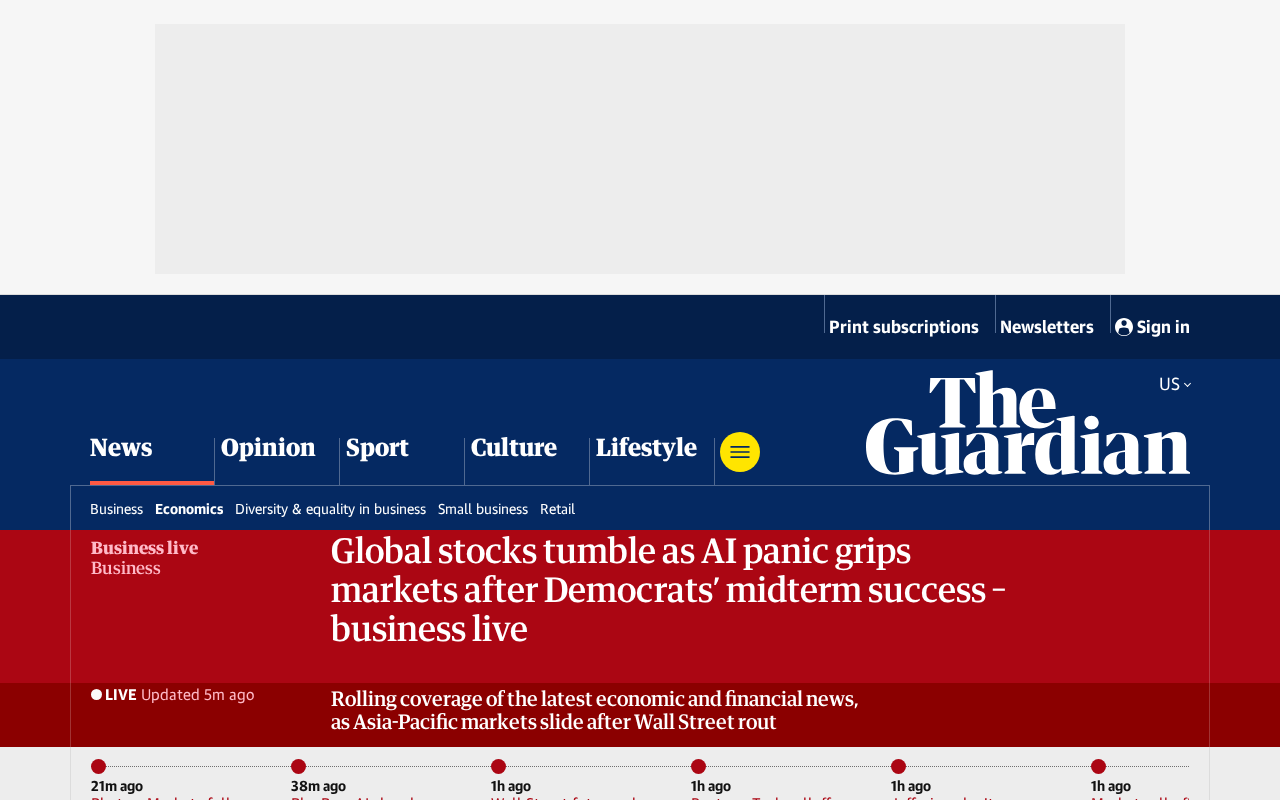
An HN headline pairs AI panic with the midterms, but data is thin and credibility is limited.
The article examines a Hacker News headline claiming global stocks tumbled due to AI panic and Democrats' midterm progress, but with only 12 points and zero comments it looks more like an algorithmically pushed news headline than real community discussion. It explains how AI anxiety transmits to markets via capex/return worries and the heavy index weighting of AI stocks, and how the midterms shift risk appetite through fiscal, regulatory, and subsidy expectations—likely parallel resonance rather than causation. It cautions against citing such headlines as market fact.
A Selloff Ignited by Politics and AI Sentiment at Once
A post on Hacker News has drawn attention: "Global stocks tumble as AI panic grips markets after Democrats' midterm success." The headline juxtaposes two threads—AI anxiety and midterm election results—and claims global stock markets fell sharply as a result. The post has only 12 points and 0 comments, which suggests it is less a deeply discussed technical topic in the community than a news headline pushed into the feed by an algorithm.
Structurally, the headline compresses three layers of meaning: global stocks experienced a selloff, the trigger was AI panic, and the timing followed Democrats' progress in the midterm elections. Whether the causal relationship among the three actually holds is not evidenced by the headline itself—and that is exactly what needs to be unpacked.
Why AI Panic Can Spill Over into the Stock Market
For some time now, market sentiment toward AI has been oscillating between "capex frenzy" and "anxiety over returns." When investors begin to doubt whether massive compute investments can translate into actual profits, any small disturbance can be amplified into a reason to sell. AI-related heavyweight stocks account for a considerable share of major indices, and a collective pullback in such stocks is enough to drag down the broader market, producing the "tumble" the headline describes.
At a deeper level, AI panic has a self-reinforcing narrative quality: the more capable the models become, the more the market worries that existing business models will be disrupted; the more companies emphasize AI transformation, the more investors demand to know where short-term profitability lies. This tension is especially easy to trigger during windows when clear earnings guidance is lacking.
"AI heavyweight stocks" refers to AI-related companies with massive market capitalizations that carry significant weight in major indices such as the S&P 500, including chip suppliers and hyperscale cloud platforms. Because mainstream indices are market-cap weighted, the price moves of such companies are multiplied in their impact on index levels. When a handful of giants together account for more than twenty percent of an index's weight, a collective pullback in their shares is enough to make the broader market appear to be in broad decline—even if most other individual stocks have not fallen. This is also the structural reason why "AI panic" can quickly transmit into a "global stocks tumble": fluctuations at the index level reflect more the valuation repricing of heavyweight stocks than a synchronized deterioration in overall economic fundamentals.
Why the Midterm Election Results Became a Market Variable
Democrats' progress in the midterm elections changed market expectations for fiscal policy, the pace of regulation, and the direction of industry subsidies. A shift in the political landscape does not point directly at the AI sector, but it does change risk appetite: when regulatory expectations tighten, high-valuation growth stocks tend to be hit first; when policy uncertainty rises, capital tends to withdraw from narrative-driven assets.
Juxtaposing a political event with AI panic is a common way of writing such headlines—it creates a dramatic sense of "two negative factors stacking." But the two threads are more likely parallel rather than causal: election results reshape macro expectations, AI anxiety suppresses sector valuations, and the two resonate within the same time window, amplifying both the magnitude of the decline and the volume of its传播—the loudness with which it spreads.
The U.S. midterm elections are held in November of the second year of a presidential term, with all 435 House seats and about one-third of Senate seats up for election. The results are typically seen as a "national referendum" on the sitting president's governance and directly determine which party controls Congress. Once control of Congress changes hands, the pace of advancing fiscal budgets, tax legislation, and industry regulation changes accordingly. For the market, the core variable in midterm elections is not who wins but whether there is "divided government": a divided Congress often means major legislation is blocked, policy predictability declines, and the direction of regulatory investigations and hearings may also shift. Growth sectors are especially sensitive to such expectation changes, because their valuations rely heavily on discounting future cash flows, and rising policy uncertainty directly raises the risk premium.
The Credibility of This Post Should Be Discounted
Objectively, the material itself contains quite limited information: no specific index levels, no magnitude of decline, no markets or institutional views involved, and no cross-validation in the comments. The low points and zero comments on Hacker News indicate that the technical community has not engaged in substantive discussion of the matter, and the post is closer to a collected news headline.
Therefore, citing it as a "market fact" is not prudent. A more reasonable interpretation is that it reflects a widely present emotional structure today—the AI narrative and the political cycle are intertwined, and fluctuations on either side are quickly priced in by the market. As for the specific magnitude of the decline and the causal chain, more complete market data and corroboration from multiple sources are needed.
Implications for Practitioners
For AI industry practitioners, this kind of news points to a reality: the technology narrative is already deeply embedded in capital markets, and model progress, regulatory direction, and political cycles together determine where resources flow. Short-term stock price fluctuations do not mean the technology roadmap has been rejected, but the financing environment and customer budgets will be genuinely affected.
For investors, treating a single headline as a basis for decisions is dangerous. Distinguishing "sentiment-driven fluctuations" from "fundamental changes" requires looking at earnings reports, capex guidance, and order data—not the adjectives in a headline. AI panic will recur, and what can survive it is still verifiable business value.
One-line Summary
An HN news headline juxtaposes AI panic with the midterms, but lacks data support and has limited credibility.
Paragraph Summary
The article analyzes a headline on Hacker News: it claims global stocks fell sharply due to AI panic and Democrats' midterm progress, but the post has only 12 points and zero comments, making it more like an algorithmically pushed news headline than substantive community discussion. The article notes that AI panic can transmit to the stock market because of market anxiety over AI capex and return realization, as well as the considerable weight of AI stocks in indices; the midterms affect risk appetite by changing expectations for fiscal policy, regulation, and subsidies. The two are more likely parallel resonance within the same time window than a causal stack. The article stresses that the original material lacks index levels, decline magnitude, and institutional views, and should not be cited as market fact, and reminds practitioners to distinguish sentiment fluctuations from fundamental changes.
Related articles
 Tech Frontiers
Stylome Bot Slammed as Useless Junk: Why Do AI Detection Tools Keep Failing?
Reddit users test the Stylome AI detection bot: Gemini-rewritten text judged human-written, consistently low confidence. An analysis of AI text detection's technical dilemmas, privacy concerns, and credibility crisis in community governance.
 Tech Frontiers
When AI Becomes a Productivity Divide: Clarity or "AI Psychosis"?
A civil engineer's deep use of agentic AI boosted efficiency but bred contempt for peers who refuse to learn. Is this clarity or AI psychosis? An analysis of the cognitive and psychological challenges behind the AI productivity divide.
 Tech Frontiers
Opus 5.5 Benchmark Scores Climb, Community Says Its "Weights Are Blessed"
Reddit community discusses Opus 5.5's rising scores on the Benchmaxxing Bench, with users describing its performance as "weights are blessed." This article interprets the community reaction and cautions against conflating benchmark scores with real capability.