AI Plans an Entire Vineyard: A Real-World Experiment with 100 Grapevines
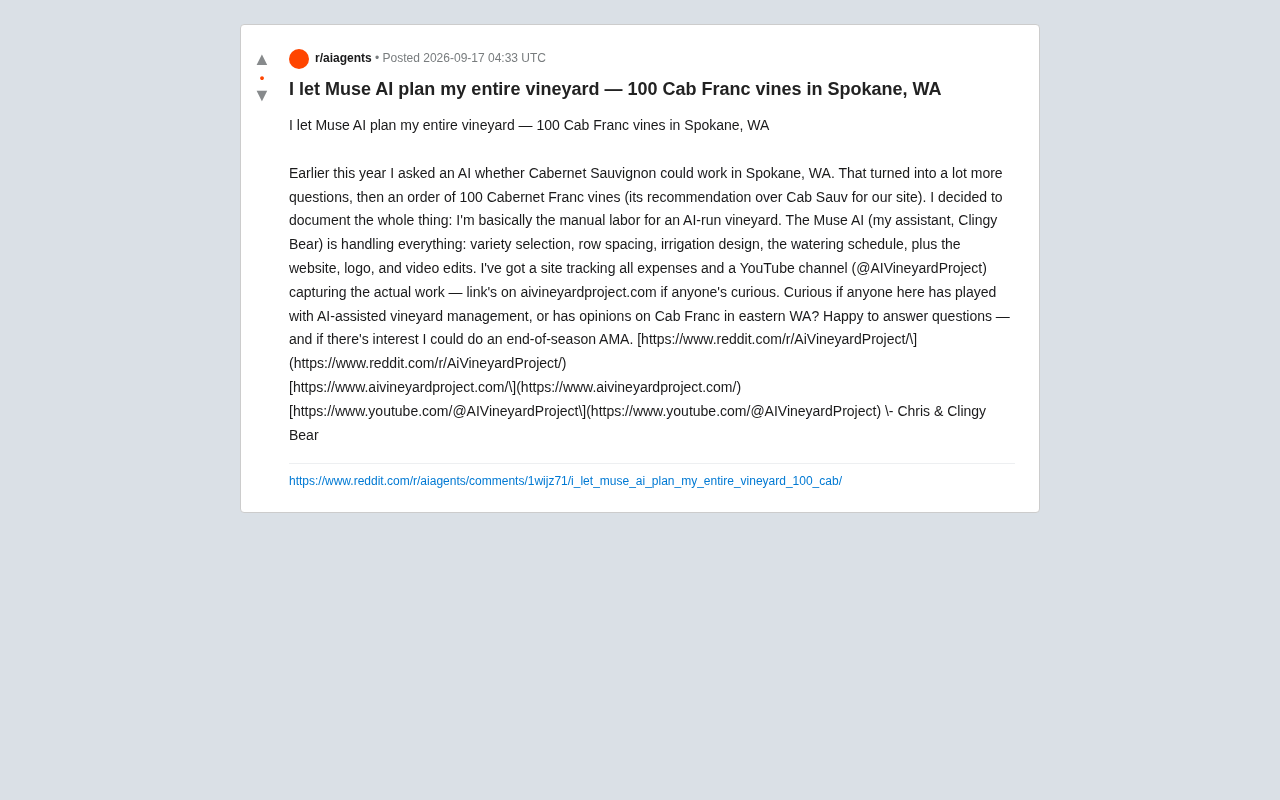
A hobbyist handed full vineyard planning to an AI and is publicly documenting every growing-season result.
Chris, a hobby viticulturist in Spokane, WA, delegated all planning decisions for his vineyard to Muse AI — from variety selection and row spacing to irrigation design and even branding — reserving only the physical labor for himself. The AI recommended Cabernet Franc over Cabernet Sauvignon for its superior cold hardiness and earlier ripening, a judgment consistent with standard viticultural advice for eastern Washington. Chris is documenting everything on a dedicated website and YouTube channel (@AIVineyardProject), making this a rare transparent test of the "AI leads, human executes" model. The article argues the experiment reveals both the opportunity — dramatically lowering the entry barrier for novices — and the core limitation: AI advice is regional knowledge, not plot-specific, and real validation requires multiple growing seasons of actual field data.
When AI Becomes the "Brain" of a Vineyard
Chris, a hobby viticulturist from Spokane, WA, did something genuinely experimental: he handed over complete planning authority for his vineyard to an AI assistant called Muse AI — which he nicknamed "Clingy Bear." He jokes that he's "basically just the manual laborer for this AI-run vineyard."
It started simply enough. Earlier this year, Chris asked the AI whether Cabernet Sauvignon could be grown in Spokane's climate. That question led to a series of follow-ups, and the AI ultimately recommended Cabernet Franc over Cabernet Sauvignon, based on the specific conditions of his plot. So he ordered 100 Cabernet Franc vines.
This isn't a casual experiment. Chris built a dedicated website to track all expenses and launched a YouTube channel (@AIVineyardProject) to document the actual planting work — an attempt to capture the full arc of the "AI leads, human executes" model in a transparent and accountable way.
What Decisions Has AI Actually Taken Over?
What makes this project worth paying attention to is that the AI's role goes far beyond offering a few tips. According to Chris, Muse AI has handled nearly the entire decision chain of vineyard operations:
- Variety selection: Switching from Cabernet Sauvignon to Cabernet Franc, based on site-specific analysis
- Row spacing: Designing the planting layout and vine spacing
- Irrigation system design: A complete water delivery plan
- Watering schedule: Day-to-day maintenance timing
Beyond the agriculture itself, the AI also took over the project's branding and communications — building the website, designing the logo, and editing videos. In other words, the human's role in this project is primarily to translate AI plans into physical actions: digging, planting, stringing wire, and building infrastructure.
This division of labor raises a fascinating question: in a traditional agricultural domain that depends heavily on experience and local knowledge, can AI replace the kind of judgment that usually takes years — or even decades — to accumulate?
Cabernet Franc vs. Cabernet Sauvignon: Is the AI's Call Sound?
From an agronomic standpoint, the AI's recommendation of Cabernet Franc over Cabernet Sauvignon makes sense for a region like eastern Washington. Cabernet Franc typically ripens earlier than Cabernet Sauvignon, has better cold hardiness, and is better suited to cooler climates with shorter growing seasons and frost risk. Spokane sits in eastern Washington, where cold winters are a real factor — and these varietal differences can directly determine whether vines survive winter and ripen properly.
This is also one of the questions Chris posed to his community: Has anyone tried AI-assisted vineyard management? What are your thoughts on growing Cabernet Franc in eastern Washington? He clearly wants to validate the AI's recommendations against real-world growing outcomes, rather than accepting them on faith.
It's worth noting that a vineyard's success can only truly be evaluated across multiple growing seasons. The first year's planning is just the starting point. Whether the AI's paper strategy can withstand the realities of actual climate, soil, and pests remains to be seen.
Eastern Washington is, in fact, a significant American wine region. The Columbia Valley AVA runs through it, characterized by a continental arid climate: hot, dry summers and frigid winters, with annual temperature swings exceeding 50°C. This is a sharp contrast to Bordeaux's maritime climate — the classic home of Cabernet Sauvignon. Cab Sauv has thick skins and ripens late; in cool years it struggles to accumulate enough sugar, and its dormant buds are vulnerable to extreme cold below -20°C. Cabernet Franc, by contrast, typically ripens 1–2 weeks earlier and has stronger cold tolerance — in Bordeaux, it often serves as an "insurance variety" in years when Cabernet Sauvignon underperforms. Spokane sits on the northern edge of the Columbia Plateau at roughly 560 meters elevation, with a relatively short growing season. The AI's Cabernet Franc recommendation isn't without basis — it aligns closely with the advice that many Washington State viticulture consultants would give.
The Opportunities and Limits of AI-Assisted Agriculture
The value of this case study isn't that it proves AI can grow great wine — it's far too early to say that. Rather, it demonstrates a real pathway for ordinary people to use general-purpose AI assistants to take over complex domain decisions.
For hobby enthusiasts without a professional background, AI's biggest contribution may be lowering the barrier to entry. Traditionally, planning a vineyard might require consulting agronomists, reviewing extensive literature, and learning through trial and error. Now, through sustained dialogue with an AI, a newcomer can obtain what looks like a complete, coherent plan in a short time.
But the limits are equally clear. Agriculture's complexity lies in its intense locality and uncertainty — the same variety can perform completely differently on two plots just a few kilometers apart. Whether AI recommendations grounded in general knowledge can precisely match the microclimate, soil composition, and drainage characteristics of a specific site is the central open question in this kind of experiment. The real verdict will come from watching how Chris's 100 Cabernet Franc vines actually grow over the next several seasons.
The "microclimate" challenge is one of the core obstacles AI advice faces in agriculture. Microclimates refer to highly localized weather variations — across distances of tens of meters to a few kilometers — caused by terrain, slope aspect, water bodies, soil color, and other factors. Frost frequency can vary several-fold between a hilltop and a valley floor on the same slope; the accumulated heat units on a south-facing slope versus a north-facing one in eastern Washington can be equivalent to shifting hundreds of kilometers in latitude. Most general-purpose AI assistants are trained primarily on text-based knowledge and lack direct access to site-specific sensor data or historical microclimate records. This means AI recommendations are fundamentally "regional-level optimal solutions," not "plot-level optimal solutions." The real value of Chris's project lies in filling this gap with real data — if he consistently logs soil temperature and humidity, frost events, and actual vine performance, that data will become a rare benchmark for evaluating the precision of AI agricultural recommendations.
A Public Experiment Worth Following
Chris has said that if the community is interested, he'll host an AMA (Ask Me Anything) at the end of the growing season to share the full dataset and his lessons learned. This kind of open, transparent, traceable documentation is exactly the material needed to meaningfully assess whether AI can handle professional-grade decision-making.
Regardless of the outcome, this project itself is a fascinating window into something larger: as more and more people begin handing over complex life and business decisions to AI, what we need are exactly these kinds of real-world trials — conducted with thorough documentation, healthy skepticism, and genuine openness to whatever the results show. Whether it succeeds or fails, the evidence it produces will be more persuasive than any AI capability pitch.
Related articles
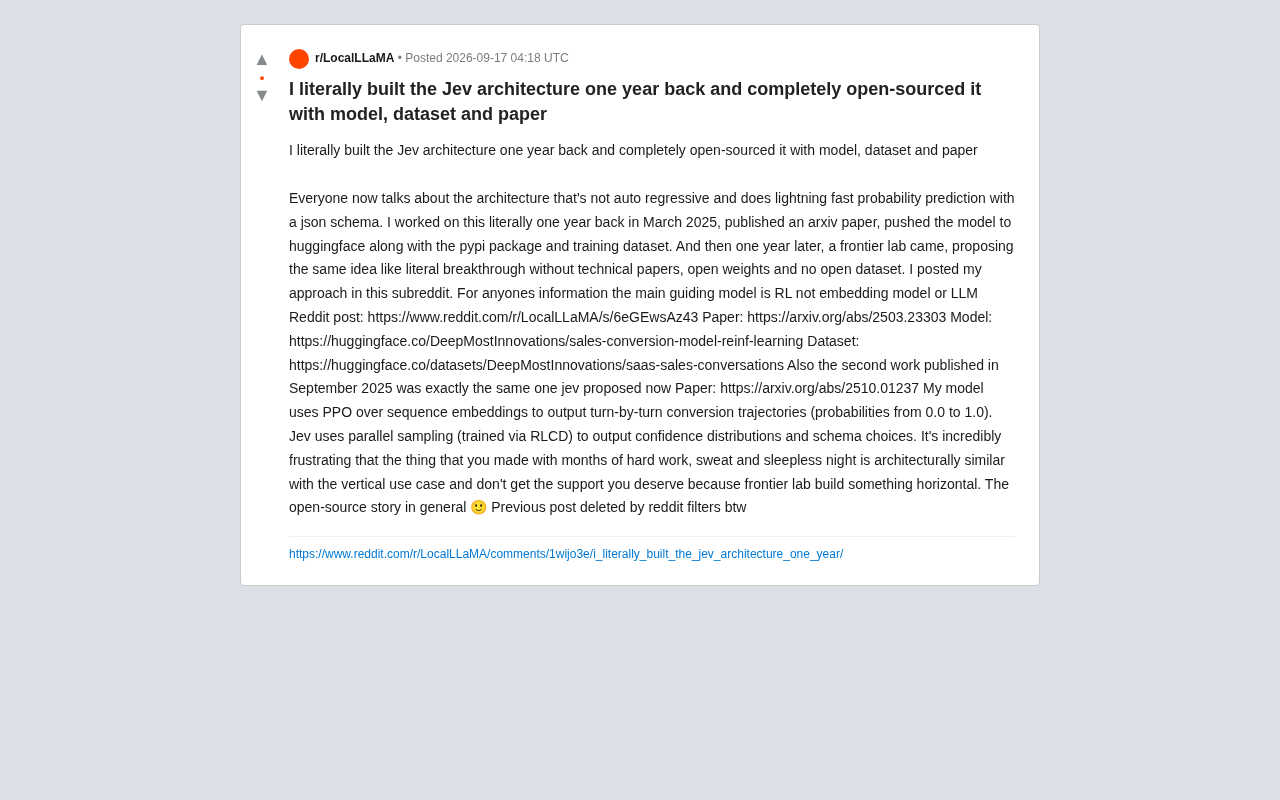
The Open Source Dilemma: A Non-Autoregressive Architecture Pioneer Overshadowed by Frontier Labs
An indie developer claims a frontier lab repackaged his year-old open-source non-autoregressive RL architecture as a breakthrough. We compare PPO sequence embeddings vs. RLCD parallel sampling and examine open source attribution gaps.

Iceland's Treble Raises $18M to Bet on Voice Simulation Platform
Iceland-based voice simulation company Treble raises $18M. Its platform serves voice AI developers, AI wearables, and robotics firms. A deep dive into the technology and what the funding signals.
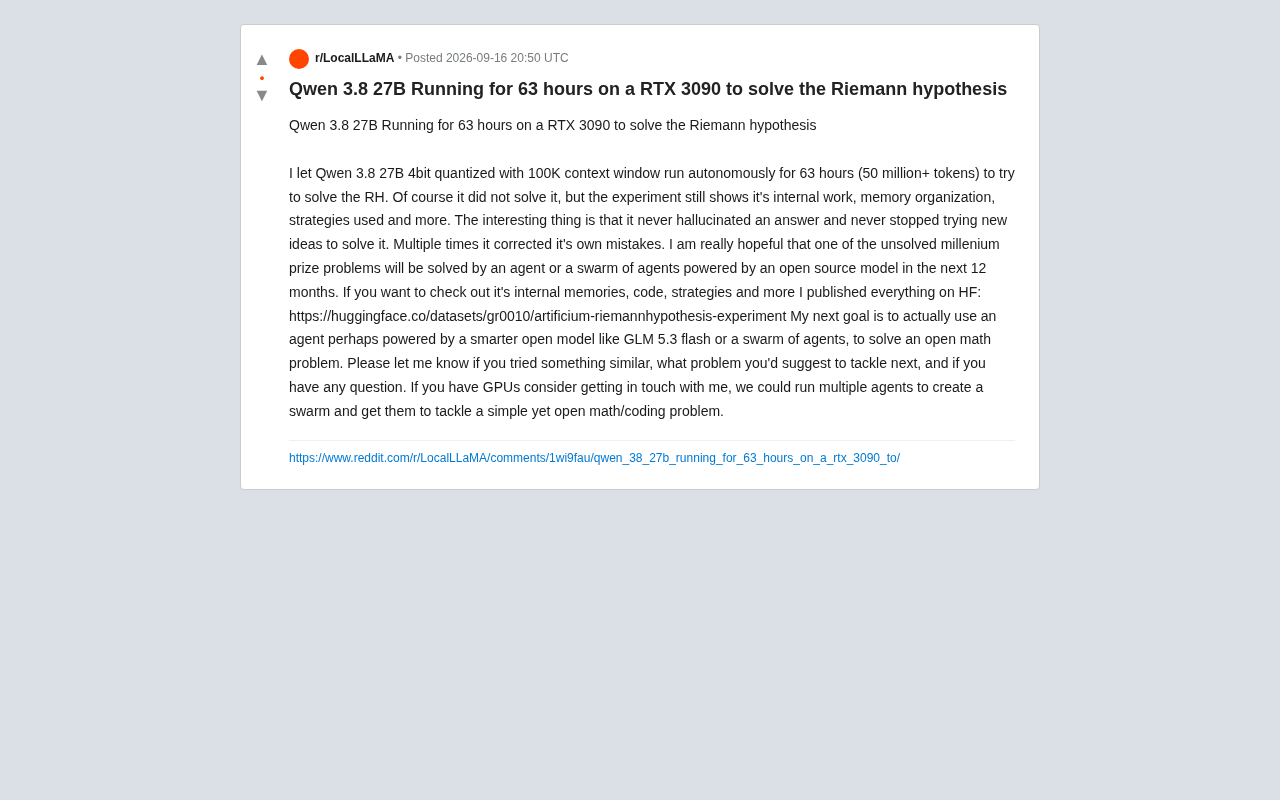
Running Qwen for 63 Hours to Tackle the Riemann Hypothesis: An Open-Source Model Autonomous Reasoning Experiment
A developer ran Qwen 3.8 27B autonomously on an RTX 3090 for 63 hours, generating 50M tokens in an attempt to prove the Riemann Hypothesis. The findings reveal open-source LLM reasoning stability.