AI-Powered End-to-End ML Platforms: Will Data Scientists Buy In?

End-to-end AI ML platform Quantum sparks debate: efficiency is tempting, but agent reliability and tool lock-in are the real tests.
The article examines Quantum, an AI-powered end-to-end ML platform being built by a developer, through Reddit community discussions. Supporters value its integration of data exploration, training, experiment tracking, automated workflows, AI agents, and MLOps deployment for reducing repetitive work and context switching. Skeptics worry it will be a jack-of-all-trades that can't beat mature tools like MLflow and Weights & Biases. AI agent autonomy is a double-edged sword: excessive oversight negates efficiency, while lax oversight introduces risk. Integration costs, vendor lock-in, and data security are adoption barriers. The author advises focusing on high-value scenarios, open extensible architecture, transparent agent decisions, and proving quantifiable time savings in real projects.
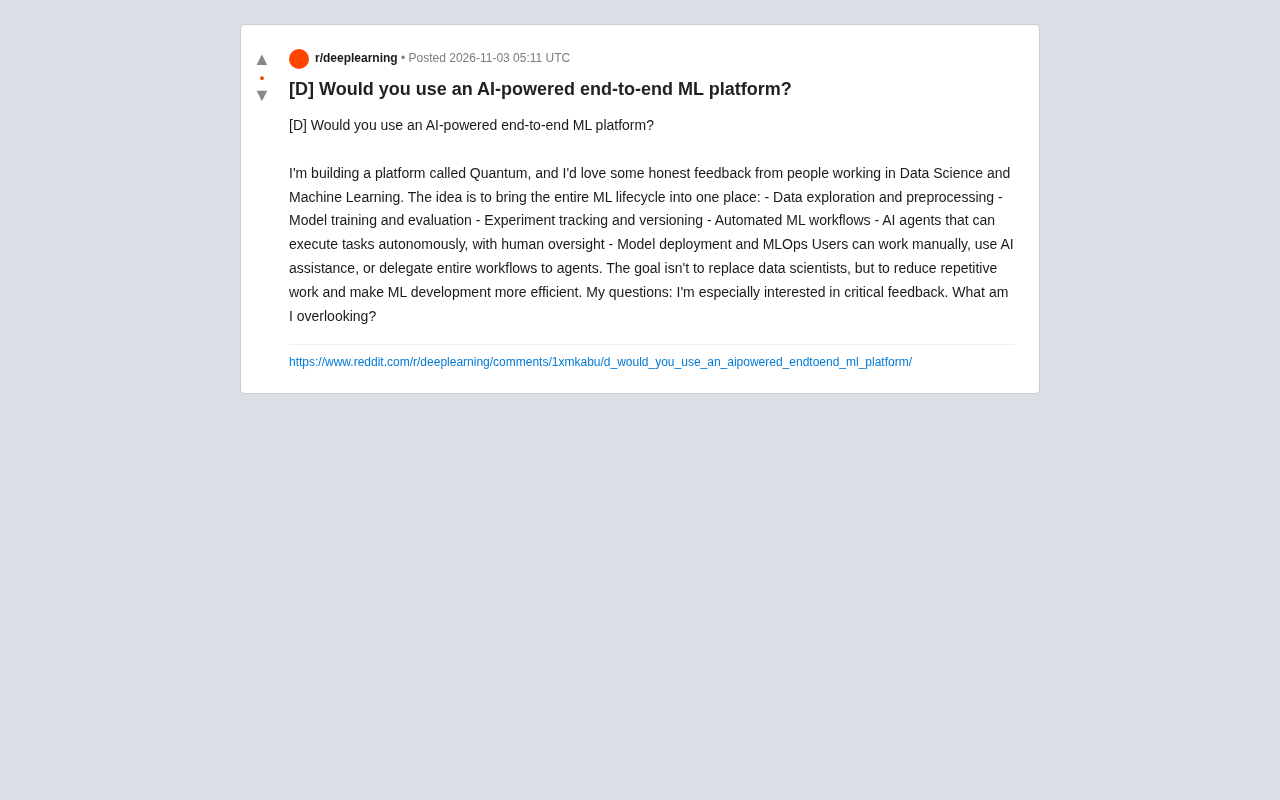
A recent post in the Reddit community has sparked discussion: a developer is building an AI-powered end-to-end machine learning platform called Quantum and is seeking real feedback from data science and ML practitioners. The platform attempts to integrate data exploration and preprocessing, model training and evaluation, experiment tracking and version management, automated ML workflows, AI agents capable of autonomously executing tasks under human supervision, and model deployment and MLOps — all in one place. Users can choose to operate manually, use AI assistance, or delegate entire workflows to agents. The developer's goal is not to replace data scientists but to reduce repetitive work and make ML development more efficient.
The Appeal of End-to-End Platforms: Efficiency and Integration
For many data scientists, a large portion of their daily work is spent on data cleaning, experiment management, and deployment coordination — repetitive tasks that are genuinely exhausting. A unified platform that can seamlessly connect these steps could, in theory, significantly reduce the cost of context switching. Built-in AI agents are particularly appealing: they can automatically execute certain standardized tasks, such as handling missing values and feature scaling in data preprocessing, or logging parameters and comparing results in experiment tracking.
The developer's positioning of "augmentation, not replacement" also aligns with the prevailing narrative around current AI-assisted tools. Across the ML lifecycle, there are indeed many steps that can be automated or semi-automated — hyperparameter tuning, model version comparison, deployment pipeline generation, and more. If the platform can do these well while remaining flexible, it would hold considerable appeal for small-to-mid-sized teams or early-stage ML projects.
MLOps (Machine Learning Operations) is the intersection of machine learning engineering and operations, aiming to reliably deliver models from experimental environments to production and maintain them continuously. Typical capabilities include pipeline orchestration (data validation, training, evaluation, deployment), model registry and version management, monitoring and drift alerting, and reproducible configuration management. It borrows the continuous integration/continuous delivery philosophy from DevOps but additionally handles "mutable" artifacts like data and models. For small-to-mid-sized teams, building a complete MLOps stack in-house is costly — which is precisely the value that end-to-end platforms attempt to package and sell.
Skepticism and Concerns: What Do Data Scientists Really Care About?
Despite the appealing vision, practitioners tend to raise pointed questions. First, end-to-end platforms are prone to falling into the trap of "doing everything but mastering nothing." Data exploration and preprocessing are highly dependent on specific business contexts and data characteristics, and generalized tools often struggle to cover all edge cases. Mature tools already exist for model training and experiment tracking (such as MLflow and Weights & Biases), and a new platform needs to demonstrate that it can offer an equal or better experience in these specific areas — otherwise, users have no reason to migrate.
Second, the autonomous execution capability of AI agents is a double-edged sword. In ML workflows, many steps require domain knowledge and judgment — for example, business logic in feature engineering, the selection of model evaluation metrics, and compliance checks before deployment. If an agent makes a mistake, the cost of troubleshooting and fixing it may exceed that of manual operation. The developer mentions "human supervision," but the granularity and interaction model of that supervision matter greatly — if supervision becomes frequent approval interruptions, the efficiency gains are limited; if supervision is too lax, it may introduce risk.
Another key point is integration and lock-in. Data scientists typically already have a toolchain (Jupyter, Git, cloud platform services, etc.). Can a new platform integrate smoothly with the existing ecosystem? If users are required to migrate all their data and workflows onto the platform, migration costs and vendor lock-in concerns will hinder adoption. Additionally, security and data privacy are inevitable concerns for enterprise users, especially when AI agents need access to sensitive data.
AutoML refers to automating the steps in the machine learning process that traditionally rely on manual tuning. Common areas include automated data preprocessing and feature engineering, algorithm/model family selection, hyperparameter optimization (such as Bayesian optimization and Hyperband), and ensembling and model selection. It addresses the question of "how to find a strong baseline model with minimal manual effort given a dataset and task." Compared to the AI agents discussed in this article, AutoML typically focuses on the modeling stage with predefined search spaces and evaluation protocols, whereas agent-based platforms attempt to extend decision-making to more upstream and downstream stages such as data preparation, experiment management, and deployment — making the challenges of reliability and explainability even greater.
Consensus and Divergence Across Multiple Perspectives
Although this discussion comes primarily from a single Reddit source, combining it with common viewpoints in the ML community reveals some consensus: the value of end-to-end platforms lies in reducing repetitive work, but success hinges on truly understanding data scientists' pain points and finding a balance between automation and controllability. Divergence exists in the degree of acceptance of AI agents — some practitioners are willing to try automated agents for repetitive tasks, while others remain reserved about agent reliability and explainability. Developers need to clearly define their target users: are they trying to attract teams just getting started, or experienced experts? Different groups have vastly different needs for a platform.
Moreover, experienced practitioners may ask: What is the fundamental difference between this platform and existing AutoML tools? Where is the unique value of AI agents? If it's merely wrapping existing tools with an AI interface, it's hard to differentiate. Developers need to demonstrate concrete, quantifiable efficiency improvement scenarios rather than speaking in generalities.
Vendor lock-in refers to the situation where, after deeply binding their data, workflows, and configurations to a particular platform, users face high costs to migrate to other tools — weakening their bargaining power and increasing long-term risk. In ML scenarios, the sources of lock-in are often not the models themselves but data pipeline definitions, experiment metadata, permission and audit records, and proprietary agent workflows. Mitigation measures include: using open formats to export data and experiment records, providing APIs and plugin mechanisms, supporting bring-your-own-cloud (BYOC), and allowing key steps to be versioned as code. When evaluating a new platform, practitioners typically weigh "exit costs" against "onboarding benefits."
Advice for Developers: How to Earn Trust
The developer's willingness to actively seek criticism is commendable. To earn data scientists' trust, several approaches are recommended: First, provide an open, extensible architecture that allows users to customize steps and integrate existing tools rather than mandating a full migration. Second, make AI agents' decision-making processes transparent — let users clearly see what the agent did and why, and provide convenient rollback and correction mechanisms. Third, focus on one or a few high-value niche scenarios (such as experiment tracking automation or deployment pipeline generation), excel at them first, and then expand gradually.
Ultimately, whether data scientists adopt a platform depends on whether it can save time and reduce errors in real projects without adding cognitive burden. If Quantum can provide convincing answers on these fronts, it has a chance to find its place in the fiercely competitive ML tools market.
One-line Summary
End-to-end AI ML platform Quantum sparks discussion: efficiency is appealing, but agent reliability and tool lock-in are key challenges.
Paragraph Summary
The article centers on Quantum, an AI-powered end-to-end ML platform being built by a developer, and reviews discussions in the Reddit community. Supporters value its ability to integrate data exploration, training and evaluation, experiment tracking, automated workflows, AI agents, and deployment MLOps, believing it can reduce repetitive work and context switching. Skeptics worry the platform is "jack of all trades, master of none" and will struggle to compete with mature tools like MLflow and Weights & Biases in specific areas such as preprocessing and experiment tracking. The autonomous execution of AI agents is seen as a double-edged sword: too-frequent supervision negates efficiency gains, while too-lax supervision introduces risk. Integration costs, vendor lock-in, and data security are also barriers to enterprise adoption. The author advises developers to focus on high-value scenarios, adopt an open and extensible architecture, make agent decisions transparent, and demonstrate quantifiable time savings in real projects.
Related articles

AI Can Read Neural Network Weights Directly: Do Models Already Exceed Expectations?
A Reddit developer experiment shows language models can directly read neural network weights and infer their function. Astra, Opus 5.5, and Muse Spark 1.3 all passed the test, sparking discussion on model generalization and training sources.

India's Microdrama Market Explodes: EloElo Secures $80M Investment from NBCUniversal
EloElo secures $80M from NBCUniversal to boost StoryTV, its microdrama platform with over 33M monthly active users, as India's microdrama market draws global capital.

Acoustic Detection of Multi-Rotor UAVs: Fusing Handcrafted Features with Pre-Trained Embeddings
Study reveals data leakage from random splits in UAV acoustic detection, proposes source-disjoint protocol with stacked ensemble of handcrafted features and YAMNet embeddings, achieving 95.29% accuracy for low-cost drone detection.