AI-Powered Full-Stack Testing in Practice: From Test Case Generation to Agent Development

Testers advancing into AI need to master two full-stack paths: workflow orchestration and AI product testing.
The article notes that enterprises' AI capability requirements for testing roles have upgraded from "knowing how to ask questions in a chat window" to "embedding AI into the complete testing workflow." Directly asking a large model to write test cases doesn't work well because it lacks the reasoning chain of understanding requirements, analyzing test points, selecting design methods, and outputting documents. The solution is to decompose the manual testing process into fine-grained nodes and orchestrate them into a pipeline using no-code platforms like Coze or code frameworks like LangChain. Extending AI capabilities also includes developing AI-driven automated testing platforms covering UI, API, and performance testing. Meanwhile, "testing AI products themselves" is another independent track requiring handling of non-deterministic outputs, data dependency, and model behavior evaluation. The article concludes with three action recommendations: map out your workflow, build a minimal workflow hands-on, and plan a learning path based on job requirements.
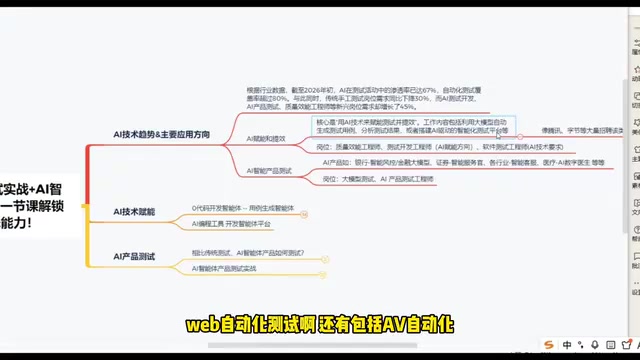
The AI skill requirements for testing roles are changing rapidly. Simply knowing how to ask questions in a large model chat window is no longer enough to meet enterprise expectations. More and more companies want testers to embed AI into their workflows—from automatically generating test cases and analyzing test results to building AI-driven testing platforms. Meanwhile, the surge of AI products has spawned another direction: testing AI products themselves. Together, these two directions form the full-stack capability map for testers advancing into AI.
What AI Testing Capabilities Do Enterprises Actually Need?
Most testers currently apply AI only at a basic level: when they're stuck writing test cases or encounter a specific problem at work, they open a chat window in DeepSeekAd, Tongyi Qianwen, or ERNIE Bot and get help through a back-and-forth Q&A style. This level of proficiency is barely competitive in the job market—as noted in the livestream, operations that "college students and everyone else can do" don't constitute a job barrier.
What enterprises truly recognize as AI application capability is the ability to simulate the complete manual testing process: from interpreting requirement documents and mining test points, to applying test design methods to generate well-structured, high-coverage test case documents, to assisting with test result analysis, executing tests, and even developing AI-driven automated testing platforms. Such roles may appear in recruitment under titles like "Intelligent Efficiency Engineer" or "Test Development Engineer (AI direction)." Large companies set up dedicated AI efficiency roles, while smaller companies tend to add AI skill requirements to existing testing positions.
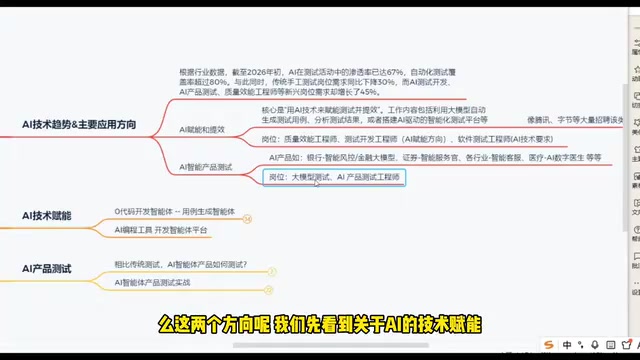
According to observations shared in the livestream, many enterprises (including those in banking, securities, and healthcare) are transitioning to develop AI products, and their internal testers are being asked to shift toward AI product testing. This means testers face not just one direction—"using AI to improve efficiency"—but also a new battleground: "testing AI products."
Why Doesn't "One Sentence to Make AI Write Test Cases" Work?
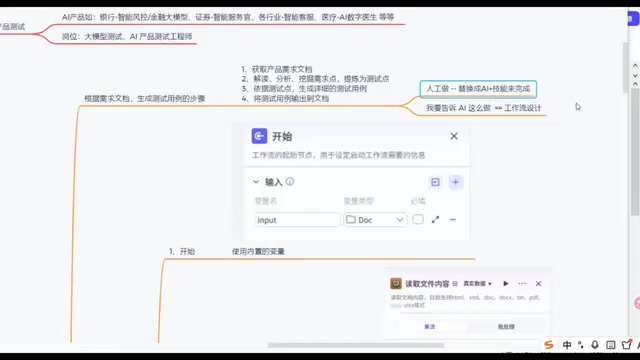
Many people have tried throwing a requirements document directly at a large model with a single instruction: "Help me write test cases." The results are often incomplete in coverage and loosely structured. The root cause is that AI doesn't go through the complete reasoning chain that humans do: "understand requirements—analyze test points—select design methods—output documents."
The solution proposed in the livestream is workflow decomposition: breaking down the manual testing steps layer by layer, assigning each step to AI or a rule engine. The finer the decomposition, the more fully AI understands, and the closer the final test case documents are to expectations. This logic doesn't depend on specific tools—whether you build workflows on a no-code platform like Coze or develop your own with a code framework, the underlying process design approach is the same.
Specifically, a test case generation workflow needs to include at least: a requirement parsing node (extracting functional points and constraints), a test point mining node (generating verifiable check items based on requirements), a test case generation node (applying functional test design methods such as equivalence partitioning and boundary value analysis), and a formatted output node (generating standard documents). Each node can invoke different prompts or model capabilities, forming a pipeline.
Prompt is the instruction text users input to a large model, and its quality directly determines output quality. The limitation of single-turn prompts is that the large model needs to simultaneously complete requirement understanding, test point identification, method selection, and document organization in one generation—any missing link will show up in the final result, and it's hard to pinpoint which step went wrong. The "node-based prompt" approach in workflows breaks complex tasks into multiple narrow tasks, giving the model one clear, verifiable goal per node (e.g., "list all input fields and their value ranges from this requirement"), thereby reducing the burden of single inference and improving controllability. Common accompanying techniques include: providing output format constraints for each node (such as JSON schema), introducing few-shot examples, and performing result validation between nodes. These practices essentially use engineering methods to compensate for the instability of large models in long-chain reasoning.
Starting with No-Code: Building a Testing Agent on the Coze Platform
For testers without a programming background, the Coze platform is a low-barrier entry point. The personal edition is free, with daily credits (the livestream mentioned about 1,500 credits, more for new users)—enough for learning and light use; for production work, you may need to pay for additional credits.
Building a test case generation agent on Coze centers on orchestrating the workflow: defining inputs (requirement documents or user stories), setting up processing nodes (invoking large models for requirement analysis and test case generation), and configuring output formats (Markdown or tables). The entire process requires no coding, but testers need to clearly understand their own testing process—which is precisely the existing advantage of testing roles.
The platform also supports publishing agents as reusable products for other team members. The livestream demonstrated the basic form of such agents and mentioned that you can later transition to low-code or code frameworks (such as LangChain) for more flexible customization.
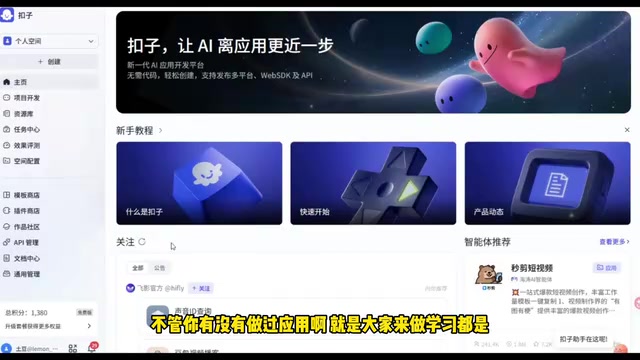
Coze is an AI agent development platform launched by ByteDance, focused on no-code/low-code. Its core abstractions include "Bot" (agent) and "Workflow": the Bot handles conversational interaction and plugin invocation, while the workflow strings multiple processing nodes (large model calls, code blocks, conditional logic, knowledge base retrieval, etc.) into a reusable pipeline. For testers, the value of workflows lies in solidifying multi-step reasoning like "requirement parsing → test point mining → test case generation → formatted output" into a repeatable process, rather than relying on single-turn prompts and hoping for the best each time. The platform supports publishing as an API or sharing Bots within a team, making it easy to turn personal productivity tools into team assets. Similar platforms include Dify and n8n—the concepts are compatible, so learning one makes migration to another relatively low-cost.
From Efficiency Tools to Testing Platforms: Extending AI Capabilities
The endpoint of AI-empowered testing isn't just generating test cases. Another scenario mentioned in the livestream is using AI to develop automated testing platforms, covering Web functional automation (i.e., "click-click-click" UI testing), API automation, and performance testing. Such platforms can reuse the capabilities of traditional automation frameworks while enhancing element location, script generation, and result analysis through AI.
For testers, this means expanding the skill stack: understanding the development logic of AI agents (prompt design, workflow orchestration, tool invocation) while retaining deep knowledge of test types (functional, performance, automation). The purpose of AI efficiency is always to serve traditional test types, not replace them.
LangChain is currently a mainstream open-source framework for developing large model applications, providing components such as model invocation wrappers, prompt templates, chain orchestration, tool/agent invocation, memory, and retrieval-augmented generation (RAG). Compared with no-code platforms like Coze, the advantage of code frameworks lies in deep customization and easy integration into existing CI/CD and automated testing systems—for example, letting AI automatically generate Selenium/Playwright locators and scripts based on page structure, or perform root cause analysis on error logs of failed test cases. Which route to choose depends on team size and engineering capability: no-code platforms suit rapid idea validation and personal efficiency, while code frameworks suit production-grade scenarios requiring long-term maintenance and integration with existing testing platforms. The two are not mutually exclusive—many teams first use low-code to get the process running, then solidify stable parts into code modules.
Another Track: Testing AI Products Themselves
AI product testing differs from traditional software testing in mindset and coverage direction. Traditional software testing focuses on deterministic inputs and outputs, while AI products (such as intelligent customer service, intelligent risk control, and large model applications) must handle non-determinism, data dependency, and model behavior evaluation. The livestream mentioned that this direction will be explained in detail through case studies; although this session didn't fully cover it, the signal is clear: testing AI products is becoming an independent skill demand, especially in finance and healthcare.
For testers, the two paths are not mutually exclusive: on one hand, use AI to improve traditional testing efficiency; on the other hand, accumulate methodologies for AI product quality assurance, forming a complete AI full-stack testing capability.
AI product testing differs from traditional software testing in its core aspect: "non-determinism." Traditional test cases assume that the same input must yield the same output, and pass/fail can be judged with precise assertions; but the output of large model applications is probabilistic—asking the same question multiple times may yield different wording or even different conclusions. Therefore, evaluation methods need to shift from "assertions" to "evaluation sets + scoring criteria": build evaluation datasets covering typical scenarios and edge cases, define dimensions such as accuracy, relevance, safety, and hallucination rate, then use human annotation or "LLM as judge" (using another large model to score according to a rubric) for batch evaluation. Additionally, new risks such as data drift, prompt injection, and sensitive content filtering need attention. This methodology is still evolving rapidly, and demand is particularly urgent in heavily regulated industries like finance and healthcare.
Actionable Advice for Testers
If you're still at the stage of "asking questions in a chat window," start with three things: First, map out the complete workflow of your daily testing work and identify the steps that can be decomposed and replaced by AI; Second, pick a no-code platform (like Coze) and actually build the simplest test case generation workflow to experience the difference between "process orchestration" and "single queries"; Third, pay attention to the job descriptions of AI testing-related positions in the job market, and compare them with your own gaps to plan your learning path.
AI won't replace testers, but testers who can use AI workflows are replacing those who only write test cases manually.
One-line Summary
Testers advancing into AI need to master two full-stack paths: workflow orchestration and AI product testing.
Paragraph Summary
The article points out that enterprises' AI capability requirements for testing roles have upgraded from "knowing how to ask questions in a chat window" to "being able to embed AI into the complete testing workflow." Directly asking a large model to write test cases doesn't work well because it lacks the reasoning chain of "understanding requirements—analyzing test points—selecting design methods—outputting documents." The solution is to decompose the manual testing process into fine-grained nodes and orchestrate them into a pipeline using no-code platforms like Coze or code frameworks like LangChain. The extension of AI capabilities also includes developing AI-driven automated testing platforms covering UI, API, and performance testing. Meanwhile, "testing AI products themselves" constitutes another independent track, requiring handling of non-deterministic outputs, data dependency, and model behavior evaluation. The article concludes with three action recommendations: map out your workflow, build a minimal workflow hands-on, and plan a learning path based on job requirements.
Related articles

Random Pruning of the DPO Computation Graph: 1.4x Training Speedup and Lower Peak Memory
DPO training too slow and memory-hungry? This paper proposes a random pruning framework for the DPO computation graph, sampling independently across position, sequence, and branch dimensions; branch pruning achieves a 1.426x step-time speedup and cuts training time by about 30%, with in-depth attribution of memory and time gains.

Why Does JEPA Underperform MLM in Longitudinal EHR Representation Learning?
New study compares JEPA and MLM for longitudinal EHR representation learning on MIMIC-IV: three JEPA variants train stably without collapse but underperform MLM; target size, not heterogeneity, drives prediction error.

Transfer Learning + Visible Light Communication: A New Approach to Energy-Efficient Indoor Positioning
A study proposes a transfer learning-based visible light communication indoor positioning method, achieving 47% accuracy improvement on the BOSCH factory dataset, 67.5% model efficiency under high noise, and introducing the ME composite metric for energy-efficient positioning in energy-constrained industrial IoT scenarios.