AI-Powered Vulnerability Hunting in Practice: Build an Intelligent Bug Hunting Platform from Scratch

Bilibili's four-module hands-on course teaches AI-driven vulnerability hunting with Agents and Skills.
This article covers the design and core content of Bilibili's course *Automated Vulnerability Hunting with AI*. Addressing the pain points of repetitive labor and manual toolchain shuffling in traditional hunting, it proposes a collaboration model where humans set strategy and AI executes. The course has four progressive modules: understanding AI hunting (Agents beat chat-style AI), building a workbench (environment setup, Hermes Agent, Skills modules, four-part prompts), five scenario walkthroughs (SQLi, XSS, privilege escalation, authentication, JS auditing), and building an intelligent platform (OneForAll, Burp Suite via MCP, Nuclei). All practice is done in authorized labs, with learning advice and legal red lines emphasized.
Why We Need AI for Vulnerability Hunting
Traditional vulnerability hunting is extremely labor-intensive. Security testers need to click through pages one by one, capture and replay requests for each parameter, repeat the same actions hundreds of times, and stare at dense response outputs looking for anomalies. What makes it worse is toolchain maintenance—one tool scans assets, another captures traffic, a third runs scans, and moving data between them is all done by hand. A huge amount of time isn't spent thinking but on repetitive labor.
The maturation of large language models and Agents is changing this. Repetitive, mechanical, patience-heavy steps can be handed to AI, freeing security engineers to focus on what genuinely requires human judgment: testing strategy, risk boundaries, and result confirmation. This isn't AI replacing security engineers—it's letting an AI-savvy engineer do the work of a small team alone.
This Bilibili course, Automated Vulnerability Hunting with AI, is designed around exactly this goal and positioned as a complete hands-on practical course, not a theory or concept course. The course is divided into four modules: understanding AI vulnerability hunting, building an AI hunting workbench, five vulnerability scenario walkthroughs, and building an intelligent vulnerability hunting platform. Each module builds on the previous one—each step is the foundation for the next.
One red line runs through the entire course and is worth emphasizing up front: all hands-on exercises take place in purpose-built teaching labs and explicitly authorized environments. The technology itself is neutral, but actions must have boundaries. Unauthorized testing is illegal no matter how skilled the technique.
Module 1: Understanding AI Vulnerability Hunting
The Essence of AI Hunting Is a Collaboration Model
Many people's first reaction to AI vulnerability hunting is "throw the URL at the AI and it spits out a vulnerability report automatically." The course explicitly rejects this notion—at least not at the current stage. AI vulnerability hunting is fundamentally a collaboration model where humans set strategy, define boundaries, and confirm results, while AI executes, analyzes, and iterates.
You need to understand what AI can do in vulnerability hunting: understand page structure and business logic, generate and mutate test cases, interpret anomaly signals in responses, and string scattered findings into a complete attack chain. At the same time, you need to know what it can't do and which steps humans must gatekeep. Only by understanding the capability boundaries will you avoid either mythologizing or underestimating it.
Why Choose an Agent Over Chat-Style AI
The core difference between an Agent and chat-style AI: chat-style AI answers one question at a time and can only "talk"; an Agent can "do work"—it can call tools, execute commands, read results, and adjust its next actions based on those results, continuously looping toward a goal. Hunting vulnerabilities is precisely a process of repeated probing, observation, and adjustment, making it naturally suited to an Agent rather than a Q&A chatbot.
The course uses Hermes Agent as the protagonist and systematically covers selection criteria: whether it can easily connect to different LLMs, mount custom skills, integrate external tools, and keep execution controllable. After finishing, even if new Agents appear on the market, you'll know how to evaluate and migrate.
Architectural differences between Agents and chat-style AI: Chat-style AI is typically built on single-turn or multi-turn conversation interfaces—text in, text out—without directly operating on the external environment. An Agent is built on a "perceive-decide-execute" loop, with core components including a planning module (decomposing goals into subtasks), tool-calling interfaces (such as APIs, command lines, browser automation), a memory module (storing intermediate results and context), and a reflection mechanism (adjusting strategy based on execution results). In vulnerability hunting scenarios, an Agent can autonomously send HTTP requests, parse responses, judge whether anomalies exist, and decide the next testing action, whereas chat-style AI can only offer suggestions and cannot execute closed-loop actions. This difference makes Agents better suited to penetration testing workflows that require repeated probing and state maintenance.
Module 2: Building an AI Hunting Workbench
This is the most hands-on module and the one you should least skip. Too many people get fired up watching practical videos, then can't even get the environment running when they try it themselves. The course breaks down every step thoroughly, ensuring you end up with a workbench you can actually use.
Environment and browser extension preparation: Clarify host requirements, prepare a clean and suitable execution host, and install browser-side extensions. Much of the first-hand information in external vulnerability hunting—requests, responses, page behavior—happens in the browser. Get this side right, and AI can obtain high-quality raw material.
Hermes Agent installation and configuration: A complete demonstration of the installation process, including common pitfalls and error troubleshooting. The Agent itself is the execution framework, and the brain is the LLM. The course teaches you how to connect the Agent to an LLM, what configuration parameters mean, and how different models perform in hunting scenarios. The same Agent connected to different models produces work of different quality—and the configuration authority is in your hands.
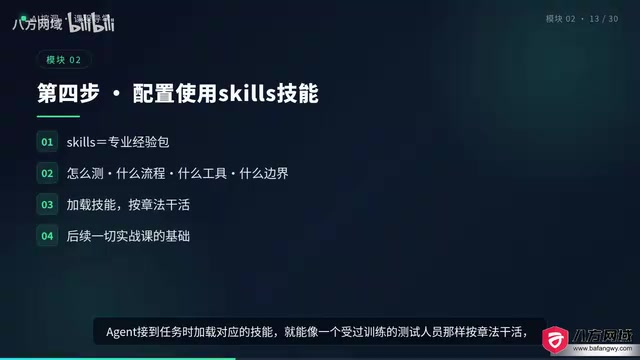
Skills modules: This is one of the course's core designs. Think of Skills as pre-installed professional experience packs for the Agent—how to test a certain type of vulnerability, in what process, with what tools, and what boundaries to watch. Experience is distilled into skill modules; when the Agent receives a task, it loads the corresponding skill and works methodically like a trained tester instead of flailing around based on the LLM's general knowledge.
Online education lab preparation: Hands-on practice needs legal targets. The course provides an online education scenario lab simulating a real business system, pre-loaded with various typical vulnerabilities. This scenario was chosen because the business form is familiar—login/registration, course browsing, purchase and payment, permission differentiation—with rich business logic and comprehensive vulnerability type coverage, so the skills you practice transfer directly to real work.
The four-part prompt method: This is the most valuable methodological takeaway. Many students get poor results using AI for hunting, and the problem isn't the model but the instructions. The four-part method fixes the instructions given to the Agent into four parts: part one, which skill module to load; part two, what environment to execute in; part three, destructive boundaries and authorization scope—telling the AI in black and white which targets are authorized and which operations are absolutely forbidden; part four, what deliverables to output, requiring standardized, reviewable test records and reports. This framework works directly with any Agent and any model.
Module 3: Five Vulnerability Scenario Walkthroughs
The course selects five of the most representative vulnerability scenarios, each a complete practical lesson—from principles, to how to assign tasks, how to load skills, how to observe execution, how to manually confirm results, and how to produce deliverables, walking through the entire closed loop.
SQL injection: The most classic and textbook vulnerability type, with clear testing logic and definite judgment signals—best suited for building your first set of instincts for collaborating with AI. You'll see how the Agent identifies suspicious input points, constructs and mutates tests, and judges whether injection exists from response differences, while you're responsible for confirming conclusions and ruling out false positives.
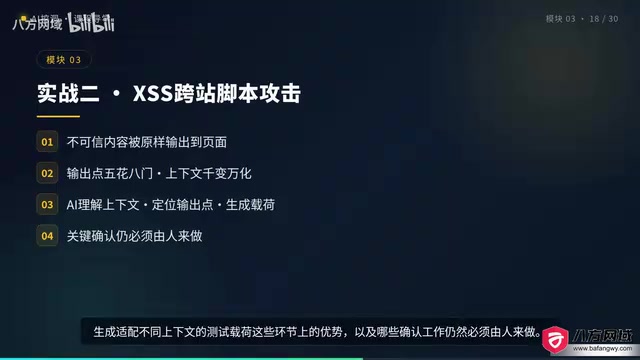
XSS cross-site scripting: The difficulty lies in the myriad output points and ever-changing contexts, making manual inspection very taxing on the eyes. The course demonstrates AI's advantages in understanding page context, locating output points, and generating test payloads adapted to different contexts, as well as which confirmation work must still be done by humans.
Privilege escalation vulnerability hunting: The scenario that best demonstrates AI's value and most tests testing strategy. Privilege escalation means seeing data you shouldn't see or performing operations you shouldn't be able to. Scanners basically can't find these because they're not syntax-level anomalies but business logic flaws—you must understand who should have what permissions in the system. The course walks you through how to explain the business permission model to AI, how to design multi-account cross-validation schemes, and how to confirm real exploitation.
Authentication and login vulnerabilities: Login and registration are the entry point for almost every system and a high-incidence area for problems—password policies, CAPTCHA bypasses, flaws in recovery flows, and session management issues all fall in this category. The course systematically covers the testing surface around the lab's authentication system, understanding the judgment criteria for each type of problem while strictly maintaining boundaries.
JS auditing: Modern web applications run a lot of logic in front-end JavaScript—API endpoints, parameter rules, encryption logic, and even sensitive information may be hidden in JS code. Manually reading thousands of lines of obfuscated code is extremely tedious, and this is exactly AI's comfort zone. The course teaches you how to have the Agent systematically audit front-end code, dig out hidden endpoints, suspicious logic, and exploitable information, then turn those clues into entry points for subsequent testing.
Module 4: Building an Intelligent Vulnerability Hunting Platform
The first three modules teach you to hunt with AI; this module upgrades you to owning an intelligent hunting pipeline. Real security work has a set of battle-tested professional tools, and the smart approach isn't to have AI replace them but to have AI command them.
Automated asset reconnaissance: The star is OneForAll, a widely used subdomain collection tool in the industry that enumerates target assets from as many sources as possible. The course doesn't just teach installation and running—it integrates it into an automated workflow, so asset reconnaissance is automatically triggered by the process, results are automatically organized, and they become direct input for subsequent AI testing.
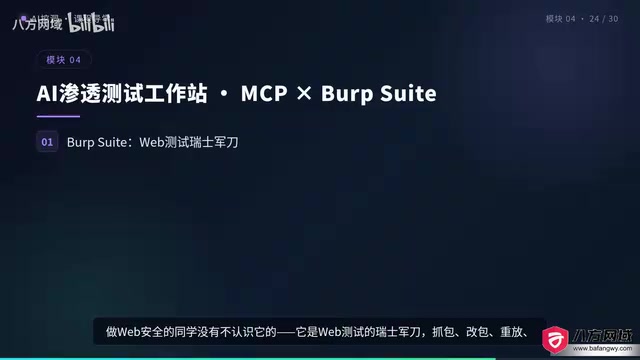
AI-driven penetration testing workstation: Connecting Burp Suite with MCP Service. Burp Suite is the Swiss Army knife of web testing, but in traditional usage every step requires manual clicking. MCP is a standard protocol for letting AI call external tools—essentially a universal socket between AI and tools. Once Burp Suite's core capabilities are wrapped as an MCP service, the Agent can automatically execute actions like capturing traffic, constructing requests, and analyzing responses within the authorized scope, while you review each step and the final conclusion at the workstation.
Intelligent vulnerability scanning: The star is Nuclei, a template-based vulnerability scanner with a large community-contributed template library, broad coverage, and high execution efficiency. The course teaches you to bring Nuclei into the AI command system, letting AI intelligently select and organize scanning tasks based on information from asset reconnaissance and testing, then perform preliminary analysis and categorization of scan results, delivering only findings truly worth manual review to you.
At this point the pipeline is complete: OneForAll maps out assets, the Agent with skills performs deep testing, Burp Suite provides request-layer execution capability, Nuclei does batch verification, AI is the orchestrator and analyst throughout, and you are the final decision-maker.
Learning Advice
First, don't cherry-pick modules—especially don't skip workbench setup. With a weak foundation, practical lessons are just entertainment. Second, for each practical lesson, give the Agent a task yourself first, then watch the course's approach and compare the gap—you'll improve much faster. The core skill is knowing how to assign tasks to AI, and that can only be built through practice. Third, carefully preserve the deliverables from each practice session in the four-part format—this habit directly determines your professionalism in real work later.
Finally, repeating that red line: all offensive operations are permitted only in teaching labs and environments with explicit written authorization, and even within the authorized scope, destructive operations must strictly follow the boundaries defined by the course. Hone your skills hard, and guard the bottom line even harder.
Background Supplement
Technical implementation of Skills modules: Skills are essentially domain knowledge encapsulated as instruction sets or tool sets that an Agent can dynamically load. Each Skill typically contains a natural-language description of the testing process, predefined command or API call templates, parameter constraints, and success/failure judgment criteria. After receiving a task, the Agent retrieves and loads the corresponding Skill based on task type, executing standardized steps in specific vulnerability scenarios and avoiding the randomness of relying on the LLM's general reasoning. This design borrows from "design patterns" and "playbook" concepts in software engineering, solidifying security experts' experience into reusable, auditable modules—improving efficiency while ensuring consistency and repeatability of the testing process.
Introduction to the MCP protocol: MCP (Model Context Protocol) is an open protocol designed to standardize how AI models interact with external tools and data sources. It defines tool description formats, calling interfaces, and return structures, enabling Agents to discover and call various services in a unified way without writing adapter code for each tool individually. In the security field, once tools like Burp Suite and Nuclei are wrapped as MCP services, the Agent can send instructions and receive structured results through the standard protocol, achieving automated orchestration of the toolchain. MCP lowers the barrier to integrating professional tools with AI and is key infrastructure for building an intelligent hunting platform.
Related articles

VP ≠ VNP: A Major Breakthrough in Computational Complexity Theory
A study claiming to prove VP ≠ VNP over every field sparks heated discussion on Hacker News. This article analyzes the algebraic complexity background of VP and VNP, the proof approach, community controversy, and its potential impact on computational complexity theory.

Developer Naming Woes: The Technical Names That Drive Us Crazy
Why is technical naming so maddening? From Nginx and Vite to Qt and Sudo, a YouTube creator rants about the chaos of developer naming and pronunciation, revealing the tug-of-war between creators' intentions and community habits, and the cultural roots behind spelling traps like PyPI and GNOME.

Figma Workplace Scandal: Employee Sues CEO for Forcing Confrontation with Harasser
Figma and its CEO are sued by a current employee alleging sexual harassment and discrimination, and forcing the victim to confront her harasser. This article outlines the background, potential impact, and industry reflection.