AI Product Manager Career Transition Guide: A 6-Week Hands-On Roadmap for Beginners

A 6-week structured path to transition into AI product management with no coding background.
This article summarizes a Bilibili video that addresses the gap between AI PM tutorials that only cover concepts and the practical know-how needed to actually break in. It offers a 6-week structured learning path covering AI literacy, prompt engineering, product thinking for AI, core technologies like RAG and Agents, end-to-end product design, industry case studies, and resume-ready project delivery. The author argues that AI PMs don't need to write code — their job is to translate between business needs and AI capabilities. After six weeks, the realistic outcome is the ability to independently design an AI product, collaborate with engineers, and present credible project experience.
Why Most AI Product Manager Tutorials Are Useless
There's no shortage of content about AI product management online — but very little of it is actually actionable. The creator behind this Bilibili video cuts straight to the point: 90% of the content out there talks about concepts, trends, and anxiety, but almost nobody tells you how an ordinary person can actually take concrete steps to break in.
The result? Two common traps — either you finish a pile of tutorials and still don't know where to start, or you learn a few prompt tricks and think you understand AI products. Or worse: everything goes into your bookmarks folder and collects dust, forever waiting for the day you feel "ready enough."

The author backs up this learning path with personal experience: a graduate from a non-top-tier university, a background in traditional product management, not a single line of code written — and yet, using this framework, they shipped their first AI product case study in three weeks and landed an offer at a major tech company in two months. No algorithm background, no prestige brand on the resume — just a clear learning path rather than raw talent.
AI Product Management Is Not About Writing Code
There's a widespread misconception that AI PMs need to understand algorithms or know how to tune models. The video addresses this head-on with a key mindset shift: the role of an AI product manager is not to write code or train models — it's to use AI capabilities to solve real business problems.

The technical heavy lifting belongs to algorithm engineers. A product manager's job is to stand at the intersection of business and technology, and direct AI to where it actually creates value. This framing matters — it determines where your learning energy should go. The focus should be on understanding and applying AI capabilities, not getting lost in technical implementation details.
In other words, an AI product manager is a translator and designer between business and technology. You need to understand what large language models can and can't do, and then map those capabilities to specific business contexts to create real value.
The 6-Week Learning Path, Broken Down
The video lays out a structured six-week study plan — arguably the most practical part of the entire piece.
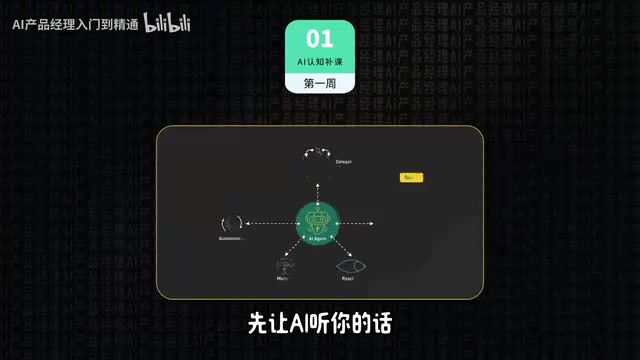
Week 1: AI Fundamentals and Intro to Prompt Engineering
Start with foundational AI literacy, paired with hands-on prompt engineering practice. The goal is to "get AI to actually do what you want" and ship one minimal viable tool. The emphasis here is on doing, not just reading.
Week 2: Rewiring Your Product Thinking
Understand the fundamental difference between AI products and traditional software products, and build the right mental model. This is the critical cognitive upgrade for anyone transitioning from a traditional PM role.
Traditional software follows deterministic logic: give input A, get output B — predictable, testable, reproducible. AI products — especially those built on large language models — are inherently probabilistic: the same input can produce different outputs at different times, models can hallucinate information that doesn't exist, and edge cases are nearly impossible to enumerate exhaustively. This shifts product design from "is the feature correct?" to "is the distribution of outputs acceptable?" It requires building evaluation systems (Evals) to continuously measure output quality, rather than relying on traditional functional testing.
The iteration rhythm is also different: improvement often isn't about changing code logic, but about refining prompts, swapping out the underlying model, or expanding training data. Product managers need to be deeply involved in these "soft" iteration decisions — not just writing requirements and waiting for engineering to deliver.
Week 3: Hands-On with Core Technologies
This week covers the core technical building blocks: RAG knowledge bases, Agents, and large model API calls. The focus isn't on mastering implementation details — it's on understanding how these components work together in a real project and where each one fits.
RAG (Retrieval-Augmented Generation) is one of the most common architectures in AI products today. The core idea: large models have a knowledge cutoff date and can't access proprietary enterprise data, so RAG addresses this by retrieving relevant content from an external knowledge base before generating a response — essentially feeding the model the right context to answer from. For product managers, understanding RAG means being able to judge which business scenarios suit a knowledge base approach (e.g., internal enterprise Q&A, document search), and knowing what factors drive quality: chunking strategy, vector embedding quality, retrieval accuracy, and so on.
Agents give large models the ability to take active action: instead of just answering questions, an Agent can call tools, execute multi-step tasks, and adjust its strategy based on intermediate results. Common examples include automatically searching the web, calling APIs, or generating and running code. Product managers need to understand the appropriate use cases for Agents — they excel at tasks that can be decomposed into steps and tolerate some error tolerance, but in high-precision or heavily regulated contexts, you need to carefully design human-in-the-loop checkpoints.
Week 4: End-to-End Product Design Process
From requirements analysis to feature design, walk through the complete product design workflow — and translate the technical understanding you've built into actual product documentation.
Week 5: Industry Case Study Deep Dives
Covers education, healthcare, finance, workplace productivity, and marketing — breaking down more than twenty real-world cases one by one. Case-based learning helps build contextual intuition and an understanding of how AI lands differently across industries.
Week 6: Full Project Delivery and Resume Packaging
Deliver a complete project, put it on your resume, and make sure you can articulate it clearly in an interview. This step directly maps to the job search goal — converting your learning into something demonstrable.
What Level Will You Reach After Six Weeks?
The author is refreshingly restrained about expected outcomes: after six weeks, you won't necessarily be an expert — but you'll be able to independently design an AI product, communicate with engineers without friction, and have a credible project to show for it.

This kind of honest framing is actually more trustworthy. Career transitions don't happen overnight. What six weeks can realistically build is a complete conceptual framework and a minimum viable set of practical experience — a solid foundation for going deeper afterward.
The video also mentions supplementary resources: study notes, prompt templates, and an AI tool reference list.
The Transition Window Is Closing
The video closes with a pragmatic observation: the AI wave is only just beginning, but the window to transition early is narrowing. The logic is straightforward — the earlier you get in, the stronger the competitive advantage you build during the talent scarcity period. As more people flood in, both the bar and the competition will keep rising.
For traditional product managers sitting on the fence, recent graduates, or career changers looking for a way in, this roadmap offers a relatively clear starting point. That said, any accelerated program deserves healthy skepticism: a six-week framework can get you through the door, but real capability only accumulates through continued work on actual projects.
The path is mapped out. What happens next depends on whether you actually walk it.
Related articles

JobRunner MCP Server: AI Agents Can Now Fix Failed Java Jobs
JobRunner launches an open-source MCP server enabling AI agents to view cluster status, diagnose failures, and recover Java jobs—incident response from any cloud coding environment or existing agent.

MLAI Digital Launches 9 Security Agents: MCP Server Safeguards the Full Lifecycle of Agentic AI
MLAI Digital launches Security MCP Server with nine built-in specialized security agents covering vulnerability discovery, attack simulation, prompt injection detection, API and infrastructure assessment, and accelerated remediation—embedding security validation across the full Agentic AI lifecycle from development to production.

Running Isaac Lab on H100 GPUs: Exploring Better Approaches
Exploring optimization methods for running Isaac Lab on NVIDIA H100 GPUs, including MIG configuration, mixed precision, TensorRT acceleration, and community experience to improve robotics simulation and reinforcement learning efficiency.