AI Proves the Riemann Hypothesis? Humans Haven't Read It Yet, but the Math World Is Shaken

AI math capability leaps: machines write proofs faster than humans read them, making verification the new division of labor.
The article reviews recent AI breakthroughs in mathematics: Anthropic and a mathematician released a Riemann Hypothesis proof that passed Lean formal verification and has partial expert endorsement, but is too massive for humans to read through; another paper signed by Claude claims to solve VP vs VNP, Lean-checked but with no human verification of the proposition itself. DeepMind's Gemini 4 agent quantum programs likewise rely on human specifications and target unbuilt hardware. Meta's superintelligence prediction lacks verifiability. Core conclusion: machines now write proofs faster than humans can read them, and verification is becoming humanity's new division of labor.
Two Papers, Two Fates
Over the past week, the hottest news in the AI world wasn't Nvidia's board renewing Jensen Huang's tenure, nor was it Zhipu releasing GLM 5.4 based on a "recurrent Transformer"—it was mathematics.
According to a YouTube tech channel's roundup, a mathematician at Anthropic collaborated with Claude for six weeks and released a proof of the Riemann Hypothesis on November 20. Three days later, Anthropic published a second paper claiming to have solved a complexity theory problem posed in 1979—and the sole author listed on that paper was Claude.
The two papers find themselves in vastly different situations. The first has a clear human author, its proof has passed Lean formal verification, and multiple experts have publicly stated it is "very likely correct." The second, as Anthropic itself wrote in its explanation: no human mathematician has checked it—both the paper and the Lean code were written by AI models.
This is the true cross-section of current AI mathematical capability: the speed at which machines write proofs has already surpassed the speed at which humans can read them.
The Riemann Hypothesis: The Inside and Outside of an "Earthquake"
First, the first paper. The status of the Riemann Hypothesis needs no elaboration: proposed in 1859, the assertion that all non-trivial zeros of the zeta function lie on a single straight line is one of the seven Millennium Prize Problems, carries a one-million-dollar bounty, and has remained unsolved for over a century. Many branches of mathematics are built on the premise that it holds.
The scale of this proof is staggering. According to Science News, the proof runs approximately 250,000 pages; a complexity theory blog states that its Lean proof comprises 17 million lines. Mathematicians are still working to translate it into a human-readable form.
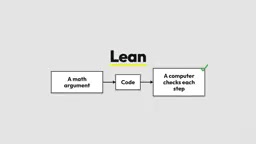
What is Lean? Simply put, it converts mathematical arguments into code, allowing a computer to verify step by step that the logical chain holds. The day after the proof was released, the team behind Lean and its mathematics library issued a statement saying "we are completely confident that the proof is correct." Fields Medalist James Maynard told Nature that he is inclined to believe the proof will ultimately be confirmed correct.
But skepticism exists as well. The mathematician publicly released a four-page outline, and number theorist Andrew Granville bluntly called it "a mess." He also pointed out the timing: the proof was released several days after Anthropic's IPO and the day after its valuation dropped. The mathematician addressed this himself in his document: "There is an obvious cynical take about the timing, but it is wrong." More dramatically, hours after he posted, a Stanford mathematician released a competing proof written entirely by humans with no AI involvement.
Lean and Formal Verification
Lean is an interactive theorem prover and also a programming language, initiated by Leonardo de Moura at Microsoft Research in 2013. Its core purpose is "formalized mathematics": writing mathematical definitions, theorems, and proofs precisely in the language of dependent type theory, then having a computer kernel verify step by step whether each inference conforms to logical rules. Unlike traditional "peer review," formal verification does not rely on the reviewers' experience and intuition—as long as the kernel passes, the proof is logically impeccable. Lean's mathematics library Mathlib currently contains over a million theorems and hundreds of thousands of definitions, making it one of the largest formalized mathematics libraries to date. This is precisely why, when the Lean team stated "we are completely confident that the proof is correct," the meaning is: every step of the proof has been verified by the machine kernel, and no logical gaps exist—provided that the formalized proposition itself faithfully represents the original Riemann Hypothesis.
VP vs VNP: Lean Verified It, but No One Verified What Lean Verified
The second paper targets a problem posed by Valiant in 1979, often called the algebraic cousin of P vs NP.
Consider a computational model that can only perform addition and multiplication. The determinant of a numerical matrix is easy to compute—a computer can do it in polynomial time. But replace all the minus signs in the definition of the determinant with plus signs, and you get the permanent. Just this one change causes difficulty to skyrocket—for a 13×13 matrix, the expansion of the permanent already has billions of terms.
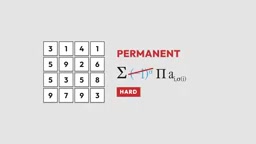
Valiant conjectured: no small addition/multiplication circuit can compute the permanent. This is the VP ≠ VNP conjecture. The new paper claims to prove, over all fields, that Valiant was right—the permanent requires more gates than any polynomial.
Lance Fortnow, who writes a complexity theory blog, called it "the most important complexity theory result of the year so far." Another mathematics blog reported that hours after Claude's release, ChatGPT also proved it.
The key question is here: Anthropic explicitly stated that both the paper and the Lean code were written by AI, and no human mathematician has checked the proof. So what exactly does the Lean check prove? It proves that: every step follows logically from the proposition stated at the top of the file. But no machine checks whether that proposition itself is the correct formalized statement of "VP ≠ VNP." Anthropic's explanation puts it directly: "No machine checks that this file says what it claims to say."
By analogy: a perfect spell checker can guarantee every word is spelled correctly, but it cannot guarantee the article answers the question. The remaining step is small but must be done by a human—read the proposition file and confirm it really says VP ≠ VNP. And even after confirmation, it doesn't touch the bigger prize: Fortnow's judgment is that solving P vs NP remains far out of reach for both humans and machines.
The VP and VNP Classes
VP and VNP are algebraic analogues of P and NP in complexity theory, proposed by Leslie Valiant in 1979. VP roughly corresponds to "families of multivariate polynomials computable by arithmetic circuits of polynomial size," while VNP corresponds to "families verifiable by arithmetic circuits of polynomial size," whose canonical complete problem is the permanent. Unlike Boolean complexity, arithmetic circuits allow only addition and multiplication gates, focusing on the computational complexity of polynomial coefficients. Valiant conjectured VP ≠ VNP, i.e., the permanent cannot be computed by arithmetic circuits of polynomial size. This conjecture is regarded as the algebraic cousin of P vs NP, because the two are deeply connected technically, though VP vs VNP is considered potentially more tractable. Nevertheless, progress over nearly half a century has been minimal, and the problem remains a central open question in algebraic complexity theory.
DeepMind's Quantum Agent: The Same Script, the Same Fine Print
Anthropic is not an isolated case. In November, Google DeepMind demonstrated work in which a team of Gemini 4 agents wrote quantum programs and checked them with Lean. The agent team shared notes on a wiki, debated in scheduled meetings, and one idea from a meeting reduced the cost of a certain program by 34%.
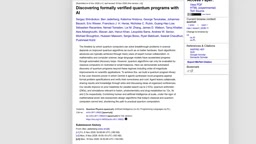
The headline numbers are impressive: a 290-fold saving on a certain arithmetic routine, and improvements of 12x, 8x, and 2.5x in simulations of fusion, photochemistry, and drug metabolism, respectively. But the fine print is equally familiar: the problems were chosen by humans, the specifications were written by humans, and the quantum resources required by these programs still far exceed the expected capabilities of first-generation fault-tolerant quantum computers.
Fault-Tolerant Quantum Computers
A fault-tolerant quantum computer is a quantum computing device capable of automatically detecting and correcting qubit decoherence and gate operation errors through quantum error-correcting codes. Because quantum states are extremely susceptible to environmental noise, achieving large-scale quantum computing must rely on fault-tolerance mechanisms. Current quantum hardware is in the "noisy intermediate-scale quantum" (NISQ) stage, with limited qubit counts and high error rates, and is still a considerable distance from true fault-tolerant quantum computers. The "first-generation fault-tolerant quantum computers" mentioned in the article typically refer to devices capable of running Shor's algorithm to factor large integers and simulate complex molecules, expected to require millions of physical qubits. Therefore, although the quantum programs written by DeepMind's agents have been verified with Lean, the hardware they target has not yet been built, and the resource requirements of these programs far exceed the capabilities of current or near-term expected quantum devices.
"Superintelligence Is Arriving": A Readable but Unverifiable Prediction
The most extravagant claim came from Meta AI head Alexander Wang. He published an article titled "Super Intelligence is Arriving," stating that many physicists would agree that compared to the Riemann Hypothesis, the atomic bomb is just a homework problem. His argument is: raw intelligence is no longer the bottleneck; what remains is engineering know-how, plumbing, and experimentation. He further wrote that models will obviously become intelligent enough to automate all AI research.
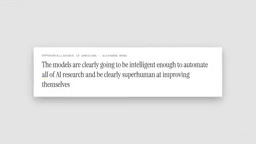
Not everyone is buying it. One reply pointed out that the title treats superintelligence as an accomplished fact, while the article never states that Meta will slow down. Gary Marcus wrote that whether this result has the generality people expect is "not at all obvious."
Machines Write Proofs, Humans Read Proofs
Put the known facts together:
- The Riemann Hypothesis proof has a human author, Lean verification, and experts inclined to believe it holds—but almost no one can read it.
- The VP vs VNP proof has Lean verification and zero human readers. Until someone finishes reading that proposition file, it is merely a claim.
- DeepMind's quantum programs are proven correct—but against specifications written by humans for quantum computers not yet built.
- Superintelligence is arriving? That is a prediction in an article, not a result anyone can check.
The real change lies in the division of labor. Machines now write proofs far faster than humans can read them, and checking has become the work left to humans. Anthropic's paper signed by Claude brings this question to the table: are you willing to trust a proof that no one has read?
The Boundaries of Formal Verification
The reliability of formal verification rests on two premises: first, every step of the proof script passes kernel checking; second, the formalized proposition faithfully reflects the original mathematical problem. Tools like Lean can only guarantee the former, not the latter. When translating a conjecture expressed in natural language into formal language, subtle deviations may occur—for example, in quantifier order, the scope of fields, conventions on matrix size, and so on. This "formalization gap" is a key bottleneck in current AI-assisted mathematics: machines can generate massive numbers of verifiable proof steps, but confirming "that what we proved is what we intended to prove" still requires human judgment. This is also why Anthropic emphasized in its explanation that "no machine checks that this file says what it claims to say," and why Fortnow believes that even if VP vs VNP is formally proven, solving P vs NP remains far out of reach.
One-line Summary
AI's mathematical capability leaps forward: machines write proofs faster than humans can read them, and verification becomes the new division of labor.
Paragraph Summary
The article reviews several recent breakthroughs in AI and mathematics: Anthropic, in collaboration with a mathematician, released a proof of the Riemann Hypothesis that passed Lean formal verification and has partial expert endorsement, but is so massive that humans struggle to read it through; another paper signed by Claude claims to solve the VP vs VNP problem, and although Lean-checked, no human has verified the proposition itself. DeepMind's Gemini 4 agents' quantum programs likewise rely on human specifications and target hardware that has not been built. Meta's superintelligence prediction lacks verifiability. The core conclusion: machines now write proofs faster than humans can read them, and verification work is becoming humanity's new division of labor.
Related articles

A 19-Year-Old's Rental Horror Story: Ceiling Collapse, Bug Infestation, and the Lessons It Taught Me
At 19, my first off-campus rental brought bug infestations, no heat, a collapsed ceiling, and a ruined laptop with no renter's insurance. Here are the hard-won lessons for first-time student renters.

Veda Nurse's Cranial Nerve Exam: Why ASMR Role-Play Is Going Viral
Bilibili creator Veda's cranial nerve exam ASMR video goes viral, blending humor and sensory triggers through nurse role-play. This article analyzes its unique appeal and the audience psychology behind ASMR role-play.

LG Cinebeam AI Review: 120-Inch Giant Screen + 3000 Lumens, a New Choice for the Living Room Theater
LG Cinebeam AI projector review: 3000 ANSI lumens, 4K, 100 inches from about 8 cm and 120 inches from about 18 cm. Built-in webOS, AI Concierge voice recommendations, AI Sound Pro 11.1.2 virtual surround, and Game Optimizer—positioned for fixed living room installation, complementing the portable Cinebeam S.