AI Quota Resets Soon—Don't Waste It! A Clever Trick from a Reddit User

Reddit discusses how to use AI quota efficiently before it resets; the consensus is to use it on demand, not deliberately burn it.
The article explores user anxiety before AI subscription quotas (such as ChatGPT Plus and Claude Pro) reset, drawing on discussions from Reddit and tech communities. It analyzes the sources of anxiety: rolling windows and fixed-period resets easily create a "use it or lose it" mindset, leading to meaningless conversations just to clear quota—essentially excessive attention to sunk costs. It then summarizes three efficient strategies: batching backlogged tasks, deeply exploring AI capability boundaries, and backing up chat logs and knowledge base summaries. The community is divided on whether to deliberately consume quota—one side says make the most of it, the other stresses using it on demand. The article concludes with practical tips such as building task lists, batch processing, and testing new features, and highlights the core conclusion: quota is a tool, not a goal.
Introduction: Pre-Reset Anxiety
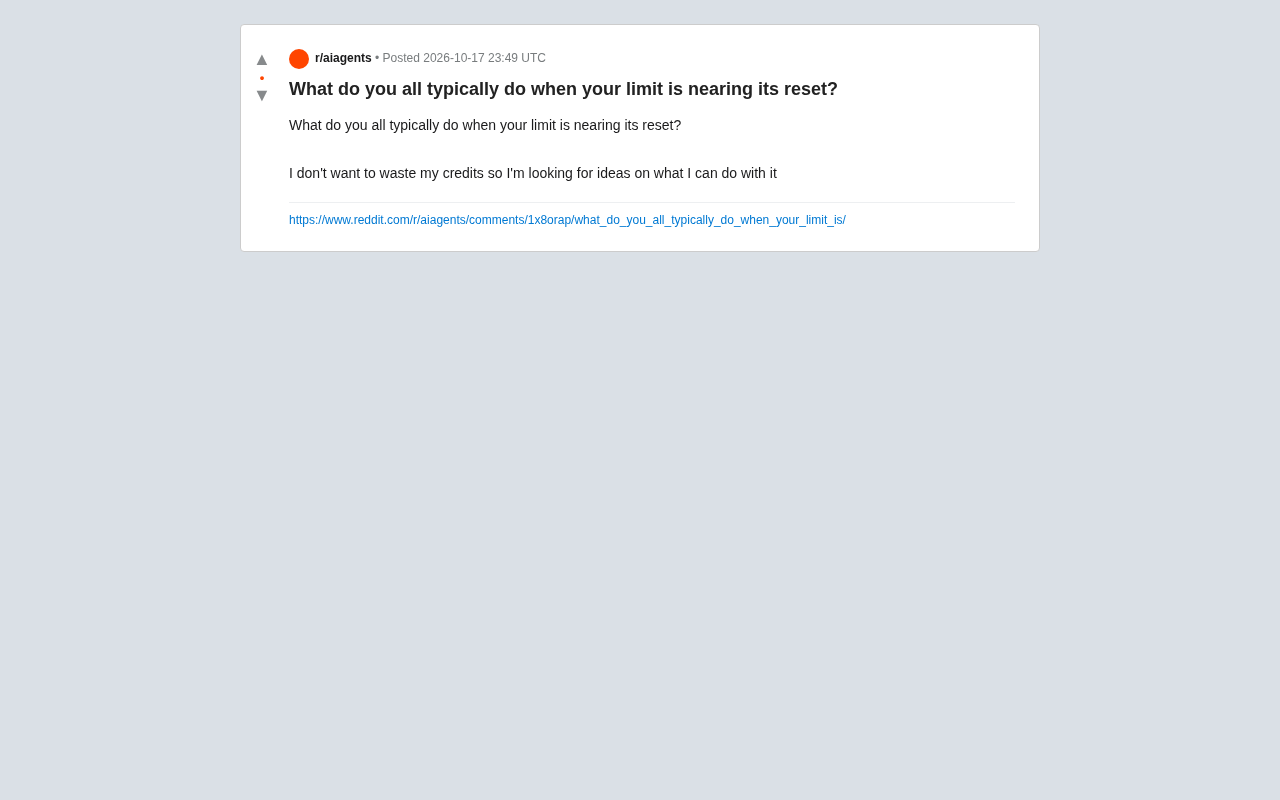
"My AI usage quota is about to reset, and I don't want to waste it—what do you usually do?" A recent question from a Reddit user sparked a lively discussion. It reflects a common pain point: many AI tools (such as ChatGPT Plus and Claude Pro) use periodic quota mechanisms, and users often fall into the anxiety of "waste if unused" before a reset.
This article combines the Reddit discussion and views from multiple tech communities to lay out practical strategies before a quota reset, helping you put every bit of quota to good use.
Why Do You Feel the Quota Is Being Wasted?
The Psychological Impact of Quota Mechanisms
Most AI services use a "rolling window" or "monthly reset" quota model. Users easily develop a "use it or lose it" mindset, and may even hold meaningless conversations just to consume quota. This psychology leads to low-quality interactions and actually wastes the AI's potential.
Rolling window and fixed-period reset are two common quota implementations. Understanding their differences helps you judge whether your sense of urgency is reasonable. A rolling window usually means the system calculates quota based on the cumulative number of requests or tokens within a recent period (such as 3 hours or 24 hours). As time passes, earlier consumption automatically "slides out" of the window and is released, so there is no clear "reset moment." A fixed-period reset zeroes out the count at the start of each calendar month or subscription cycle, and users do face the "use it or lose it" situation at the end of the cycle. In addition, different services define "quota" differently: some count messages, some count tokens (input and output calculated separately or combined), and some set separate limits for advanced models. Confusing these mechanisms easily amplifies anxiety. It is advisable to first check the specific billing terms in the service agreement, and then decide whether you need to concentrate usage before a reset.
Common Misconception: Using It for the Sake of Using It
According to Reddit users, many people repeatedly ask simple questions or have the AI generate irrelevant content just to "clear" their quota. This is actually a cognitive bias—the quota itself has no value; what has value is the tasks you complete with the AI.
Sunk cost fallacy is a classic concept in behavioral economics. It refers to people's tendency to keep investing resources to "recover" costs already paid (money, time, or effort), even when continuing to invest is itself irrational. In the AI subscription scenario, the monthly fee is a sunk cost that has already been paid and is non-refundable; no matter how much quota you use, that money will not change. Rational decision-making should consider only marginal benefits: can this conversation bring real value? When users repeatedly engage in low-quality interactions to "get their money's worth," the real costs are time, attention, and the risk of being misled by low-quality output. Recognizing that the monthly fee and usage volume are not an equivalent exchange helps shift attention from "quota balance" to "task completion."
Community Consensus: Efficient Strategies Before a Reset
Strategy 1: Batch-Process Backlogged Tasks
Multiple sources suggest concentrating on tasks that require large amounts of generation or analysis before the quota resets, such as batch-writing emails, organizing meeting notes, or generating report outlines. A Bilibili creator shared in a video: "Before the reset, I have the AI generate first drafts of a week's worth of copy, and then I revise them slowly."
Strategy 2: Deeply Explore the Boundaries of AI Capabilities
The YouTube channel "AI Evolution Theory" mentions that when quota is plentiful, it is a good time for "stress testing": trying complex reasoning, multi-turn conversations, code debugging, and other quota-consuming tasks to better understand the AI's strengths and weaknesses. This is more valuable than everyday simple Q&A.
Stress testing in software engineering means testing system behavior under conditions beyond normal load. Borrowed here, it means using high-difficulty, long-chain tasks to probe the model's performance boundaries. Specific examples include multi-step mathematical or logical reasoning, multi-turn conversations that require maintaining long-context consistency, cross-file code debugging, and structured data extraction and validation. Such tasks usually consume more tokens and are suitable when quota is abundant. During testing, it is advisable to record failure modes—for example, after how many turns the model starts forgetting earlier context, and under which types of instructions it tends to hallucinate. These observations can be turned into prompt design experience for later daily use, making "consuming quota" itself a productive capability assessment.
Strategy 3: Backup and Knowledge Management
Some users suggest using pre-reset quota to have the AI summarize chat logs, generate knowledge base summaries, or export important conversations. This way, even after the quota resets, the core information is already saved.
Divergent Views: Should You "Deliberately Consume" Quota?
Supporters: Make the Most of What You Paid For
Some Reddit users believe that since they have paid, they should make full use of the quota, even if it means some experimental attempts. This can bring unexpected gains.
Opponents: Using on Demand Is More Efficient
Another camp believes that deliberately consuming quota wastes time and energy. AI is just a tool and should be used according to actual needs. According to an analysis by a Zhihu respondent: "The time you waste trying not to waste quota may be worth more than the quota itself."
Practical Tips: Make Every Bit of Quota Count
Tip 1: Build a Task List
List in advance the tasks that need AI assistance, sort them by priority, and concentrate on high-value tasks before the reset.
Tip 2: Use Batch Processing
For text-generation tasks, you can give the AI multiple prompts at once and have it output in batches, improving quota efficiency.
Tip 3: Test New Features
Many AI platforms update their features. Use the time before a reset to test new capabilities, such as file uploads and web search, and you may discover new workflows.
Conclusion: Quota Is a Tool, Not a Goal
The discussion on Reddit reveals a simple truth: the anxiety before an AI quota reset is essentially excessive attention to "sunk costs." Rather than agonizing over how to "get your money's worth," it is better to focus your energy on tasks that truly need AI. The community consensus is that batching backlogged tasks, exploring capability boundaries, and backing up knowledge are the right ways to use quota efficiently. Remember, AI is a tool that serves you, not a task you need to complete.
Related articles

When Did Paid Childcare Become the Norm? Working Mothers and the Evolution of Childcare
When did paid childcare become the norm? This article traces the evolution from the rise of childcare centers in the 1970s–80s and the 1990s linking of federal subsidies to work requirements, to declining stigma and rising costs, and explores advocates' 25-year effort to catch up with other countries on childcare and paid parental leave.

Red Flags for Product-Market Fit: A Practical Guide from Top VCs and the Superhuman Founder
Investors from Iconiq and Sapphire Ventures and Superhuman founder Rahul Vohra share PMF red flags and practical methods, including the 40% disappointment rule, retention curves, and acquisition costs.

What Task Should AI Agents Take Over Most? Heated Reddit Discussion
Reddit discussion: Which task do you most want AI agents to take over completely? Cross-app data migration, CRM updates, and report generation top the list, but insufficient reliability and the trust gap are the biggest obstacles to automation adoption.