AI Reads Neural Network Weights? Understand the Method Before the Headline

Frontier agents can read and repair small network weights, but the headline demo is overhyped; the real value is automating the ML debugging loop.
The article dissects the AI weight-programming capabilities claimed in *Sparks of Weight Space Programming*. The core finding: the most eye-catching Math 500 improvement (7.9% to 48.1%) used Python and a test budget of up to 50 batches, while pure weight reading was only validated on small networks. Game recognition is overestimated because inputs are labeled—three lines of NumPy reproduce it. The math gain is actually clipping a loop direction and doesn't work on models that rarely loop. The real value: a frontier agent ran the ML engineer's debugging loop in one session, potentially making narrow repairs to small open-source models much cheaper. But weight edits are invisible to code review, so weights must be treated as code with hashing, change logs, and versioning. Reading such claims should focus on the methods table, tool use, failure cases, and independent reproduction.
A researcher handed 17,253 numbers—the weights of a small neural network that learned to play a certain game—to GPT-6 Astra and asked it to guess which game. All four networks were guessed correctly. This work, codenamed Sparks of Weight Space Programming, was done by Rikyei Tekhi, Jaden Teo, Alex Zhang, and Omar Khadab, and claims that frontier models can read network weights, repair weights, and even write new weights from scratch. The most eye-catching result: without any training, Astra changed only 0.016% of a small model's weights and raised its score on the Math 500 benchmark from 7.9% to 48.1%. The post racked up nearly 3,000 points on Hacker News, a clear sign of how heated the discussion was.

Part of the excitement lies in the direction it hints at: recursive self-improvement, where a model inspects and improves its own weights. Around the same time, Anthropic's updated IPO filing mentioned that its expectations for future models suggest the company may be approaching the threshold it set for "AI causing significantly accelerated progress," but it also explicitly stated that no current model has crossed that line. Put the two together, and it's easy to conjure associations with "the singularity is near." But what's truly worth reading is the method, not the headline.
What the Methods Table Reveals
Matthew Honnable (creator of Spacey) put each experiment into the same table: how large the network was, whether the model read the raw numbers, whether it could use Python, and whether it could actually run the network. The results are telling—the "no tools, pure raw numbers" setting appeared in only three experiments, involving networks ranging from 17,000 to 172,000 weights. The stunning Math 500 result, by contrast, used Python, and the model could actually run the network on up to 50 batches of practice problems.
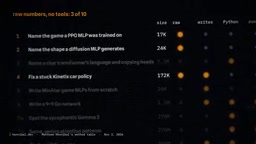
His analogy is apt: it's like a stage magician performing the same trick using several different techniques. The audience sees the same result, but each technique has completely different difficulty and implications. Conflating "running the network with Python" and "purely staring at the numbers and guessing" would seriously overestimate the model's capabilities.
Weight space refers to the high-dimensional space formed by all learnable parameters of a neural network. A model with 17,000 weights has a weight space that is a 17,000-dimensional real space; modern large models with hundreds of billions of parameters can have weight spaces of that magnitude. "Reading weights" means the model directly receives this string of numbers as input and infers the network's structure, function, or training state from them. This is extremely difficult in practice, because the mapping from weight vectors to network behavior is highly nonlinear, and weights obtained from different training runs can be arranged completely differently (permutation symmetry). This is exactly why the "pure raw numbers, no tools" setting has only been validated on very small networks—the lower the dimensionality, the more limited but reliable the inferable information; the higher the dimensionality, the more likely the model relies on surface statistics rather than genuine understanding.
Permutation symmetry is a key concept for understanding the difficulty of weight reading. In a neural network, swapping all input weights and output weights of two neurons in the same layer leaves the network's overall function completely unchanged. This means the same function can be realized by an exponential number of weight permutations. For weight-reading tasks, the model cannot simply memorize "the 3rd weight corresponds to some feature"; it must learn permutation-invariant representations. This is also why generating weights from scratch is harder than repairing existing weights: generation requires choosing a permutation consistent with the training distribution, while repair only requires local adjustments to an existing permutation.
Why Game Recognition Isn't That Magical
Sean Godecki added a simpler point: the inputs to those game networks are labeled—the agent, moving objects, reward targets. So "which grid cells each channel attends to" is easy to compute. He used three lines of NumPy code on publicly available Pac-Man weights to reproduce the maze diagram shown at the beginning of the video. In other words, the difficulty of the game-recognition "headline demo" itself may be overestimated.
As for the math improvement, Godecki pointed out that the model wasn't bad to begin with; it just got stuck in loops during long responses. Astra found the direction behind the loop and clipped it—this is more like what a competent researcher would do, not some supernatural ability. Editing weights can unlock capabilities the model already has, but cannot add new capabilities out of thin air. The authors themselves admit this: on Gemma, which rarely falls into loops, the same method did not change the score.
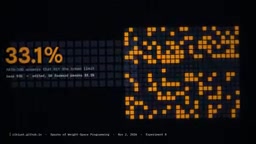
Repetition loops are a common failure mode when language models generate long responses: the model repeatedly outputs the same or highly similar phrases, sentence patterns, or reasoning steps and cannot break out on its own. On math benchmarks like Math 500, such loops waste a large number of tokens and lead to incorrect final answers. What Astra did by "clipping the loop direction" is essentially finding a low-dimensional direction in weight space associated with looping behavior and making a tiny perturbation along that direction (only 0.016% of weights). This is similar to the idea of weight editing or model surgery: instead of retraining, locate and modify a subset of parameters associated with a specific behavior. Such methods can unlock capabilities the model already has but that are suppressed, yet cannot create new capabilities absent from the training data—which explains why the same operation is ineffective on Gemma, which rarely falls into loops.
Math 500 is a commonly used benchmark for measuring mathematical reasoning, containing 500 competition-style math problems whose answers usually require exact matching. A baseline of 7.9% means the model fails on the vast majority of problems, while 48.1% indicates that after repair the model can correctly solve nearly half. Note, however, that this improvement was achieved under conditions allowing the model to use Python and actually run the network on up to 50 batches of practice problems—not pure weight reading or zero-shot reasoning.
A Cold Shower and Warmth from Independent Reproduction
Simon Willison tried the game prompt on his own laptop with Qwen 3.8B. After 46 minutes and 43,000 reasoning tokens, it recognized Pac-Man, then Pong, then Breakout, but missed Freeway. His conclusion: impressive, but an experienced human with a notepad and pencil could probably do the same.
This isn't disparagement; it's calibration. Only by placing these experiments in the right frame of reference can we judge what they actually advance and what they don't.
What Actually Happened
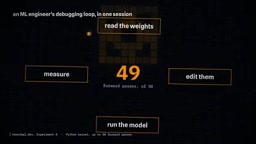
Not superhuman weight reading. Something more practical: a frontier agent, given Python and a test budget, ran the machine-learning engineer's debugging loop on a small model within a single session. This is indeed useful—narrow-scope repairs to small open-source models could become much cheaper.
But there's another side: model files are now things agents can modify. That Qwen edit touched 131,000 of 800 million weights, invisible to any code review. The authors even propose a reverse use: having models audit weights for hidden issues, such as backdoors, without running any tests.
Weight backdoors refer to malicious behaviors implanted during model training, possibly triggered by a specific input pattern, while the model behaves perfectly normally otherwise. Because backdoors are encoded in weights rather than code, traditional code review, input-output testing, and even some red-teaming are hard-pressed to detect them. The reverse use proposed by the authors—having an agent audit hidden issues in weights—leverages the model's ability to directly read weights to detect anomalous parameter patterns without running tests. This complements traditional model scanning methods: the latter typically rely on activation analysis or specific trigger searches and require many forward passes; weight-space auditing could theoretically be done at zero inference cost, though its reliability remains to be verified.
Hashing and change logs are necessary in weight management because of a simple fact: model files are binary large objects, and traditional diff tools cannot produce meaningful differences. Cryptographic hashing (e.g., SHA-256) of weight files ensures that the deployed model exactly matches the reviewed version; keeping a change log of every agent modification (including which parameters were changed, by how much, and evaluation results before and after) provides traceability. Retaining the original version for rollback is the last line of defense against accidental or malicious weight modification. This practice borrows from artifact management in software supply-chain security, treating model weights as software artifacts that require version control, signing, and auditing.
How to Read Claims Like This
Before building anything based on such claims, you can follow five steps: first, find the methods table—don't just read the abstract; second, ask what tools the model used and whether it could run the thing it was modifying; third, look for failure cases—failures tell you where the boundaries are; fourth, wait for independent reproduction; fifth, if agents can edit models in your deployment environment, treat weights as code—hash them, log changes, and keep original versions for rollback.
The interesting part is never the headline; it's the method.
One-line Summary
Frontier agents can read and repair small network weights, but the headline demo is overhyped; the real value is automating the ML debugging loop.
Paragraph Summary
The article dissects the AI weight-programming capabilities claimed in Sparks of Weight Space Programming. The core finding: the most eye-catching Math 500 improvement (7.9% to 48.1%) used Python and a test budget of up to 50 batches, while pure weight reading was only validated on small networks. The game-recognition task's difficulty is overestimated because inputs are labeled—three lines of NumPy suffice to reproduce it. The math improvement is actually clipping a loop direction and does not work on models that rarely loop. The truly valuable result is that a frontier agent ran the ML engineer's debugging loop within a single session, potentially greatly reducing the cost of narrow-scope repairs to small open-source models. But weight modifications are invisible to code review, requiring weights to be treated as code with hashing, change logs, and version management. Reading such claims should focus on the methods table, tool use, failure cases, and independent reproduction.
Related articles

DSH + Ollama Local LLM Deployment in Practice: Free Chat with Da Fei Yu
Bilibili creator tests DSH + Ollama local LLM deployment end to end: Ollama install, Xunlei-accelerated downloads, ModelScope GGUF model import, DSH custom API address setup, and a comparison of Qwen 3.5 4B, 8B, Gemma, and other models on 8GB VRAM, with advice on choosing local deployment vs. API calls.

Tested: A $899 Mac Mini vs. a $200/Month AI Subscription
Real-world test of whether an M4 Mac mini can replace a $200 AI subscription: 16GB can't fit large models, and both speed and quality fall short—but privacy, no caps, and near-zero running costs make it an ideal host for an always-on agent. Includes buying advice per configuration and money-saving strategies.

RSTGameTranslation: Real-Time OCR Localization + Offline Translation with Local LLMs
RSTGameTranslation is an open-source real-time Windows game translation tool: OCR for English, Japanese, and Korean with Chinese overlays in place, plus Ollama or LM Studio local LLM offline translation and Whisper speech transcription for games, manga, and visual novels.