AI Receptionists Are Everywhere—The Real Opportunity Is a Full Workflow System

AI front desk supply is excessive; selling call answering alone is unsustainable—providers must transform into full-workflow lead-handling systems.
An 8-year software engineer shares Reddit observations on the AI voice and SMS agent market. With GHL's built-in voice AI and tools like Retell and Vapi lowering the barrier, AI receptionist products have become a red ocean, and selling "call answering" alone can hardly sustain a monthly fee. Business owners often misdiagnose the problem as missed calls, but what actually gets lost most is delayed responses to web forms and social leads. Proving ROI is difficult because call volume cannot directly reflect business growth. The real moat lies in system integration beyond the call—calendar rules, CRM sync, human transfer handling—with prompts only 10% of the work. He suggests providers sell a full-workflow "best front desk that never clocks out" system accountable for lead conversion and bookings.
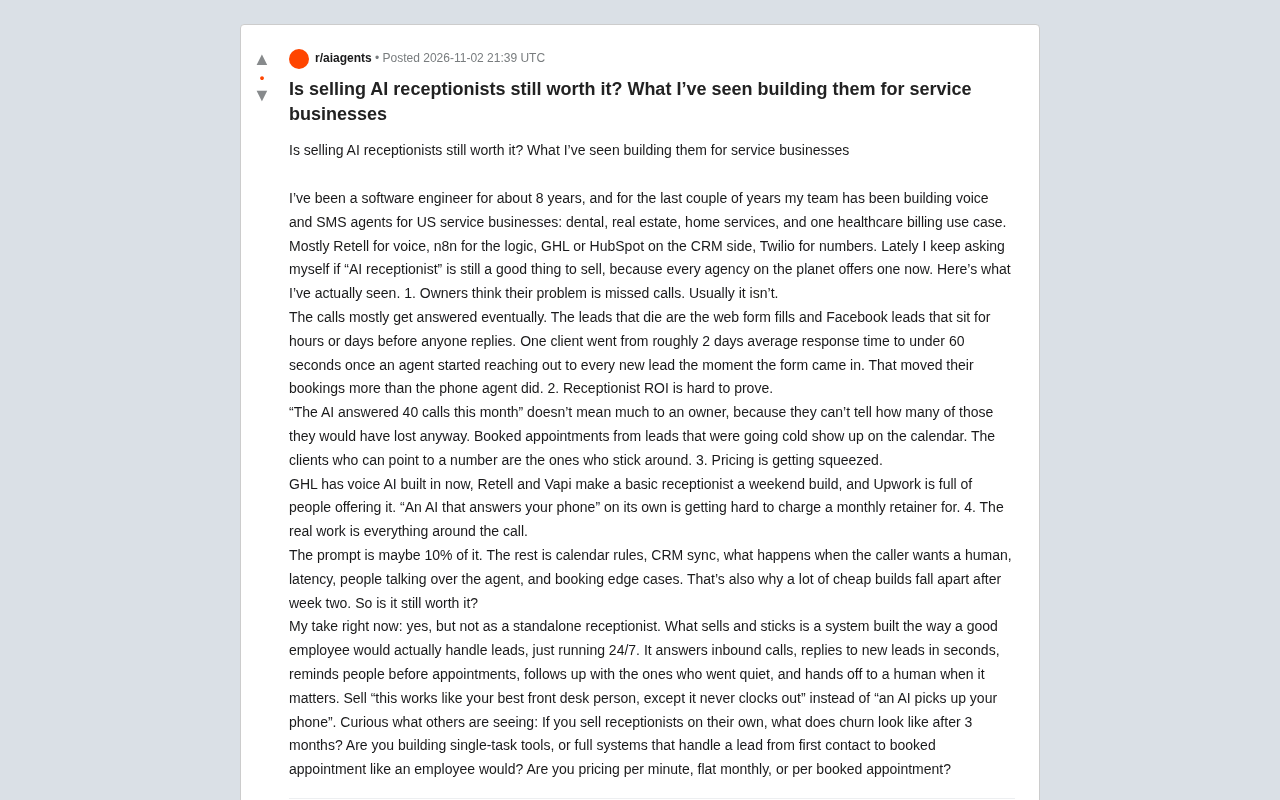
A software engineer with 8 years of experience posted on Reddit, sharing observations from building voice and SMS AI agents for U.S. service businesses (dental, real estate, home services, and one medical billing case). His team mainly uses Retell for voice, n8n for logic orchestration, GHL or HubSpot as the CRM, and Twilio for phone numbers. Facing the current situation where "every agency is selling an AI receptionist," he raised a sharp question: is it still worth selling "AI answering calls" alone?
Market Reality: AI Receptionists Are Already a Red Ocean
According to this engineer, the supply side of AI receptionist products is already extremely crowded. GHL (GoHighLevel) has built-in voice AI features, Retell and Vapi have turned building a basic receptionist into a "weekend project," and Upwork is packed with freelancers offering similar services. This means that "an AI that can answer your calls" alone is already hard-pressed to sustain a fixed monthly service fee.
Pricing pressure follows. When the technical barrier disappears, a price war is inevitable. For service providers, if the product's value remains at the level of the action of "answering," clients can easily find cheaper alternatives.
GoHighLevel (GHL) is a CRM and marketing automation platform for marketing agencies. Its built-in voice AI features mean agencies can offer basic AI answering services to clients without an additional tech stack. Retell and Vapi are developer platforms focused on voice AI agents, providing APIs and low-code tools that let developers quickly build, test, and deploy voice bots. The maturity of these tools has significantly lowered the development barrier for AI receptionists, enabling a basic usable voice agent to go from concept to launch in just days or even a single weekend, thereby intensifying competition on the supply side.
Core Insight: Owners Misdiagnose the Problem
The engineer points out that business owners usually think their problem is "missed calls," but the reality is often different. Most calls eventually get answered; what really dies are potential customers from web forms and Facebook leads—leads that sit unanswered for hours or even days.
He gave a client case: after starting to have an AI agent contact every new lead the moment a form is submitted, that client's average response time dropped from about 2 days to under 60 seconds. The increase in bookings from this change was even greater than what the phone voice agent brought. This shows that if service providers only focus on "answering calls," they may be missing a much larger value gap.
Web forms and Facebook leads refer to contact information submitted through a company's website inquiry form or Facebook ad lead forms. These leads usually carry clear purchase intent but require timely follow-up to convert. If the response is delayed by hours or even days, the lead's purchase intent drops sharply, because customers often turn to competitors who respond faster. In service industries (such as dental and real estate), the timeliness of leads is especially critical; fast responses can significantly improve appointment conversion rates.
Why Is Front Desk ROI Hard to Prove?
"The AI answered 40 calls this month"—this statement means little to a business owner, because they cannot determine how many of those would have been missed anyway. What truly moves clients is bookings converted from leads on the verge of being lost, which show up concretely on the calendar.
Clients who can point to specific numbers are the ones who will renew long-term. This reveals a key point: proving the value of an AI receptionist needs to be directly tied to business outcomes (bookings, revenue), not停留在 activity metrics.
ROI (return on investment) is hard to quantify in the AI receptionist scenario because traditional metrics such as "number of calls answered" cannot directly reflect business growth. What business owners need is attributable incremental value, such as bookings converted from leads that would have been lost without the AI's fast response. Only by tying the AI system's performance to specific business outcomes (such as new appointments on the calendar) can clients intuitively feel the return on investment and be willing to pay long-term.
The Real Moat Is Beyond the Call
The engineer emphasizes that the prompt accounts for only about 10% of the entire work. The remaining 90% is: calendar rules, CRM sync, how to handle when a customer asks for a human transfer, latency optimization, handling interruptions when users talk over the AI, and various booking edge cases. This is also why many cheap builds start falling apart in the second week.
"What sells and sticks is a system built the way a good employee would actually handle leads, just running 24/7."
His conclusion is: AI receptionists are still worth selling, but not as a standalone product. What truly sells and retains clients is a system built the way an excellent employee would handle leads—it answers incoming calls, responds to new leads within seconds, reminds clients before appointments, follows up on silent leads, and hands over to a human at critical moments.
A prompt is the text instruction that guides an AI agent on how to understand and respond to customer input; it determines the basic logic and style of the conversation. However, in actual deployment, optimizing the prompt alone is far from enough. Calendar rules involve appointment availability, buffer time, time zone handling, etc.; CRM sync requires the AI agent to read and write customer data in real time to ensure consistency; human transfer logic requires seamless switching when customers request it or in complex scenarios; latency optimization concerns response speed to avoid making users wait too long; and interruption handling requires dealing with users cutting off the AI mid-sentence. Handling these edge cases requires deep business understanding and system integration, which constitute the real technical moat.
Repositioning: Sell "the Best Front Desk That Never Clocks Out"
He suggests that service providers change their sales pitch: don't sell "an AI that answers your calls," but sell "this system is like your best front desk employee, except it never clocks out." This positioning shifts the value from a single feature to full workflow coverage, and naturally solves the problem of hard-to-prove ROI—because the system is directly responsible for lead conversion and bookings.
At the end of the post, he asked peers three questions: if you sell the receptionist separately, what is the churn rate after 3 months? Are you building a single-task tool, or a complete system that handles everything from first contact to booking like an employee? Is pricing per minute, a fixed monthly fee, or per booking?
These questions all point in the same direction: the AI front desk dividend is shifting from "whether you have it" to "whether it works well and can be accountable for results". For service providers, deepening integration depth and business understanding may be more important than chasing the next voice AI framework.
One-line Summary
AI front desk supply is excessive; selling call answering alone is unsustainable—providers must transform into full-workflow lead-handling systems.
Paragraph Summary
A software engineer with 8 years of experience shared observations on the AI voice and SMS agent market on Reddit. He noted that with GHL's built-in voice AI and tools like Retell and Vapi lowering the barrier, AI receptionist products have fallen into a red ocean, and selling "call answering" alone can hardly sustain a monthly fee. Business owners often misdiagnose the problem as missed calls, but what actually gets lost most is delayed responses to web forms and social leads. Proving ROI for an AI front desk is difficult because call volume cannot directly reflect business growth. The real moat lies in system integration beyond the call—calendar rules, CRM sync, human transfer handling, etc.—with prompts accounting for only 10% of the work. He suggests service providers transform into selling a full-workflow "best front desk that never clocks out" system that is directly accountable for lead conversion and bookings, rather than a point tool.
Related articles

Qwen 3.8 Beats Opus at Coding—But Can Your Mac Run It?
Open-source Qwen 3.8 beats Opus 4.6 at coding at just 18GB, but how much Mac memory do you need? 24GB crashes; 32GB is the sweet spot. Full config guide inside.

Claude Code + Agent: Building a Fully Automated AI Testing Loop
Bilibili course breakdown: how test developers can use Claude Code terminal-based Agents to build a fully automated AI testing loop. Compares permission boundaries of terminal vs. device Agents, explains why enterprise projects choose Claude Code over Open Claude-type tools, and outlines the Node.js environment setup and DeepSeek model integration path.

Working with AI Agents Requires Nerves of Steel
The more autonomous AI agents become, the heavier the user's psychological burden. Drawing from a Hacker News discussion, this article analyzes black-box anxiety, behavior drift, and monitoring fatigue in agent collaboration, and offers practical approaches like sandbox isolation, permission control, and task granularity management to reduce cognitive load.