AI SDK Adds ZAI Provider: A Breakdown of @ai-sdk/zai 2.0.10

Vercel AI SDK's ZAI provider released the 2.0.10 patch, syncing dependencies with no breaking changes.
@ai-sdk/zai released patch 2.0.10, a backward-compatible dependency sync that only bumps @ai-sdk/provider-utils to 4.0.58 and @ai-sdk/openai-compatible to 2.0.82, with no API-level changes. The package lets developers call ZAI models via Vercel AI SDK's unified interface; it's built on openai-compatible, meaning switching models only requires swapping the provider instance. The article notes the update's own value is limited but confirms the provider is still maintained, lowering compatibility and security risks for production projects; developers can upgrade directly and run existing tests.
Vercel's AI SDK ecosystem is expanding once again. Recently, @ai-sdk/zai@2.0.10 was released as a patch update on GitHub, which means developers can now call ZAI's model capabilities through the unified AI SDK interface.
What Exactly Changed in This Update
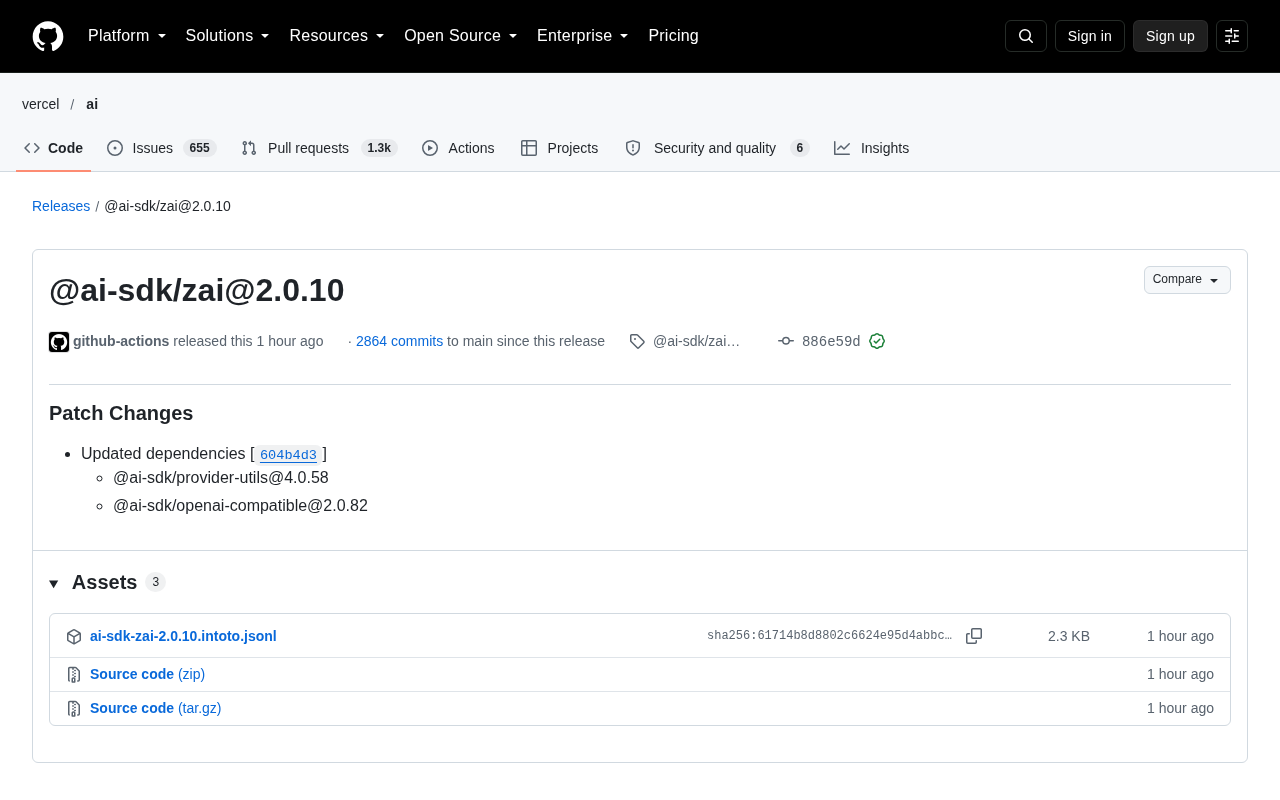
According to the release notes, @ai-sdk/zai@2.0.10 is a Patch Changes release, meaning it's a backward-compatible fix or dependency refresh. There's only one core change: the underlying dependencies were updated, with @ai-sdk/provider-utils bumped to 4.0.58 and @ai-sdk/openai-compatible bumped to 2.0.82.
This kind of "dependency sync" is very common in monorepos. AI SDK uses unified version management, so whenever a foundational package like provider-utils or openai-compatible changes, all downstream provider packages follow with a version bump to keep the dependency tree consistent. For users, this upgrade usually requires no code changes, but it's worth tracking in your package.json.
Why @ai-sdk/zai Is Worth Paying Attention To
ZAI joining the AI SDK ecosystem as a model provider has several practical implications.
A Unified Interface Reduces Migration Costs
AI SDK's biggest selling point is abstracting different vendors' models into a single calling convention. @ai-sdk/zai is built on openai-compatible, which indicates that ZAI offers an OpenAI-compatible API shape. Developers can call it using functions like generateText and streamText, and switching models only requires swapping the provider instance—your business code stays essentially untouched.
@ai-sdk/openai-compatible is a special "universal adapter" in the AI SDK ecosystem: it assumes the target service implements OpenAI's REST API contract—the same /chat/completions path, the same Authorization: Bearer authentication, and the same SSE streaming chunk format. As long as a vendor exposes its interface according to this contract, the adapter can be reused directly without writing a provider from scratch. ZAI taking this route shows it chose to "compatible with the de facto standard" rather than "build its own spec." The upside is fast integration and a small maintenance surface; the trade-off is that it can't expose unique capabilities beyond the OpenAI protocol. For developers, this also means you can configure ZAI's request parameters using your experience with OpenAI's documentation.
Patch Updates Reflect Maintenance Activity
A 2.0.10 patch release may seem unremarkable, but it proves the provider is still being actively maintained. For production projects, an SDK package that hasn't been updated in a long time is a hidden risk; continuously tracking upstream dependencies means compatibility and security fixes can be delivered in a timely manner.
Vercel AI SDK is an open-source TypeScript toolkit from Vercel for unified calling of various large language models in web applications. Its core design is the "provider adapter layer": each model provider (such as OpenAI, Anthropic, Google, ZAI) corresponds to an independent provider package responsible for translating that vendor's authentication method, request body structure, and streaming response format into the standard interface defined by AI SDK. Upper-layer applications only need to depend on functions like generateText, streamText, and generateObject exposed by the main ai package, without being aware of underlying differences. This architecture downgrades "switching models" from modifying business code to swapping a provider instance, and also allows the ecosystem to expand horizontally—as long as a vendor is willing to be adapted, developers can integrate it at extremely low cost.
SemVer (Semantic Versioning) specifies that a version number consists of three parts: "major.minor.patch." A major version change represents incompatible breaking changes, a minor version represents backward-compatible new features, and a patch number represents only backward-compatible bug fixes. The 2.0.10 mentioned in this article is patch-level, meaning the upgrade won't affect how existing APIs are called. In the npm ecosystem, range declarations like ^2.0.10 allow automatic acceptance of all updates within the same major version, so for projects on 2.x, running npm update will usually pull in this patch automatically without manually changing the version number.
What Developers Should Do
If you're already using ZAI models in your project, you can upgrade directly:
npm install @ai-sdk/zai@2.0.10
If you're using it alongside the main ai package, it's a good idea to also confirm there are no conflicts with the versions of ai and @ai-sdk/provider-utils. Since this is a dependency-level patch, running your existing type checks and unit tests after upgrading is sufficient; breaking changes are unlikely.
For teams that haven't integrated yet, you can start by testing it on a small-scale feature to verify whether key paths like streaming output and tool calling meet your needs, then decide whether to expand usage.
Industry Perspective: Standardization Attempts Amid Provider Fragmentation
The fragmentation of model APIs has long been a pain point for developers. Every vendor differs in authentication, request body, and streaming format. AI SDK's approach is to absorb these differences with a provider adapter layer, so upper-layer applications only face a unified abstraction.
ZAI integrating through the openai-compatible path is exactly a reflection of this approach—rather than inventing its own API spec, it's better to be compatible with the de facto standard and lower the barrier for developers. It's reasonable to expect more model providers to take a similar route going forward.
Beyond AI SDK, there are several similar standardization attempts in the industry. OpenAI's own API spec has in fact become the most widely imitated "de facto standard," with a large number of domestic and open-source model services offering OpenAI-compatible endpoints. Running in parallel is aggregation gateways like OpenRouter, which connects to multiple upstream models and exposes a unified OpenAI-style interface downstream—similar in spirit to AI SDK's provider layer, except the former is a server-side proxy and the latter is a client-side library. These solutions all point to one trend: model capabilities can compete on differentiation, but calling protocols are rapidly converging.
Summary
@ai-sdk/zai@2.0.10 is a routine dependency-sync patch with no API-level changes. Its value isn't in the changes themselves, but in confirming ZAI's continued presence and maintenance within the AI SDK ecosystem. For projects that want to call multiple models through a unified interface, this is a provider worth adding to your shortlist.
One-line Summary
Vercel AI SDK's ZAI provider released the 2.0.10 patch, syncing underlying dependencies with no breaking changes.
Paragraph Summary
The @ai-sdk/zai package released patch version 2.0.10, a backward-compatible dependency-sync update that only bumps @ai-sdk/provider-utils to 4.0.58 and @ai-sdk/openai-compatible to 2.0.82, with no API-level changes. This package lets developers call ZAI models through Vercel AI SDK's unified interface. It's built on openai-compatible, indicating ZAI adopts an OpenAI-compatible API shape, so switching models only requires swapping the provider instance. The article argues that while this update's value is limited on its own, it proves the provider is still actively maintained, meaning lower compatibility and security risks for production projects; developers who need it can upgrade directly and run existing tests to verify.
Related articles

WorkBuddy Full Tutorial: Build an AI Office Automation Agent from Scratch
A complete WorkBuddy tutorial: installation, three working modes, multimodal picture book video practice, expert team agent building, and workflow configuration for low-cost AI office automation.

WorkBuddy Agent Complete Guide: From Beginner to Automation in 7 Days
Based on Bilibili's 256-episode WorkBuddy masterclass, this systematically breaks down Tencent's AI office workbench core capabilities: Agent principles, Skill encapsulation, cross-platform connectors, scheduled automation, knowledge bases, and zero-code development, with learning path recommendations.

8 AI Accounts, 7 Failed: An Honest Review of Using AI to Get Work Done
Only 1 of 8 AI-run Bilibili accounts succeeded. We break down the real difference between "performing AI" and "using AI to get work done."