AI SDK and LlamaIndex Integration Update: Version 2.0.336 Released
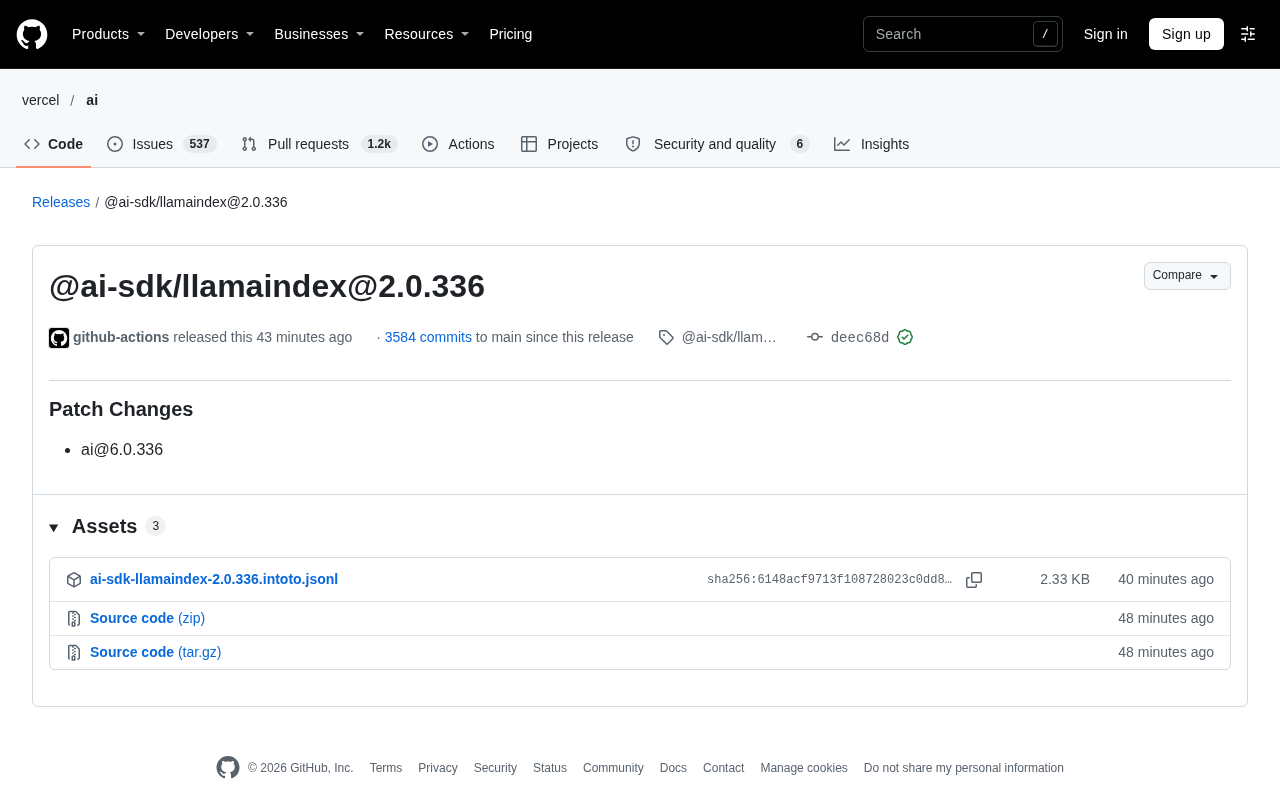
@ai-sdk/llamaindex releases patch 2.0.336, synced with ai@6.0.336, reflecting the AI toolchain's modularization trend.
@ai-sdk/llamaindex has released patch 2.0.336, primarily aligned with ai@6.0.336. The patch contains no breaking changes—mainly fixes and minor optimizations—so upgrade risk is low. It enables unified model calls via AI SDK alongside LlamaIndex's data indexing, simplifying RAG development. Teams should sync updates, use lockfiles, and add CI upgrade tests.
The integration package between AI SDK and LlamaIndex, @ai-sdk/llamaindex, has released version 2.0.336. At first glance, this update seems like just another increment of the trailing digit in the version number, but it reflects a broader trend: the AI application development toolchain is accelerating toward integration.
What the Version Update Actually Contains
According to the changelog published on GitHub, @ai-sdk/llamaindex@2.0.336 is a patch release (Patch Changes), primarily aligned with the release of ai@6.0.336. This means the two packages stay in sync on version cadence, and developers can expect consistency in features and behavior between them.
Patch releases typically contain no breaking changes—mostly bug fixes and minor optimizations. For teams already using this combination, the upgrade risk is low, but new features should not be expected either. The high frequency of such releases reflects the maintenance team's emphasis on responsiveness and iteration speed.
Looking at the commit history, this version corresponds to the state of the main branch after 3,584 commits, with commits verified by GitHub signature. While this engineering practice isn't directly user-facing, it has real significance for the security and traceability of the dependency chain.
Patch Versions and Semantic Versioning (SemVer)
In the Node.js ecosystem, version numbers typically follow the Semantic Versioning specification (SemVer), formatted as major.minor.patch. An increment in the patch number indicates backward-compatible bug fixes, a minor version increment indicates backward-compatible feature additions, and a major version increment indicates breaking changes. The version number of @ai-sdk/llamaindex has reached 2.0.336, with the patch number as high as 336, indicating that the maintenance team adopts a high-frequency release strategy—possibly publishing a new version with every merged PR or bug fix. This practice is common in large open-source projects, but it also requires users to precisely control dependency versions through lockfiles (such as package-lock.json or yarn.lock) to avoid potential risks from automatic upgrades.
Why This Integration Matters
AI SDK is an open-source toolkit from Vercel that aims to unify the way different AI model providers are called. LlamaIndex focuses on data frameworks, excelling at connecting private data with language models, and is widely used in retrieval-augmented generation (RAG) scenarios.
The integration package @ai-sdk/llamaindex addresses a specific problem: developers want to call models through AI SDK's unified interface while leveraging LlamaIndex's data processing and indexing capabilities. Without this integration, teams often have to write their own adapter layer, which carries significant maintenance costs.
The existence of this package shows that AI application development is evolving from "hand-written glue code" toward "standardized component composition." For teams building applications such as knowledge base Q&A and document analysis, integrations like this reduce repetitive work and let them focus on business logic.
Retrieval-Augmented Generation (RAG)
Retrieval-Augmented Generation (RAG) is a technical paradigm that combines external knowledge bases with large language models. Its core workflow is: first split and vectorize private documents and store them in a vector database; when a user asks a question, the system retrieves the most relevant document fragments from the database, then submits the fragments as context along with the question to the language model, producing fact-based answers. RAG can effectively mitigate model hallucinations, overcome the timeliness limitations of training data, and avoid the high cost of fine-tuning. LlamaIndex is a data framework designed specifically for RAG scenarios, providing abstractions such as document loading, index construction, and retrievers, while AI SDK is responsible for unifying the model invocation layer. Together, their integration simplifies the development pipeline for RAG applications.
How Developers Should Use It
If you already use both AI SDK and LlamaIndex in your project, pay attention to version alignment. This release explicitly associates @ai-sdk/llamaindex@2.0.336 with ai@6.0.336, so it's best to update them together to avoid interface incompatibilities caused by version mismatches.
For teams that haven't adopted this combination yet, first evaluate your own scenarios. If your application needs to process large amounts of private documents, build retrieval pipelines, and maintain flexibility in model invocation, this integration is worth trying. If you only need simple API calls, using the core AI SDK package directly may be more lightweight.
The frequency of patch releases also suggests one thing: when depending on fast-iterating open-source packages like this, it's advisable to pin version numbers or use lockfiles, and to include upgrade tests in your CI pipeline to avoid unexpected issues from automatic upgrades.
Lockfiles and CI Upgrade Testing
A lockfile is a dependency tree snapshot automatically generated by package managers (npm, yarn, pnpm, etc.), precisely recording the version number and download URL of each dependency. Committing the lockfile to version control ensures that all developers and CI environments install exactly the same dependency versions, avoiding unexpected changes from automatic pulls of new versions due to semantic version ranges (such as ^2.0.336). In continuous integration (CI) pipelines, you can add a periodic job that specifically tests whether builds and tests pass after upgrading to the latest patch version. This catches compatibility issues early without affecting the stability of the main branch. For fast-iterating open-source packages, this strategy lets you enjoy the benefits of fixes while controlling risk.
The Trend Toward Toolchain Integration
From a broader perspective, the continuous updates to @ai-sdk/llamaindex are a microcosm of the AI development toolchain moving toward modularization. In the past, developers had to assemble model invocation, data processing, prompt management, and other components themselves; now, more and more integration packages connect these pieces.
This trend is good for the ecosystem, but it also brings selection costs. Teams need to judge which integrations are truly necessary and which merely add dependency complexity. The release of a patch version itself carries limited information, but it reminds us to pay attention to changes in the relationships between underlying tools.
For technical decision-makers, rather than chasing every version number, it's better to periodically review the dependency structure: which packages are actively maintained, which integrations are actually used by the project, and which can be removed. Version numbers are surface-level; dependency health is what matters in the long run.
One-line Summary
@ai-sdk/llamaindex releases patch 2.0.336, synced with ai@6.0.336, reflecting the modularization trend in the AI toolchain.
Paragraph Summary
@ai-sdk/llamaindex has released patch version 2.0.336, primarily aligned with the release of ai@6.0.336, with both packages staying in sync on version cadence. This patch contains no breaking changes—mainly bug fixes and minor optimizations—so upgrade risk is low. The article notes that this integration package enables developers to call models through AI SDK's unified interface while leveraging LlamaIndex's data indexing capabilities, simplifying development for scenarios like RAG. For teams already using this combination, it's recommended to update related packages together when upgrading, use lockfiles to pin versions, and add upgrade tests to CI. From a broader perspective, the continuous updates to such integration packages reflect the AI development toolchain's move toward modularization and standardization; teams should focus on dependency health rather than simply chasing version numbers.
Related articles

Unkernel: Compiling the Linux Kernel to WebAssembly
The Unkernel project compiles a real Linux kernel to WebAssembly, making it possible to run a complete kernel in the browser. This article covers its technical principles, challenges, and prospects.
New Claude Sonnet Model Tested: Performance Approaches Opus with Less Thinking
Anthropic quietly tests a new Sonnet model in Claude Code—performance approaches Opus 5.5 with far fewer thinking tokens, plus Codex transfer optimization, xAI's low-level rewrite, Google Antigravity updates, and the AI science understanding gap.

Building a Reasoning Model from Scratch: Making Complex AI Algorithms Accessible
Mike Finley, author of Build a Reasoning Model from Scratch, shows how a few hundred lines of code, single-sample training, and code reuse make complex AI algorithms like RL and verifiers accessible to all.