AI SDK Ecosystem Update: sandbox-vercel Releases 1.0.162 Patch

@ai-sdk/sandbox-vercel releases 1.0.162 patch, with core changes in harness — a low-risk maintenance update.
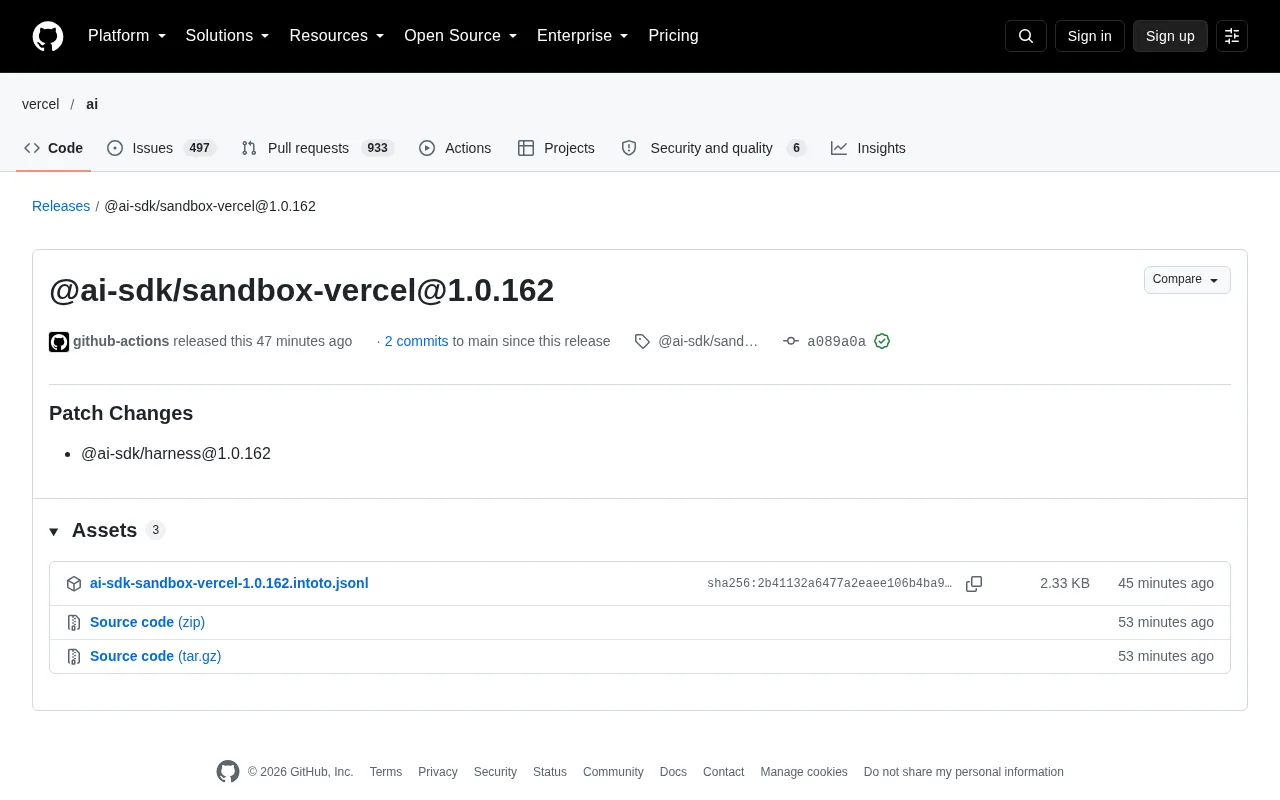
@ai-sdk/sandbox-vercel released version 1.0.162 (commit a089a0a), auto-published by github-actions with a GitHub verified signature. The release notes mark it as Patch Changes, with core changes in @ai-sdk/harness@1.0.162; sandbox-vercel appears to just follow harness's version bump. The article explains SemVer patch rules and the AI SDK's unified versioning strategy, and advises reviewing harness commits and keeping both packages in sync before upgrading.
The AI SDK ecosystem moves fast, and this release of @ai-sdk/sandbox-vercel 1.0.162 — alongside a synchronized update to @ai-sdk/harness — is worth noting for developers using Vercel sandbox capabilities.
Release Overview
According to the release record on GitHub, @ai-sdk/sandbox-vercel version 1.0.162 was auto-published by github-actions with commit hash a089a0a, and the commit carries a GitHub verified signature (GPG key ID: B5690EEEBB952194). The release sits just two commits ahead of the main branch, making it a typical patch-level update.
Per the release notes, the change type is marked as Patch Changes, with the core changes concentrated in @ai-sdk/harness@1.0.162. This suggests sandbox-vercel itself likely just follows harness's version bump in sync, rather than introducing new APIs or breaking changes.
What the Patch Update Means
Under semantic versioning (SemVer), a patch number moving from 1.0.161 to 1.0.162 typically represents backward-compatible bug fixes or internal dependency adjustments. For teams already using this sandbox package in production, such updates are generally low-risk to upgrade, though it's still advisable to verify the interplay with harness in a test environment.
A small detail worth noting: the AI SDK family of packages follows a unified versioning strategy, where multiple sub-packages release the same version number at the same point in time. This makes it easier for developers to align dependency versions and reduces integration issues caused by version mismatches.
Semantic Versioning (SemVer) uses a three-part format of major.minor.patch, with these rules: the major version increments for incompatible API changes, the minor version increments for backward-compatible feature additions, and the patch number increments only for backward-compatible bug fixes and internal adjustments. So when the version goes from 1.0.161 to 1.0.162, it means the package's public interface stays the same — only the internal implementation or dependencies were fixed.
In practice, developers can leverage this convention in package.json: a range declaration like ^1.0.161 automatically accepts all 1.x patch and minor updates, while pinning an exact version (e.g., 1.0.161) is better suited for scenarios requiring strictly reproducible builds. Keep in mind, however, that SemVer is only the publisher's self-declaration and does not guarantee actual behavior — transitive updates deep in the dependency chain can still change runtime behavior, so CI testing is always a necessary safety net.
Practical Impact for Developers
If you install @ai-sdk/sandbox-vercel via npm, the main changes after upgrading to 1.0.162 come from the underlying harness. As the testing and runtime support component of the AI SDK, harness's patch fixes may involve details such as sandbox execution stability, resource isolation, or log output.
It's recommended to review harness's commit history before upgrading to confirm whether the fixes relate to your use case. For Agent applications that rely on sandboxed code execution or external tool calls, keeping harness and sandbox-vercel versions in sync is especially important.
AI SDK is an open-source TypeScript toolkit from Vercel for unifying access to APIs from multiple model providers such as OpenAI, Anthropic, and Google, abstracting capabilities like streaming responses, tool calls, and structured output into a consistent interface. A series of companion packages has grown around it, and both @ai-sdk/sandbox-vercel and @ai-sdk/harness covered in this article belong to this ecosystem.
Among them, sandbox refers to a mechanism for executing untrusted code or external tool calls in a controlled, isolated runtime environment — when an Agent needs to run model-generated code, access the filesystem, or make network requests, the sandbox enforces permission boundaries to prevent impact on the host environment. Vercel's sandbox capability is typically built on its cloud functions and isolated runtimes. Harness, originally meaning "a set of straps for an animal," in software testing refers to the scaffolding or test fixture that wraps the component under test, responsible for setting up the runtime environment, injecting dependencies, and collecting execution results. When working together, harness provides the execution and observability support layer, while sandbox-vercel provides the concrete isolated execution backend.
Summary and Recommendations
This 1.0.162 release is a routine patch release with no new features. Developers can treat it as a maintenance update and follow up as needed. For projects prioritizing stability, you can wait for the next minor version with feature changes before upgrading all at once; for teams wanting the latest fixes, simply upgrade and run your existing test suite.
One-line Summary
@ai-sdk/sandbox-vercel releases 1.0.162 patch, with core changes in harness — a low-risk maintenance update.
Paragraph Summary
@ai-sdk/sandbox-vercel released version 1.0.162 (commit a089a0a), auto-published by github-actions with a GitHub verified signature and just two commits ahead of main. The release notes mark the change as Patch Changes, with core changes in @ai-sdk/harness@1.0.162; sandbox-vercel itself appears to just follow harness's version bump in sync without introducing new APIs or breaking changes. The article explains, via SemVer rules, that a patch number increment represents backward-compatible fixes and internal adjustments, and notes that the AI SDK family uses a unified versioning strategy for dependency alignment. For Agent applications using Vercel sandboxes to execute code or call tools, it's recommended to review harness's commit history before upgrading, keep both packages on matching versions, and verify their interplay in a test environment.
Related articles
Getting Started with Gemini 4 Argonne: A Hands-On Guide from Building Sites to Agents
Complete Gemini 4 Argonne tutorial: build a calorie tracker app with one prompt in Google AI Studio, review 10-page technical documents with long context, develop a browser game as a coding Agent in Anti-Gravity, plus API Key setup, pricing, and subscription requirements.
Cursor vs. Claude Code vs. Copilot: A Scenario-Based Selection Guide
Cursor, Claude Code, or GitHub Copilot? A scenario-based guide covering daily coding, large refactors and long tasks, and teams locked into existing IDEs—plus common pitfalls and combined-use advice.
DB Chat: Conversing with PostgreSQL in Natural Language, with AI Auto-Generating SQL
dbchat lets users converse with a PostgreSQL database in natural language, with an AI agent auto-generating SQL and returning live results. This article analyzes its MCP Server + Next.js + AWS full-stack architecture and anti-hallucination guardrail design.