@ai-sdk/harness-github-copilot 1.0.90 Released: The Versioning Strategy Behind a Dependency Update

@ai-sdk/harness-github-copilot releases patch 1.0.90, syncing upstream dependencies only.
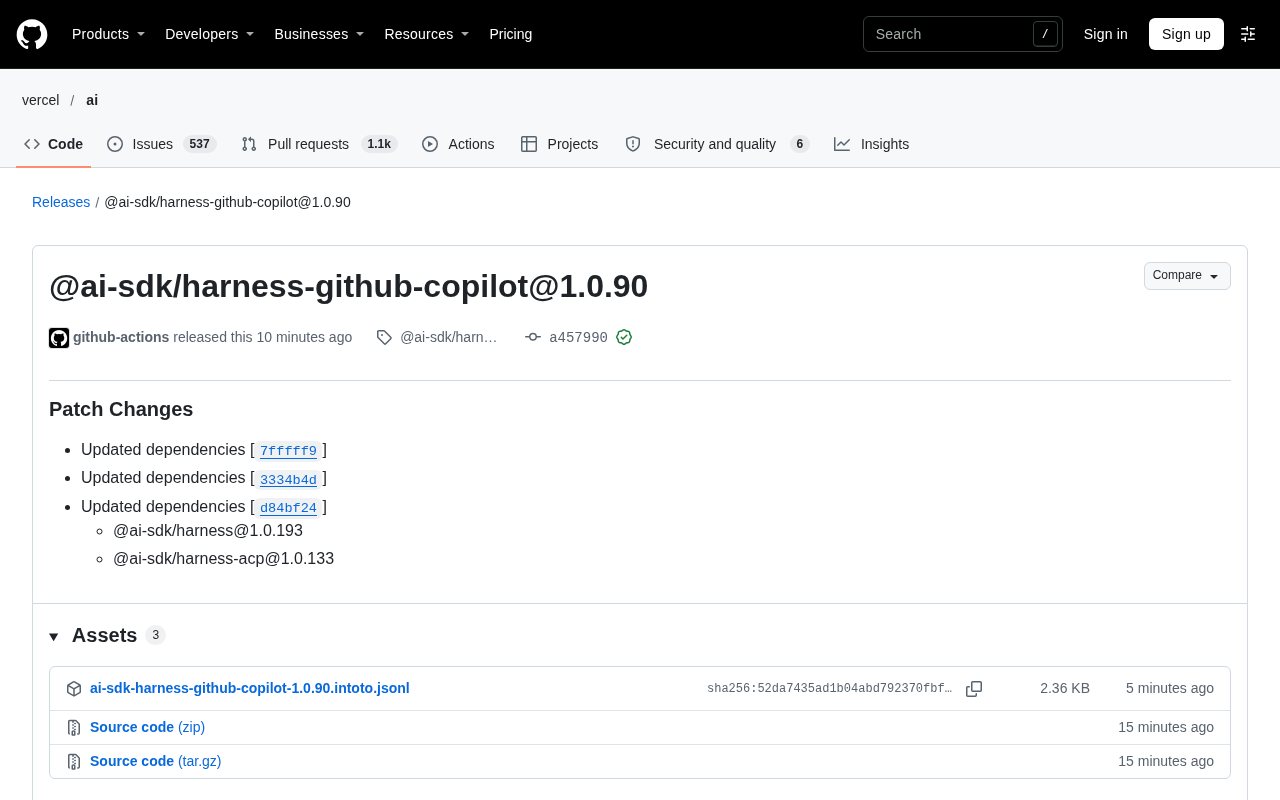
The GitHub Copilot adapter package in the AI SDK ecosystem, `@ai-sdk/harness-github-copilot`, has released version 1.0.90. According to GitHub Releases, this is a patch version automatically published by github-actions, with the only change being dependency updates: `@ai-sdk/harness` bumped to 1.0.193 and `@ai-sdk/harness-acp` to 1.0.133, with no new features or breaking changes. The article notes that the package name structure reflects the layered design of the harness system — the core abstraction layer, the ACP protocol layer, and the concrete Copilot implementation are separated, allowing each adapter package to iterate independently at the cost of frequent version synchronization. For users, the expected benefit of upgrading comes from cumulative upstream fixes; code changes are usually unnecessary, but it is recommended to run tests after upgrading to confirm call behavior is unchanged and to check dependency version compatibility.
The GitHub Copilot adapter layer in the AI SDK ecosystem has received a minor version update. @ai-sdk/harness-github-copilot has released version 1.0.90, and judging from the changelog, this is a typical dependency synchronization release with no new features or breaking changes.
A "quiet" patch release
According to the GitHub Releases page, this version was automatically published by github-actions, and the commit carries a GitHub-verified signature. The only change is a single Patch Changes entry: updating dependencies. Specifically, @ai-sdk/harness was bumped to 1.0.193 and @ai-sdk/harness-acp to 1.0.133.
This kind of release is common in mature open-source projects — an upstream package fixes an issue or adjusts its internal implementation, and the downstream adapter package syncs its version number accordingly to keep the dependency tree consistent. For users, no code changes are usually needed; upgrading delivers the upstream fixes.
Semantic Versioning (SemVer) specifies version numbers in the form MAJOR.MINOR.PATCH: a major version change indicates incompatible API changes, a minor version indicates backward-compatible feature additions, and a patch version indicates backward-compatible bug fixes. The 1.0.90 in this article is a patch-number increment, which by convention should contain no breaking changes or new interfaces; "Patch Changes" is the standard category label that the Changesets tool generates when producing a changelog, marking that this release contains only patch-level modifications. Changesets is commonly used in monorepo projects — developers attach a change description when committing code, and the release process uses it to automatically aggregate the changelog, increment version numbers, and publish to npm. This is exactly why the log contains only a single "update dependencies" record and why the release was completed automatically by github-actions: the dependency sync is treated as a patch-level change and requires no manual version orchestration.
The modular design behind the version number
The package name structure reveals that the AI SDK's harness system uses a layered design: @ai-sdk/harness is the core abstraction layer, @ai-sdk/harness-acp handles Agent Client Protocol capabilities, and @ai-sdk/harness-github-copilot is the concrete implementation for GitHub Copilot.
This split allows integrations for different AI coding assistants to iterate independently. When the core layer or protocol layer updates, each adapter package only needs to follow the dependency version rather than rewriting business logic. The trade-off is that version numbers need to be synchronized frequently and release records look somewhat "monotonous," but it is the cleaner approach for dependency management.
ACP (Agent Client Protocol) is a protocol for establishing standardized communication between AI coding assistants and clients (such as editors and terminal tools), positioned similarly to what the Language Server Protocol (LSP) is for code editors: clients and agents interact through a unified message format, allowing assistants from different vendors to plug into the same host environment. ACP typically defines interaction semantics such as session initialization, context passing, tool invocation, and streaming responses, so that the adapter layer does not need to reimplement integration logic for each client. Having @ai-sdk/harness-acp separate this protocol capability into its own package means that protocol version evolution is decoupled from the concrete Copilot implementation. When the ACP specification adjusts message structures or handshake flows, you only need to upgrade that package and sync the adapter layer's dependencies, without touching upper-layer business code — which is one reason this release only needed to update dependency version numbers.
Practical impact on developers
If you use this package in your project to integrate with GitHub Copilot, the expected benefit of this upgrade comes from cumulative fixes in upstream dependencies. Since the changelog does not list specific fixes, it is recommended to run your existing tests after upgrading to confirm that Copilot-related call behavior has not changed.
Projects with strict dependency version locking may want to check whether the corresponding versions of @ai-sdk/harness and @ai-sdk/harness-acp are compatible with your other AI SDK packages. The fact that automatic publishing is handled by github-actions also indicates that the project has established a relatively mature CI/CD pipeline, and that release frequency may be high.
In the npm ecosystem, dependency version synchronization is usually accompanied by updates to lock files (package-lock.json, pnpm-lock.yaml, or yarn.lock). Lock files record the exact version and integrity hash of each package in the dependency tree, ensuring that different environments install a consistent set of dependencies. After upgrading this package, the @ai-sdk/harness and @ai-sdk/harness-acp entries in the lock file will change accordingly; if your project uses a strict locking strategy, you need to explicitly run the install command to refresh the lock file, otherwise CI may still resolve the old versions. In addition, if your project also directly depends on the core-layer package, you should confirm that its version range intersects with the 1.0.193 required by the new adapter layer, to avoid type mismatches or runtime behavior differences caused by multiple versions of the same package coexisting.
Signals worth watching
A single patch version carries limited information, but it shows that the AI SDK ecosystem is using a modular approach to cover multiple coding assistant entry points. As one of them, GitHub Copilot's adapter layer being continuously maintained means the team is keeping pace with the upstream protocol. It is only when a minor or major version appears that it will be more worth watching whether new capabilities or interface adjustments have been introduced.
Related articles

A 19-Year-Old's Rental Horror Story: Ceiling Collapse, Bug Infestation, and the Lessons It Taught Me
At 19, my first off-campus rental brought bug infestations, no heat, a collapsed ceiling, and a ruined laptop with no renter's insurance. Here are the hard-won lessons for first-time student renters.

Veda Nurse's Cranial Nerve Exam: Why ASMR Role-Play Is Going Viral
Bilibili creator Veda's cranial nerve exam ASMR video goes viral, blending humor and sensory triggers through nurse role-play. This article analyzes its unique appeal and the audience psychology behind ASMR role-play.

LG Cinebeam AI Review: 120-Inch Giant Screen + 3000 Lumens, a New Choice for the Living Room Theater
LG Cinebeam AI projector review: 3000 ANSI lumens, 4K, 100 inches from about 8 cm and 120 inches from about 18 cm. Built-in webOS, AI Concierge voice recommendations, AI Sound Pro 11.1.2 virtual surround, and Game Optimizer—positioned for fixed living room installation, complementing the portable Cinebeam S.