@ai-sdk/harness-grok-build 1.0.132 Patch Update Overview

AI SDK build package 1.0.132 releases a pure dependency patch, aligning upstream harness and ACP versions.
`@ai-sdk/harness-grok-build` releases patch 1.0.132 with only three dependency updates, no functional changes or breaking changes, automatically triggered by github-actions and signature-verified. It aligns core `@ai-sdk/harness` to 1.0.193 and `@ai-sdk/harness-acp` to 1.0.133, a typical upstream-to-downstream fix propagation. The article notes near-zero impact on business code, recommends a standard patch upgrade with existing tests, and warns that lockfile-based projects must explicitly upgrade to pick up fixes. Since the log omits upstream commit details, regression verification is still advised if behavioral changes are involved, and cross-referencing upstream repo release records is suggested for interpreting such minimal logs.
A Typical Dependency-Chain Patch
The build package @ai-sdk/harness-grok-build in the AI SDK ecosystem has released version 1.0.132. The changelog is very brief: three dependency updates, no functional changes, no new features, and no breaking changes. This type of release is commonly referred to in the npm ecosystem as a "patch version," whose main purpose is to let downstream packages promptly pick up fixes from upstream dependencies.
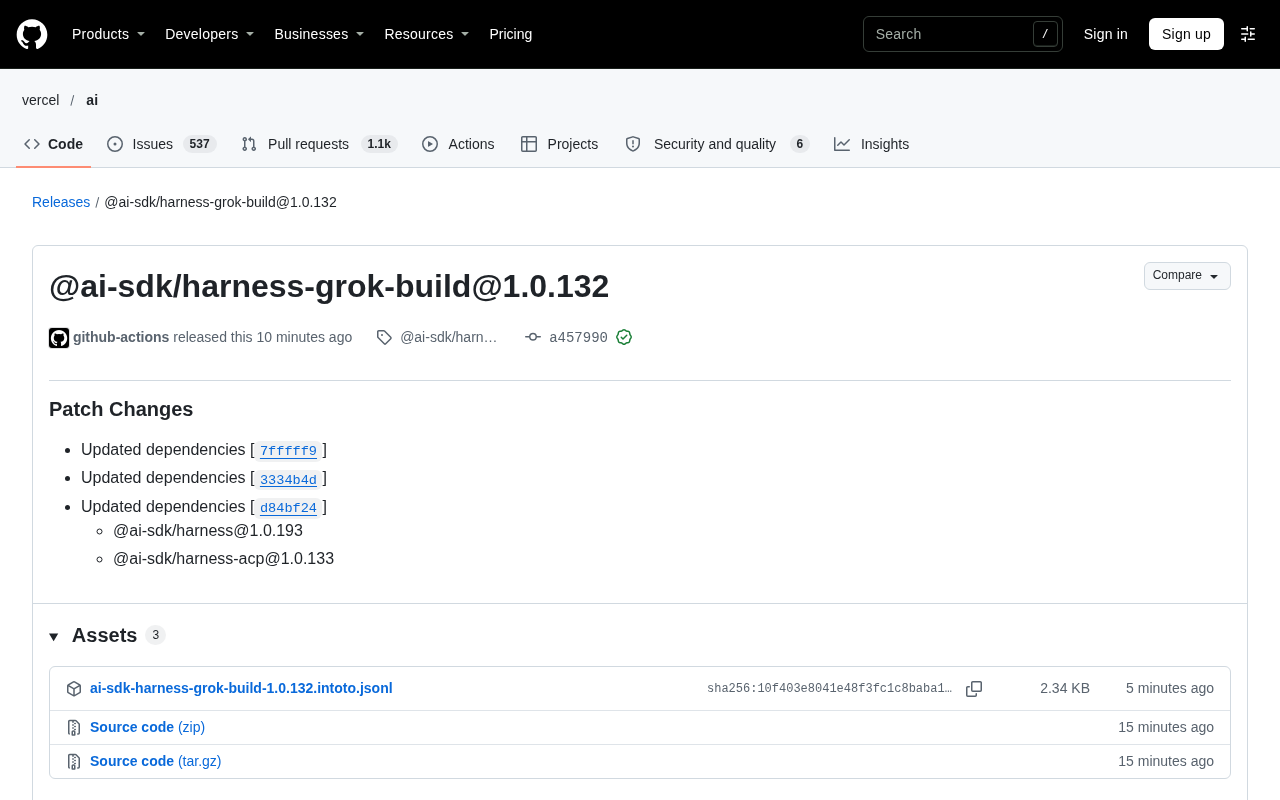
According to the release record, this update was automatically triggered by github-actions, and commit a457990 passed GitHub's signature verification. This indicates the release process is a standardized CI pipeline, consistent with the automated release cadence of the AI SDK series packages. For developers who depend on this package, this upgrade is a low-risk operation.
What the Three Dependency Updates Mean
The changelog lists three commit hashes (7fffff9, 3334b4d, d84bf24) and notes the new versions of the corresponding dependencies: @ai-sdk/harness@1.0.193 and @ai-sdk/harness-acp@1.0.133.
This means the patch primarily does one thing: aligning the core harness package and the ACP-related package to their latest patch versions. harness is the foundational package at the runtime and orchestration layer, while harness-acp relates to the Agent Client Protocol, and the two typically serve as the underlying support for the build toolchain. When upstream dependencies fix issues, downstream build packages follow up and sync — this is a typical patch propagation chain.
It's worth noting that the changelog does not elaborate on what the three upstream commits specifically changed. If the upstream fixes involve behavioral changes, then even though this patch has a small version number, a basic regression check is still needed after upgrading.
Semantic Versioning (SemVer) and Patch Versions: The npm ecosystem follows the semantic versioning specification MAJOR.MINOR.PATCH, where an increment in the PATCH position represents a backward-compatible bug fix and should not introduce new features or breaking changes. This release, 1.0.132, only bumps the PATCH position relative to the previous version, and is theoretically fully compatible with downstream. However, note that SemVer is a convention rather than a mandate; if upstream makes undeclared behavioral adjustments, they can still propagate through patch versions. Therefore, "low risk" does not equal "zero risk," and regression verification remains a necessary step.
Lockfiles and Dependency Pinning: Lock files such as package-lock.json, pnpm-lock.yaml, and yarn.lock record the exact versions and integrity hashes of the dependency tree, ensuring consistent installation results across different environments. The side effect is that even if a transitive dependency releases a new patch, as long as the lockfile is not updated, the old version will still be pulled during installation. To pick up upstream fixes, you need to explicitly run npm update <pkg> or adjust the version range and regenerate the lockfile; if you only manually modify package.json without refreshing the lockfile, version drift and inconsistency may occur in CI.
Agent Client Protocol (ACP): ACP is a type of protocol convention used to standardize communication between agents and clients/runtime environments, typically defining interaction semantics such as message formats, capability negotiation, session lifecycle, and tool invocation. In build toolchains like the AI SDK, harness-acp serves as the protocol adaptation layer, responsible for translating upper-layer orchestration logic into protocol-compliant messages. Patch updates to protocol implementation packages often involve details such as field compatibility, timeout handling, or error code mapping. Such changes usually do not alter the external API but may affect interoperability with specific client versions, so they deserve attention during cross-version integration testing.
Practical Impact on Users
For developers who directly use @ai-sdk/harness-grok-build, this version requires virtually no changes to business code. The recommended upgrade approach is a standard patch upgrade: update the version number in package.json or use the package manager to update, then run the existing tests.
For teams maintaining downstream build processes, what's worth paying attention to is the dependency pinning strategy. If the project uses a lockfile to pin an old version, this patch will not take effect automatically; if you want to pick up upstream fixes, you need to explicitly upgrade the package and regenerate the lockfile.
The value of this type of automated patch version lies not in feature increments but in keeping the version tree consistent and reducing tricky issues caused by dependency misalignment. For long-term AI engineering projects, regularly clearing out this kind of accumulated patches is far more reliable than facing a large number of changes all at once during a major version upgrade.
How to Interpret This Kind of Minimal Release Log
The release logs of the AI SDK series packages have long maintained a style of "listing only results without elaborating on details," and this log is no exception. When faced with such minimal logs, you can follow two clues: first, see which dependencies were updated and their corresponding new version numbers; second, cross-reference the upstream packages' own release records to reconstruct the changes.
The information explicitly provided in this log is the version alignment relationship, while the specific contents of the three upstream commits are not explained in the log and need to be checked in the corresponding repositories. Reading patch logs as a version map rather than as documentation is an effective way to track this kind of rapidly iterating toolchain.
One-line Summary
AI SDK build package 1.0.132 releases a pure dependency patch, aligning upstream harness and ACP versions.
Paragraph Summary
@ai-sdk/harness-grok-build has released patch version 1.0.132, containing only three dependency updates with no functional changes or breaking changes, automatically triggered by github-actions and passing signature verification. The update aligns the core @ai-sdk/harness to 1.0.193 and @ai-sdk/harness-acp to 1.0.133, representing a typical propagation of upstream fixes to downstream. The article notes that this version has virtually no impact on business code and recommends upgrading via the standard patch process and running existing tests; projects using lockfiles need to explicitly upgrade to pick up the fixes. Since the log does not detail the upstream commits, regression verification is still needed if behavioral changes are involved, and it is recommended to cross-reference the upstream repository release records to interpret such minimal logs.
Related articles

A 19-Year-Old's Rental Horror Story: Ceiling Collapse, Bug Infestation, and the Lessons It Taught Me
At 19, my first off-campus rental brought bug infestations, no heat, a collapsed ceiling, and a ruined laptop with no renter's insurance. Here are the hard-won lessons for first-time student renters.

Veda Nurse's Cranial Nerve Exam: Why ASMR Role-Play Is Going Viral
Bilibili creator Veda's cranial nerve exam ASMR video goes viral, blending humor and sensory triggers through nurse role-play. This article analyzes its unique appeal and the audience psychology behind ASMR role-play.

LG Cinebeam AI Review: 120-Inch Giant Screen + 3000 Lumens, a New Choice for the Living Room Theater
LG Cinebeam AI projector review: 3000 ANSI lumens, 4K, 100 inches from about 8 cm and 120 inches from about 18 cm. Built-in webOS, AI Concierge voice recommendations, AI Sound Pro 11.1.2 virtual surround, and Game Optimizer—positioned for fixed living room installation, complementing the portable Cinebeam S.