@ai-sdk/harness-pi 1.0.196 Update: Hardening Temporary Configuration Security
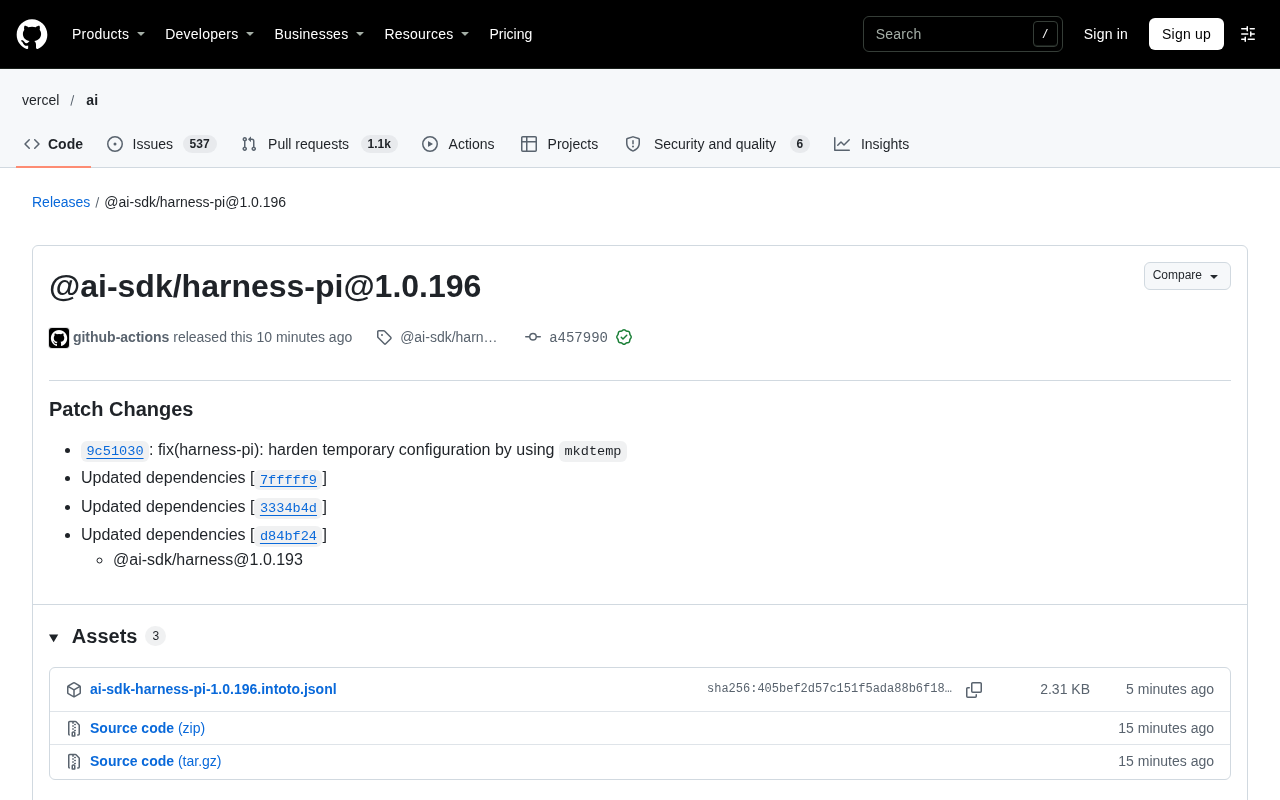
@ai-sdk/harness-pi 1.0.196 hardens temporary config directories with mkdtemp and syncs dependency versions.
@ai-sdk/harness-pi releases version 1.0.196, with the core change being the use of Node.js's mkdtemp to harden temporary configuration handling logic. The article explains how mkdtemp atomically creates a unique directory with a random suffix, avoiding predictable paths being grabbed or tampered with via symbolic links, thereby improving configuration isolation. This version also updates @ai-sdk/harness to 1.0.193 to keep the dependency chain aligned; the release is done automatically by github-actions with a verified signature, reflecting a standardized process. The change does not involve API changes and is internal implementation-level security hardening with low upgrade cost, and projects using or indirectly depending on harness-pi are advised to follow up.
A Minor Version Update Hiding Security Details
Component package updates in the AI SDK ecosystem rarely attract much attention, but the small fixes behind version numbers are precisely where engineering quality shows. @ai-sdk/harness-pi has released version 1.0.196, with just one core change: fixing the temporary configuration handling logic in harness-pi by switching to mkdtemp to harden how temporary directories are created.
Patches like this look unremarkable, yet they directly affect the isolation and security of runtime configuration files. Why does the way a temporary directory is created deserve its own release? It starts with mkdtemp itself.
What Problem Does mkdtemp Solve
When creating temporary directories in a Node.js environment, a common approach is to concatenate a timestamp or random number and then call mkdir. The problem is that if the directory name is predictable, an attacker has an opportunity to grab the same path before the directory is created, or to redirect the program to an unintended location via a symbolic link.
mkdtemp atomically generates a unique directory with a random suffix and creates it with secure permissions. Placing temporary configuration in such a directory prevents cross-contamination between multiple processes or repeated calls, and reduces the risk of configuration being tampered with externally. The patch description uses "harden temporary configuration," indicating that the maintainers are focused precisely on this layer of configuration isolation.
mkdtemp is an API provided by the Node.js fs module and can also be called in Promise form via fs.promises.mkdtemp. It works by accepting a prefix string, appending 6 random characters after that prefix, then atomically creating the directory and returning the full path. Atomicity here means that "generating the random name" and "creating the directory" happen in a single step at the system call level, with no time window in which another process can intervene.
By contrast, the approach of concatenating a name with Math.random() and then calling mkdir leaves a race condition between the two steps (TOCTOU, time-of-check to time-of-use): an attacker can create a same-named directory or symbolic link after the program generates the name but before the directory is actually created, thereby hijacking subsequent read and write operations. mkdtemp eliminates this window by API design.
Directory permissions also deserve attention. Directories created by mkdtemp follow Node's default mkdir mode, and the effective permissions are further filtered by the process's umask. On multi-user systems, this usually means only the directory owner can access it, but the specific permissions still depend on the umask setting of the runtime environment. For temporary directories holding sensitive configuration, in addition to relying on default permissions, you should explicitly check or tighten permissions after creation and proactively clean up after use to avoid temporary files lingering long-term.
Dependency Chain Updated in Sync
This version also updates several dependencies, including @ai-sdk/harness bumped to 1.0.193. For a harness-type toolkit, aligning the versions of underlying dependencies matters—harness-pi handles the specific runtime support, while @ai-sdk/harness provides more general foundational capabilities, and matching the two versions reduces debugging costs caused by interface incompatibilities.
The release was completed automatically by github-actions, and the commit carries a GitHub verified signature, indicating that this repository's release process has been standardized. For teams building applications on the AI SDK, this kind of automated release means they can follow minor version upgrades with more confidence.
In the npm ecosystem, dependency updates for packages like @ai-sdk/harness-pi are typically initiated automatically as PRs by tools such as Renovate or Dependabot, then validated by CI and released by github-actions. The GitHub verified signature on the commit (the Verified badge) indicates that the commit was indeed signed with the repository's configured key, which to some extent prevents forged commits from slipping into the release process. This combination of "automatic upgrades + signature verification + CI release" is the mainstream approach to maintaining open source packages today, and it gives downstream users more basis for following minor versions.
Practical Impact on Users
If you directly use harness-pi in your project to manage temporary configuration, it's worth following this upgrade. The change does not involve API changes and is an internal implementation-level hardening, so the upgrade cost is very low. For projects that pull in harness-pi as an indirect dependency, this linked update of the dependency tree will also take effect automatically on the next install.
From a broader perspective, the AI SDK-related toolchain is transitioning from the "it runs" stage to the "it runs reliably" stage. Security hardening, dependency alignment, and automated releases are all signals of engineering maturity. Paying attention to minor version updates like these is far more worthwhile than being caught off guard when a major version introduces breaking changes.
One-line Summary
@ai-sdk/harness-pi 1.0.196 hardens temporary configuration directories with mkdtemp and syncs dependency versions.
Paragraph Summary
@ai-sdk/harness-pi has released version 1.0.196, with the core change being the use of Node.js's mkdtemp to harden temporary configuration handling logic. The article explains how mkdtemp atomically creates a unique directory with a random suffix, avoiding the problem of predictable paths being grabbed or tampered with via symbolic links, thereby improving configuration isolation. This version also updates @ai-sdk/harness to 1.0.193 to keep the dependency chain aligned; the release is completed automatically by github-actions with a verified signature, reflecting a standardized process. The change does not involve API changes and is a security hardening at the internal implementation level, with low upgrade cost, and projects that use or indirectly depend on harness-pi are advised to follow up.
Related articles

AI Teams Up with Mathematicians to Attack the Riemann Hypothesis: 17 Million Lines of Code Tear Open a 167-Year Gap
In November 2026, Anthropic mathematicians and Claude claimed to have discovered a proof of the Riemann Hypothesis, publishing 17 million lines of Lean formalized code that passed machine verification. This article analyzes the event's impact on mathematics and cryptography, and the deeper questions raised by the separation of discovery and understanding.

AI Claims Formal Proof of the Riemann Hypothesis — But Machine Verification Isn't a Mathematical Proof
In Nov 2026, Anthropic's Levent Alpöğe released a Riemann Hypothesis proof of 175,000 code files that passed machine formal verification. But machine verification isn't a mathematical proof: the kernel can't confirm the proposition is the Riemann Hypothesis humans understand, and there's no human-readable paper. This article breaks down how ζ function zeros determine prime-count deviation, and the core of the controversy.

Anthropic Raises Over $80 Billion in IPO, DeepSeek Secures $100 Billion in Funding: AI Weekly Roundup
This week in AI: Anthropic's Nasdaq IPO raises $93.5B in the largest ever, DeepSeek closes ~100B yuan round, AI claims formal Riemann proof, MiniMax breaks crypto candidates in seconds.