@ai-sdk/react 3.0.339 Patch Update: The AI SDK Ecosystem's Steady Evolution

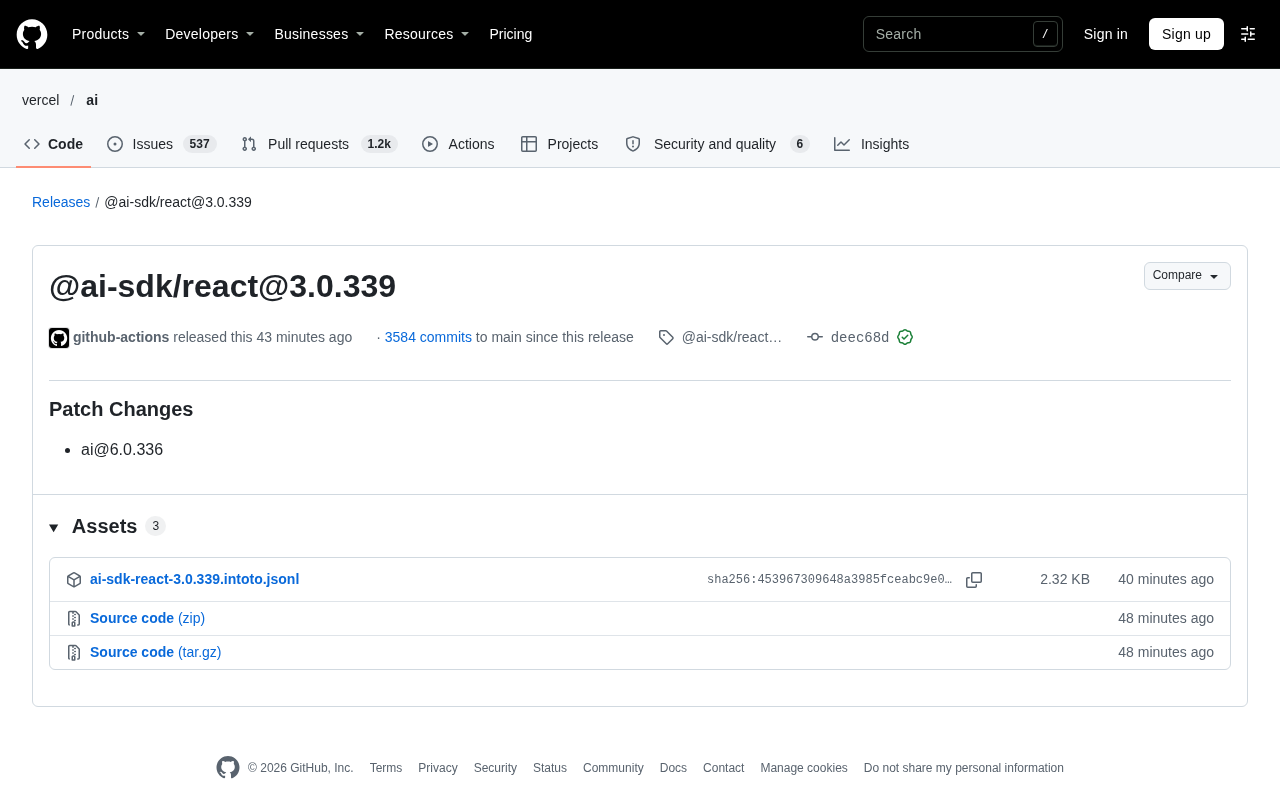
@ai-sdk/react releases patch 3.0.339 aligned with core package ai@6.0.336, a low-risk stability update.
@ai-sdk/react has released patch version 3.0.339, associated with core package ai@6.0.336, a Patch Changes-level update. The article notes that the 3.0.x series has long remained in a patch-increment stage, indicating that the API surface is stabilizing and maintenance is focused on detail fixes and dependency synchronization. For React projects already using the Vercel AI SDK, the main value of such updates is avoiding peer dependency warnings and maintaining interface consistency between hooks and the core SDK, with low upgrade risk. However, it is recommended to run tests for streaming-response-related interactions after upgrading and to watch for hook behavior changes in the changelog. From an ecosystem perspective, the article also explains that such patch releases reflect the gradual engineering maturity of the AI development toolchain.
A Quiet Patch Update
Within the AI SDK ecosystem, @ai-sdk/react has released version 3.0.339. According to the GitHub Releases page, this is a patch-level update (Patch Changes), with the associated change pointing to ai@6.0.336. The version suffix has now reached three digits, indicating that this package is being frequently refined through continuous iteration—for React developers who depend on it, such updates typically mean stability fixes and alignment adjustments with upstream dependencies rather than the introduction of breaking changes.
What the Version Number Reveals
The @ai-sdk/react 3.0.x series has long remained in a stage of incrementing patch numbers, which itself sends a signal: the API surface is stabilizing, and the maintenance team's focus is on detail fixes and dependency synchronization. In this update entry, only ai@6.0.336 is listed as the associated item for Patch Changes, suggesting that the changes to @ai-sdk/react are likely intended to stay consistent with the version of the core package ai, avoiding dependency version mismatch issues that developers might encounter during use.
Semantic Versioning (SemVer) and Patch Numbers
The version number format used by @ai-sdk/react follows the semantic versioning specification: MAJOR.MINOR.PATCH. An increment in the patch number means backward-compatible bug fixes, with no new features or breaking changes; an increment in the minor number indicates new backward-compatible functionality; and an increment in the major number may bring incompatible API changes. Therefore, when the version changes from 3.0.338 to 3.0.339, developers can expect the upgrade to be safe. However, patch versions can still fix internal hook logic (such as the timing of streaming state updates). Although such fixes do not change public API signatures, they may affect observable behavior, so the article's recommendation to pay attention to streaming-response-related entries in the changelog is a reasonable practice.
The Practical Significance of Patch Updates for Developers
For developers who have already integrated the Vercel AI SDK into their projects, the value of such patch versions is often reflected at two levels. The first is smooth dependency resolution: when the core package ai advances to 6.0.336, the React adapter layer following suit can prevent peer dependency warnings after running npm install or pnpm update. The second is behavioral consistency: the interface contract between React hooks and the core SDK remains compatible within the patch scope, so upgrade risk is low.
How to View Frequent Minor Releases
In the field of AI application development, SDK release cadence often follows changes in model capabilities and API forms. The high-frequency patch releases of @ai-sdk/react reflect the maintainers' responsiveness to issues. Developers do not need to track every patch version individually, but when upgrading, it is advisable to check whether the changelog involves changes in hook behavior, especially logic related to streaming response handling.
Peer Dependencies and Dependency Alignment
In the npm ecosystem, a peer dependency is used to declare that a package needs to share the same dependency instance with the host project rather than installing its own copy. @ai-sdk/react very likely declares the core package ai as a peer dependency to ensure that React hooks and the core SDK use the same runtime code and state management logic. If the ai version range required by @ai-sdk/react does not match the ai version actually installed in the project, npm 7+ will try to automatically install a compatible version or output a peer dependency warning, while pnpm may directly report an error. Aligning this patch update of @ai-sdk/react with ai@6.0.336 is precisely intended to narrow the intersection of version ranges, eliminate such warnings, and ensure that the internal protocol between hooks and the core SDK (such as the chunk format of streaming responses) remains consistent.
React Hooks and Streaming Response Handling
@ai-sdk/react wraps the capabilities of the core SDK into React hooks (such as useChat and useCompletion), and internally relies on React's state update mechanism to drive UI re-renders. In streaming response scenarios, the text returned by the model arrives in chunks, and the hooks need to call setState or similar update functions each time a chunk arrives, while also handling aborts, error retries, and race conditions among concurrent requests. Patch versions may adjust these internal scheduling logic—for example, merging multiple state updates to reduce the number of renders, or fixing the issue of attempting to update state after a component has unmounted. Such changes do not alter the call signatures of the hooks, but they may affect the rhythm and final presentation of streaming output, so running a regression test for streaming interactions after upgrading is a prudent approach.
The AI SDK from an Ecosystem Perspective
As the middle layer connecting frontend frameworks and model services, the stability of the AI SDK directly affects the experience of common AI application scenarios such as chat interfaces and streaming generation. @ai-sdk/react focuses on adapting to the React ecosystem, wrapping the capabilities of the core SDK in the form of hooks and lowering the barrier to integrating model calls in React projects. The continuous output of patch versions is the foundational work that keeps this middle layer reliable.
For content creators and technology decision-makers, such version releases are not major news in themselves, but they remind us that the toolchain for AI applications is gradually maturing in an engineering-oriented way. Traditional software engineering topics such as version management, dependency alignment, and backward compatibility also apply to the AI development stack.
The Layered Architecture of the Vercel AI SDK
The Vercel AI SDK adopts a layered design: the core package ai provides a unified interface independent of model providers (such as streamText and generateText) as well as a provider adaptation layer; framework adapter packages (@ai-sdk/react, @ai-sdk/vue, @ai-sdk/svelte, etc.) wrap the core capabilities into the reactive primitives customary in each framework. This layering allows the same set of model invocation logic to be reused across frontend frameworks while allowing each adapter package to be released independently. The cost is version coupling between adapter packages and the core package, which needs to be maintained through dependency alignment—this is also the main reason why @ai-sdk/react frequently releases patches and closely follows the version of the ai core package. Understanding this architecture helps developers determine whether a change comes from the adapter layer or the core layer when upgrading.
Upgrade Recommendations
If your project is locked to the 3.0.x branch, you can handle it through the常规 patch upgrade process and run interaction tests related to streaming responses after upgrading. If you have not yet upgraded to the 3.0 series, it is recommended to first evaluate the version requirements of the core package ai before deciding whether to follow this update.
Related articles

ChatGPT Plus Subscription Pitfall Guide: Go/Plus/Pro Tier Comparison and Quick Activation
A complete ChatGPT Plus subscription guide based on a Bilibili tutorial: from registering an account, comparing Go/Plus/Pro tiers, to the practical steps for quickly completing your subscription.

GPT-6.2 Sol/Astra Released! A Step-by-Step ChatGPT Plus Subscription Guide and Tier Comparison
GPT-6.2 Sol/Astra is out—here's a ChatGPT Plus subscription guide: register an account, compare Go/Plus/Pro tiers, and subscribe in a minute.

Comparing Three Channels for Subscribing to GPT Plus in China: Is Website Top-Up the Easiest?
How to subscribe to GPT Plus in China? This article compares website top-up, credit card, and mobile top-up channels—process, cost, and risk—with steps and tips to help you choose wisely.