AI SDK Releases workflow-harness 1.0.149 Patch Version

@ai-sdk/workflow-harness releases 1.0.149 patch version, automatically built by CI with signature verification.
The AI SDK ecosystem's @ai-sdk/workflow-harness has released a 1.0.149 patch version, automatically completed by the GitHub Actions bot with a GitHub verified signature (GPG key ID B5690EEEBB952194 and vigilant mode enabled). This version includes 3 commits merged into the main branch since the previous release and is semantically marked as Patch Changes, indicating no breaking API changes and very low upgrade cost. However, the release record does not expand on specific fix entries—the Changes section only shows the version number, and some page areas also show rendering errors. Therefore, to understand what the 3 commits actually changed, you still need to directly review the commit history and diff on the main branch. Overall, this is a routine stability maintenance release that also reflects the high-frequency, small-step iteration pace of the AI SDK toolchain.
Title
The AI SDK ecosystem has rolled out another minor version iteration. According to the official GitHub release records, @ai-sdk/[email protected] has been automatically released via GitHub Actions, complete with a GitHub verified signature and marked as a Patch Changes update.
A Typical Automated Patch Release
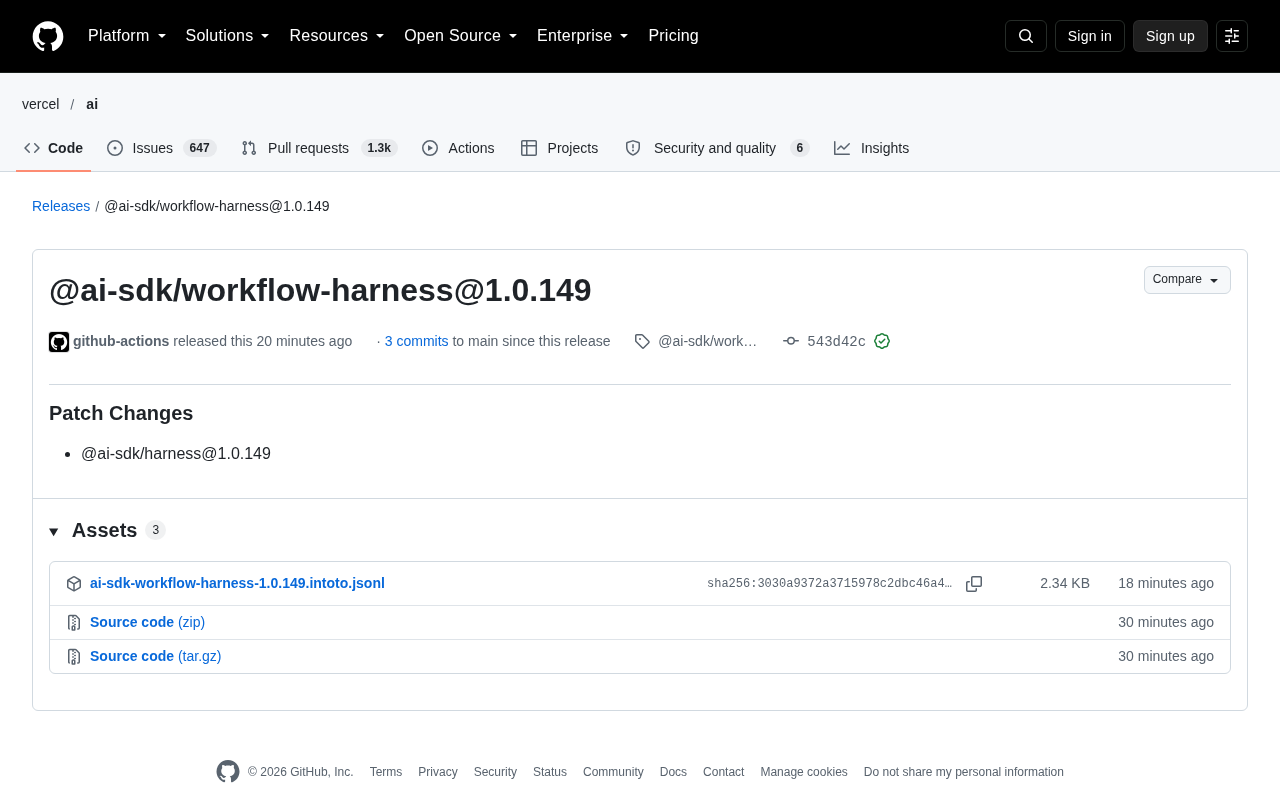
Based on the release records, this update was initiated by the github-actions bot on the 12th at 17:51, with 3 commits merged into the main branch since the previous version. The entire release process followed GitHub's standard automation path: commits are protected by GitHub verified signatures, with the GPG key ID B5690EEEBB952194, and vigilant mode enabled.
For developers who have long tracked the AI SDK, this release cadence is nothing new. As an AI application development toolchain introduced by Vercel, the AI SDK and its surrounding packages (such as @ai-sdk/harness) have maintained a high frequency of rolling minor version updates. The naming of workflow-harness suggests it is related to workflow orchestration, agent behavior testing, or harness testing frameworks—part of the SDK's auxiliary infrastructure for building reproducible AI workflows.
GPG signing and vigilant mode is an integrity protection mechanism GitHub provides for commits and tags. Developers can bind a GPG (or SSH, S/MIME) public key to their GitHub account, after which each git commit can be signed with the private key. GitHub's server verifies the signature using the corresponding public key and displays a "Verified" badge next to the commit. The GPG key ID B5690EEEBB952194 in the example identifies a specific signing key. Vigilant mode is a GitHub account setting: when enabled, any commit without a verified signature is explicitly marked as "Unverified" in the web interface rather than silently passing. This mode is especially important for automated release pipelines—when a CI bot (such as github-actions) commits on your behalf, configuring a signing key lets downstream users be confident that the commit genuinely came from the official pipeline rather than being pushed by an impersonator, reducing the risk of package tampering from a supply chain perspective.
The Semantics Behind the Version Number
This version number jumped from the existing baseline to 1.0.149, with the patch digit reaching 149, indicating that the package has undergone numerous incremental fixes within the 1.0 mainline. Combined with the explicitly marked Patch Changes in the release notes, it can be determined that this update does not involve breaking API changes and is most likely focused on internal logic corrections, dependency alignment, or stability handling for edge cases.
Such "silent patches" are often overlooked in mature open-source projects, but they are precisely a direct reflection of a project's maintenance health. Compared to high-profile minor/major releases, continuous small steps allow downstream users to reap the benefits of fixes at lower risk.
Semantic Versioning (SemVer) is the universal convention behind numbering like 1.0.149, with the format MAJOR.MINOR.PATCH. A change in the MAJOR digit signifies incompatible breaking API changes, an increase in the MINOR digit represents backward-compatible new features, and the PATCH digit should only contain backward-compatible bug fixes. Accordingly, 1.0.149 indicates that the package remains on the 1.0 mainline with no major version jump; the patch digit has accumulated to 149, indicating numerous granular iterations over the 1.0 lifecycle. The Patch Changes label in the release notes is the Changesets tool's marker for the change level, which automatically determines how the version number increments at release time and affects whether package managers auto-pull new versions under ranges like ^1.0.0. Therefore, seeing Patch Changes basically confirms: this update does not alter the public interface, and downstream upgrades typically require no changes to any calling code—both risk and cost are very low.
Practical Implications for Developers
If your project directly depends on @ai-sdk/workflow-harness, you can upgrade to 1.0.149 via your package manager to get the latest fixes. Since it's a patch-level update, the upgrade cost is minimal, and you typically won't need to modify any calling code.
One caveat: this release record does not include a detailed changelog body—the Changes section on the page only shows the version number without expanding on specific fix entries. The filtering, loading, and other areas in the release log also returned error messages, which may be a rendering issue on the GitHub page at the time of crawling. Therefore, to understand what the 3 commits actually changed, the most reliable approach is still to directly review the commit history and diff on the main branch.
Changesets is a widely used version and release management tool in the JavaScript/TypeScript ecosystem today, and the release pipeline for AI SDK packages is most likely built on it. When developers submit code, they attach a Markdown file (changeset) describing the change, declaring whether it is a patch, minor, or major change; CI aggregates these changesets at release time, automatically calculates the new version number, generates the CHANGELOG, and pushes the tag. The article mentions that "the Changes section only shows the version number without expanding on specific fix entries." In the context of Changesets, there are typically two possibilities: either the commit did not include a changeset, or the CI rendering of the CHANGELOG encountered an error. Either way, it doesn't affect the fact that the package has already been released, but it does explain why this release lacks readable change details—this is precisely the information gap that requires going back to the commit history and diff to fill.
Summary
@ai-sdk/[email protected] is a routine patch release automatically completed by CI, with three key characteristics: signature verification, 3 commits, and patch-level semantics. For ecosystem users, it represents the ongoing advancement of stability maintenance; for observers, it is also a microcosm of the AI SDK toolchain's high-frequency iteration.
One-line Summary
@ai-sdk/workflow-harness releases 1.0.149 patch version, automatically built by CI with signature verification.
Paragraph Summary
The AI SDK ecosystem's @ai-sdk/workflow-harness has released a 1.0.149 patch version, automatically completed by the GitHub Actions bot with a GitHub verified signature (GPG key ID B5690EEEBB952194 and vigilant mode enabled). This version includes 3 commits merged into the main branch since the previous release and is semantically marked as Patch Changes, indicating no breaking API changes and very low upgrade cost. However, the release record does not expand on specific fix entries—the Changes section only shows the version number, and some page areas also show rendering errors. Therefore, to understand what the 3 commits actually changed, you still need to directly review the commit history and diff on the main branch. Overall, this is a routine stability maintenance release that also reflects the high-frequency, small-step iteration pace of the AI SDK toolchain.
Related articles

Gaussian Process Bandit Optimization: Exploration Strategies and Inference Regret Guarantees
Cumulative regret guarantees in Bayesian optimization fail to reflect final recommendation quality. This article examines a new study that provides inference regret guarantees for Gaussian process bandit optimization through exploration query strategies and fill distance analysis, validated on hyperparameter optimization and control tasks.

The Most Detailed Codex Guide on Bilibili: From Installation to Real-World Practice
The most detailed Codex guide on Bilibili: from app store installation to daily work mode configuration, with a real coffee shop project demonstrating file organization, data extraction, dashboard creation, and other practical tasks. Learn to use Plan Mode and desktop pets to leverage Codex efficiently.

Appearance Compensation in Volume Rendering: Why RGB Accuracy Cannot Guarantee Density Correctness
Volume rendering research reveals that volumetric data perfectly reproducing external RGB views may still contain density errors: appearance compensation can double central density and keep external rays unchanged even when L2 error exceeds 14.52%. Density recovery depends on appearance capacity, spatial resolution, and measurement design.