AI SDK Releases workflow-harness 1.0.154 Patch Version

@ai-sdk/workflow-harness releases patch 1.0.154, keeping version alignment with core harness
The @ai-sdk/workflow-harness in the AI SDK ecosystem has released patch version 1.0.154, automatically published by GitHub Actions with signature verification. This patch-level change mainly involves bug fixes, dependency synchronization, or internal adjustments, without new features or breaking changes, and stays aligned with the core @ai-sdk/harness to ensure interface compatibility between the workflow orchestration layer and the underlying execution engine. With over a hundred patches accumulated in the 1.0 major version, the article notes the API surface is stabilizing; teams needing to upgrade should review the full diff of commit b7f6255.
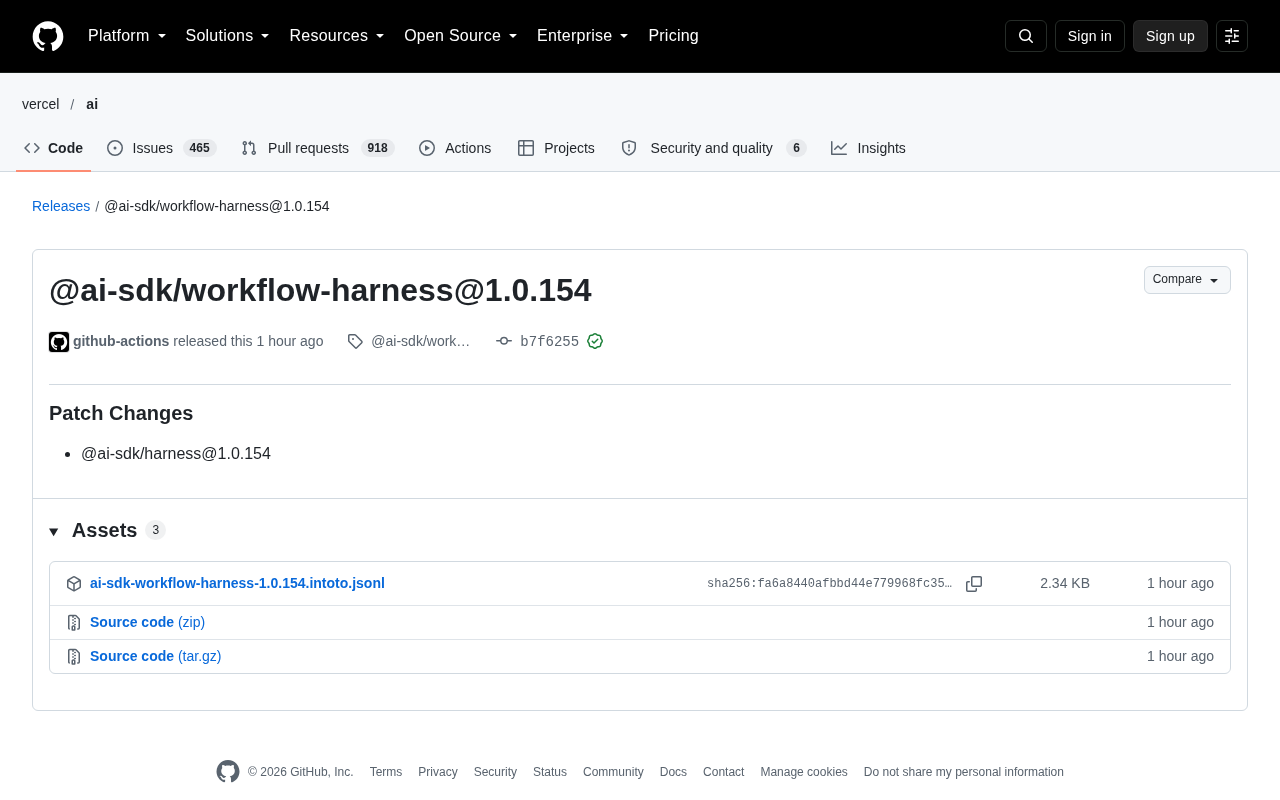
@ai-sdk/workflow-harness in the AI SDK ecosystem has released version 1.0.154. This is a typical patch update (Patch Changes), automatically published by GitHub Actions, with the commit record showing the commit has been verified with a GitHub signature.
What changed in this update?
Judging from the release notes, 1.0.154 is a patch-level change, meaning it primarily addresses bug fixes, dependency synchronization, or minor internal implementation adjustments, rather than introducing new features or breaking changes.
The release record lists the corresponding @ai-sdk/harness@1.0.154, indicating that workflow-harness and the core harness package remain synchronized in this version. This practice of aligning version numbers is typically intended to ensure compatibility between the workflow orchestration layer and the underlying execution engine — for developers building multi-step Agents or automation pipelines on top of the AI SDK, this means they don't need to worry about interface mismatches between the two packages when upgrading.
The automated release process (triggered by github-actions) also reflects the project's preference for high-frequency, small-step iteration in version management. The frequent release of patch versions indicates, to some extent, that maintainers respond quickly to production issues.
Why workflow-harness is worth paying attention to
The package name workflow-harness itself points to a key proposition in AI application development: how to organize LLM calls, tool executions, conditional branches, and other steps into manageable, testable workflows.
Within the AI SDK ecosystem, the harness plays an "orchestration" role — it allows developers to define an AI processing pipeline in a structured way, rather than cramming all logic into a single prompt call. As Agent-type applications move from demos to production environments, the stability of this kind of workflow orchestration layer directly determines the maintainability of the system. A patch version may seem inconspicuous, but if it fixes issues in concurrent scheduling or state passing, the impact on actual business operations could be quite direct.
What is a harness in the AI SDK
In software engineering, a harness (test/execution scaffold) originally refers to a scaffolding program used to run code under test in isolation and capture its output. In the context of the AI SDK, this concept is extended to the Agent's runtime control layer: it drives the LLM's reasoning loop — repeatedly calling the model, parsing returned tool-call requests, executing tools, feeding results back to the model, until the task is complete. Thus the harness determines the scheduling logic of an Agent session, and workflow-harness is a wrapper that brings this loop into declarable, reusable workflow definitions. The fact that both share the same version number is precisely to ensure that the step semantics described by the orchestration layer remain consistent with the behavior of the underlying execution loop.
What a patch version number means
Under Semantic Versioning (SemVer), a version number takes the form major.minor.patch. A major version change indicates breaking API adjustments, a minor version represents backward-compatible new features, and a patch number contains only backward-compatible bug fixes, documentation, or dependency synchronization. Therefore, an increment in the last digit of 1.0.154 theoretically won't change the signatures and behavioral contracts of existing calls. The practical exception is dependency drift: a patch version may only synchronize upstream dependencies, and fixes within those dependencies could still indirectly affect runtime behavior — which is why it's worth checking the diff before upgrading.
How developers should handle this kind of patch update
For teams already using @ai-sdk/workflow-harness in production, patch versions are generally recommended to follow, especially if you've recently encountered workflow execution exceptions, state loss, or version mismatches with the core harness.
Before upgrading, you can check the repository's commit history to confirm whether the scope of changes touches APIs you're currently using. If your project uses lock files (such as pnpm-lock.yaml or package-lock.json), remember to reinstall dependencies and run integration tests after the patch update.
For developers still in the evaluation phase, this version number alone doesn't constitute a reason to choose the tool, but a frequent patch release cadence can serve as a reference signal for judging project activity — a package that's continuously being patched at least indicates it's still being actively used and maintained.
Lock files and dependency reinstallation
Lock files like pnpm-lock.yaml and package-lock.json record the exact versions and integrity hashes that each package in the dependency tree resolves to, ensuring consistent installation results across different machines. When you upgrade a package to a new patch version in package.json, the lock file won't automatically follow — you need to run an install command (such as pnpm install or npm install) to re-resolve and write in the new version. If the lock file isn't updated before committing, the CI environment may still install the old version, causing inconsistencies between local and pipeline behavior. Therefore, reinstalling dependencies and running integration tests after a patch upgrade is the standard practice to ensure changes actually take effect.
Reading the AI SDK's iteration cadence from version numbers
@ai-sdk/workflow-harness has already iterated to 1.0.154, and that number itself tells the story. Accumulating over a hundred patches within the 1.0 major version means the module's API surface has become relatively stable, with the main effort focused on polishing details rather than refactoring interfaces.
For toolchain-type projects, this is a healthy state: once the core abstractions are settled, edge cases and integration issues are continuously addressed through patches. Developers can use this to judge that the migration cost of adopting this module now is relatively manageable.
Of course, a single patch version's release notes offer limited information. The release log doesn't list specific change entries — the actual changes require further examination of the commit diff. Teams with upgrade needs are advised to directly review the full diff of commit b7f6255 in the repository.
One-line Summary
@ai-sdk/workflow-harness releases 1.0.154 patch, keeping version alignment with core harness
Paragraph Summary
The @ai-sdk/workflow-harness in the AI SDK ecosystem has released patch version 1.0.154, automatically published by GitHub Actions with signature verification. This is a patch-level change primarily involving bug fixes, dependency synchronization, or internal adjustments, without introducing new features or breaking changes, and it maintains the same version number as the core @ai-sdk/harness to ensure interface compatibility between the workflow orchestration layer and the underlying execution engine. As the component responsible for workflow orchestration in the AI SDK, workflow-harness is a key element in building multi-step Agents and automation pipelines, and its stability directly affects the maintainability of production systems. The article notes that over a hundred patches have accumulated within the 1.0 major version, indicating the API surface is stabilizing and iteration focus is shifting to detail refinement; the release log doesn't list specific change entries, so teams needing to upgrade should review the full diff of commit b7f6255.
Related articles

Random Pruning of the DPO Computation Graph: 1.4x Training Speedup and Lower Peak Memory
DPO training too slow and memory-hungry? This paper proposes a random pruning framework for the DPO computation graph, sampling independently across position, sequence, and branch dimensions; branch pruning achieves a 1.426x step-time speedup and cuts training time by about 30%, with in-depth attribution of memory and time gains.

Why Does JEPA Underperform MLM in Longitudinal EHR Representation Learning?
New study compares JEPA and MLM for longitudinal EHR representation learning on MIMIC-IV: three JEPA variants train stably without collapse but underperform MLM; target size, not heterogeneity, drives prediction error.

Transfer Learning + Visible Light Communication: A New Approach to Energy-Efficient Indoor Positioning
A study proposes a transfer learning-based visible light communication indoor positioning method, achieving 47% accuracy improvement on the BOSCH factory dataset, 67.5% model efficiency under high noise, and introducing the ME composite metric for energy-efficient positioning in energy-constrained industrial IoT scenarios.