AI SDK Releases ZAI Provider Patch Update

@ai-sdk/zai releases patch 3.0.54, only syncing underlying dependencies, with low upgrade risk.
The article introduces the patch-level release of `@ai-sdk/zai@3.0.54` in the AI SDK ecosystem. This version was automatically published by github-actions with a GitHub verified signature. The changelog contains only one item: syncing two underlying dependencies, `@ai-sdk/provider-utils@5.0.81` and `@ai-sdk/openai-compatible@3.0.92`, with no new features or behavior changes. The article explains the role of such patches in the multi-package architecture: keeping provider-specific adapter layers behaviorally consistent with upstream utility and compatibility layers. For upgrade advice, it suggests checking whether the project has pinned specific versions of related dependencies and regression-testing model invocation cases in a test environment. Overall, it can be safely followed through the normal dependency upgrade process.
Article Content
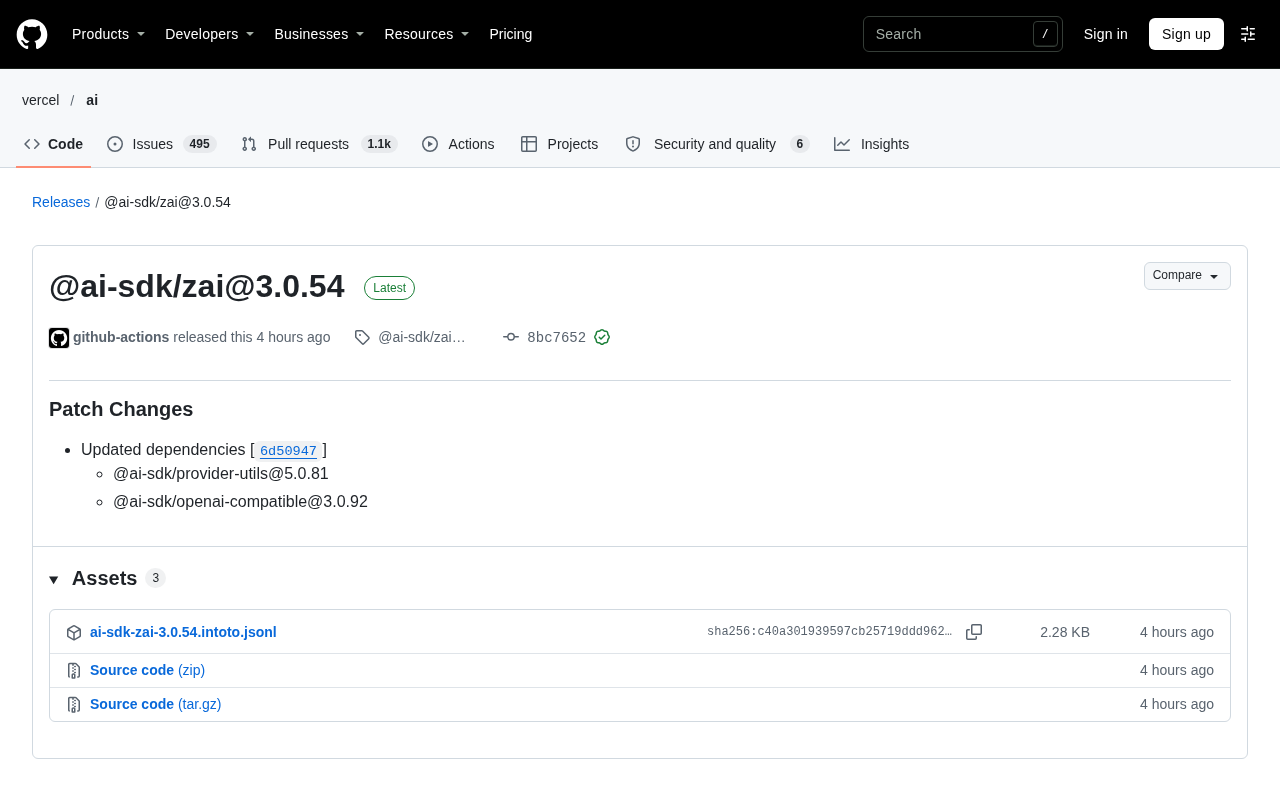
The AI SDK ecosystem has received a routine maintenance update. According to the release records published on GitHub, @ai-sdk/zai@3.0.54 was released on the 13th. This is a patch-level change, with the main purpose of syncing underlying dependencies.
What Changed: Primarily Dependency Sync
Judging from the commit information, the changes in this release are very restrained. The core content listed in the changelog is just one item: updating dependencies, involving two packages, @ai-sdk/provider-utils@5.0.81 and @ai-sdk/openai-compatible@3.0.92. The release was automatically published by github-actions, and the commit carries a GitHub verified signature, making it a standardized pipeline artifact.
This means the update most likely contains no new features or behavior changes, but instead propagates fixes and adjustments from upstream base packages to the ZAI provider adapter layer. For projects currently using this package, the upgrade risk is low.
What Is the Significance of Patch Updates
The AI SDK uses a multi-package structure. @ai-sdk/zai, as an adapter package for a specific model provider, depends on public utility layers such as provider-utils and compatibility layers such as openai-compatible. When upstream packages iterate, downstream adapter packages need to follow with upgrades to keep behavior consistent.
This kind of patch release plays an "alignment" role in the ecosystem: when the compatibility layer fixes protocol details or the utility layer adjusts validation logic, consumers can benefit through dependency upgrades without having to patch each package individually.
Patch-level changes in Semantic Versioning (SemVer) refer to an increment of the rightmost number in the version number MAJOR.MINOR.PATCH. By convention, it should only include backward-compatible bug fixes and should not introduce new features or breaking changes. @ai-sdk/zai moving from 3.0.53 to 3.0.54 falls into exactly this level, so the community usually treats it as a version that can be upgraded "without thinking." However, note that SemVer is a convention rather than a mandatory constraint. Whether the actual behavior is compatible still depends on how strictly maintainers enforce it. At the same time, the compatibility here refers to this package's own API. If the internally depended-on provider-utils or openai-compatible undergo subtle behavior changes, they may still indirectly affect call results. This is also why the original article recommends regression-testing model invocation test cases in a test environment.
github-actions automated publishing and GitHub verified signatures: github-actions is GitHub's built-in CI/CD bot account. When a repository is configured with a release workflow, such as a changesets-based release pipeline, changes merged into the main branch trigger automatic builds, tagging, and publishing to npm. Such commits display a "Verified" badge on GitHub, indicating that the commit was signed by GitHub's GPG key, which proves the artifact came from the official pipeline rather than an individual's local environment. For consumers, this information helps assess the trustworthiness of the package source and is also a common check in supply chain security reviews. However, a signature only guarantees that it was "generated by that pipeline"; it does not mean the code has undergone manual security auditing.
Division of responsibilities between @ai-sdk/provider-utils and @ai-sdk/openai-compatible: The AI SDK uses a layered design. provider-utils belongs to the public utility layer and provides foundational capabilities shared by provider adapter packages, such as request parameter validation (zod-based schema validation), streaming response parsing, and error type encapsulation. openai-compatible is a general implementation layer for "OpenAI-compatible interfaces." Because many model service providers, including many domestic model platforms, expose APIs consistent with OpenAI Chat Completions, this layer encapsulates common logic for request construction, SSE stream parsing, and tool calling. @ai-sdk/zai sits at the top layer and only needs to add provider-specific model identifiers, default parameters, and a small amount of difference handling on top of the compatibility layer. Therefore, fixes in upstream base packages can be propagated downstream at low cost through a single dependency upgrade.
Upgrade Recommendations
For projects that depend on @ai-sdk/zai, this is a version that can be safely followed. It is recommended to pay attention to two points: first, whether the project has pinned specific versions of provider-utils or openai-compatible; if version pinning exists, it should be checked as well. Second, after upgrading, run the test cases related to model invocation in a test environment to confirm that the compatibility layer behaves as expected.
Since the official changelog only lists dependency updates and does not mention breaking changes, it can be handled according to the normal dependency upgrade process.
Related articles

VP ≠ VNP: A Major Breakthrough in Computational Complexity Theory
A study claiming to prove VP ≠ VNP over every field sparks heated discussion on Hacker News. This article analyzes the algebraic complexity background of VP and VNP, the proof approach, community controversy, and its potential impact on computational complexity theory.

Developer Naming Woes: The Technical Names That Drive Us Crazy
Why is technical naming so maddening? From Nginx and Vite to Qt and Sudo, a YouTube creator rants about the chaos of developer naming and pronunciation, revealing the tug-of-war between creators' intentions and community habits, and the cultural roots behind spelling traps like PyPI and GNOME.

Figma Workplace Scandal: Employee Sues CEO for Forcing Confrontation with Harasser
Figma and its CEO are sued by a current employee alleging sexual harassment and discrimination, and forcing the victim to confront her harasser. This article outlines the background, potential impact, and industry reflection.