AI SDK RSC 2.0.336 Patch Update: Synced with ai 6.0.336

@ai-sdk/rsc 2.0.336 released, synced with core package ai@6.0.336, a routine patch update.
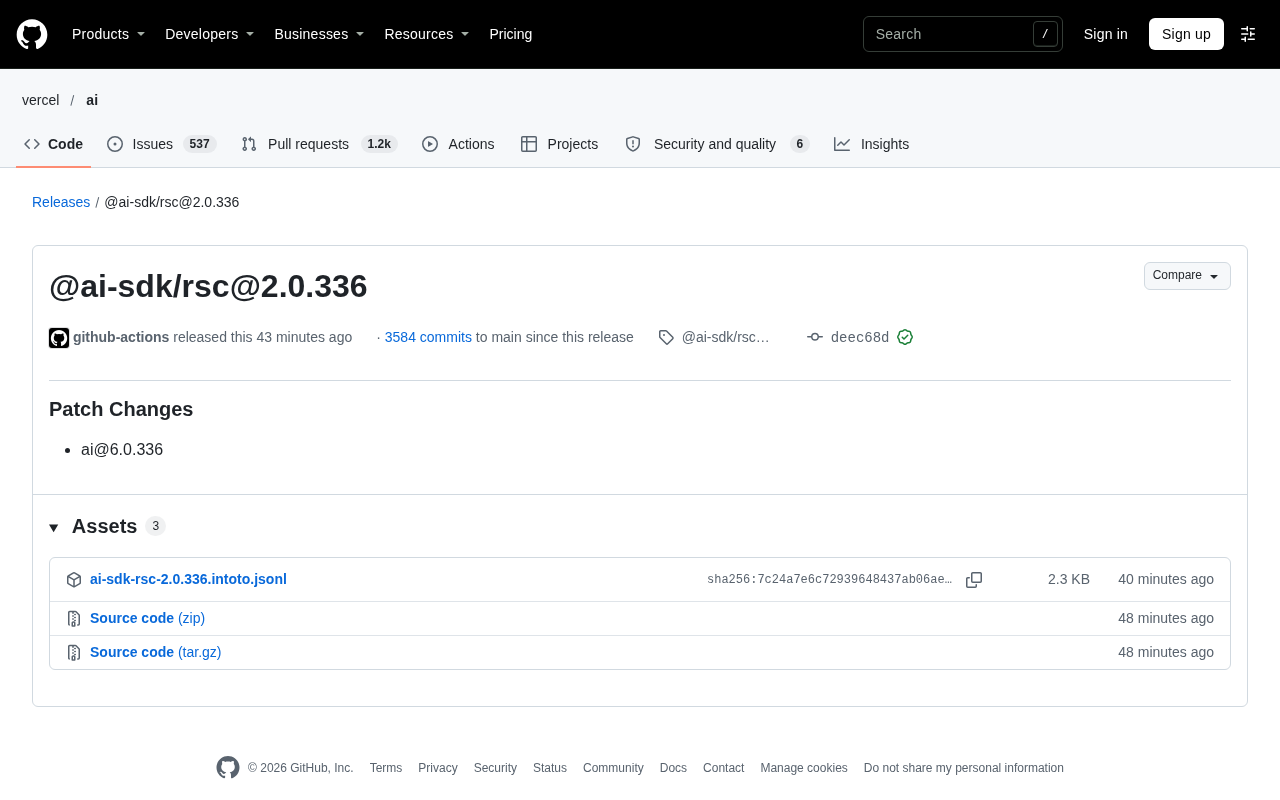
The article interprets the release information of @ai-sdk/rsc 2.0.336. This version is a patch update whose only change entry is synchronization with the core package ai@6.0.336. It was automatically released by github-actions and the commit has passed GitHub signature verification. The article notes that the AI SDK adopts a version strategy linking the patch numbers of the RSC package and the core package, making it easier for developers to determine whether the two match and reducing dependency resolution ambiguity. Since no new API surface is introduced, this update is expected to mainly consist of bug fixes, type corrections, or documentation adjustments. The author recommends that projects integrating large models using React Server Components follow up with the upgrade, and that projects pinning exact versions should first compare against the core package's patch notes; given the high release cadence, an upgrade strategy should be established involving pre-release validation, lock file control, and version pinning.
A Low-Key Patch Release
@ai-sdk/rsc has released version 2.0.336. According to the GitHub release record, this is a routine patch update, with the core change pointing to synchronizing the patch contents of ai@6.0.336. The release was completed automatically by github-actions, and the commit has been verified with a GitHub signature.
For developers building React Server Components applications with the AI SDK, version-alignment updates like this typically mean behavior corrections or type definition synchronization in the underlying dependencies, rather than the introduction of new features.
Interpreting the Patch Contents
What Patch Changes Actually Mean
The only entry listed in the release notes is ai@6.0.336. In the AI SDK's version management practice, @ai-sdk/rsc maintains version linkage with the core package ai, and matching patch numbers usually indicate that the RSC package has made a synchronized release following the core package.
The benefit of this linkage mechanism is a clear version correspondence: when you use both ai and @ai-sdk/rsc in a project, you can directly determine whether the two match based on patch numbers, reducing ambiguity during dependency resolution.
Who Should Pay Attention to This Update
Projects integrating large model capabilities using the React Server Components approach are worth following up on. Although this release does not list specific functional changes, patch-level updates typically involve bug fixes, type corrections, or documentation adjustments, which have a direct impact on production environment stability.
If you have pinned an exact version, it is recommended to compare the corresponding patch notes of the ai core package before upgrading, to confirm there are no changes affecting existing usage patterns.
React Server Components (RSC) is a component type introduced by React. It is rendered on the server and serialized before being transmitted to the client, and does not participate in client-side JavaScript bundling. It allows components to directly access server-side resources (databases, internal APIs, secrets), thereby reducing the mental burden and security risks exposed to the browser. In AI scenarios, RSC is suitable for handling server-side logic such as prompt assembly, model call orchestration, and streaming response assembly, while leaving interactive parts to client components. It should be noted that RSC depends on frameworks that support this feature (such as Next.js App Router) and corresponding build configurations, and is not available out of the box in any React project; this is also the value of adapter packages like @ai-sdk/rsc—aligning the AI SDK's calling patterns with RSC's rendering model.
SemVer (Semantic Versioning) conventions take the form major.minor.patch: major version changes indicate incompatible API changes, minor versions indicate backward-compatible new features, and patch numbers indicate only backward-compatible bug fixes. Therefore, the "patch-level update" repeatedly emphasized in this article means that existing usage patterns should theoretically not be broken, but behavior details or type definitions may still be corrected, and under strict mode these changes occasionally expose latent issues in existing code. Another commonly confused point is "version number linkage": @ai-sdk/rsc and the core package ai are not constrained through dependency ranges, but rather by an agreement that patch numbers match. This is alignment at the release process level rather than an npm dependency resolution mechanism, so it is still recommended to explicitly pin both versions in package.json to avoid mismatches caused by automatic upgrades.
Observations on Release Cadence
The AI SDK series maintains a high release frequency, with dense patch version iterations. On one hand, this cadence shows that the maintenance team responds quickly to issues; on the other hand, it reminds users to establish a clear upgrade strategy—for example, validating in a pre-release environment before syncing to production, or using lock files to control version drift.
This release's commit is based on the main branch, and the cumulative commit count has reached the thousands, reflecting the repository's level of activity.
A lock file (such as package-lock.json, pnpm-lock.yaml, yarn.lock) records the exact resolution result of the dependency tree and is the primary means of controlling "version drift." If only a range version like ^2.0.336 is specified, reinstalling may pull in a newer patch version, causing different dependency trees to be built in different environments and at different times. Common practice is: use range versions in library projects to benefit from fixes, and use exact versions in application projects while committing lock files; at the same time, use pre-release environments and commands like npm ci in CI to ensure reproducible installations. For the high-frequency-release AI SDK series, splitting upgrades into separate commits and comparing against changelogs makes issue diagnosis simpler.
Summary
@ai-sdk/rsc 2.0.336 is a patch release centered on synchronizing ai@6.0.336, without introducing a new API surface. For most teams, handling it according to the standard patch upgrade process is sufficient; for version-sensitive projects, it is recommended to check the core package's patch notes before making a decision.
Related articles

ChatGPT Plus Subscription Pitfall Guide: Go/Plus/Pro Tier Comparison and Quick Activation
A complete ChatGPT Plus subscription guide based on a Bilibili tutorial: from registering an account, comparing Go/Plus/Pro tiers, to the practical steps for quickly completing your subscription.

GPT-6.2 Sol/Astra Released! A Step-by-Step ChatGPT Plus Subscription Guide and Tier Comparison
GPT-6.2 Sol/Astra is out—here's a ChatGPT Plus subscription guide: register an account, compare Go/Plus/Pro tiers, and subscribe in a minute.

Comparing Three Channels for Subscribing to GPT Plus in China: Is Website Top-Up the Easiest?
How to subscribe to GPT Plus in China? This article compares website top-up, credit card, and mobile top-up channels—process, cost, and risk—with steps and tips to help you choose wisely.