AI SDK RSC 3.0.156 Patch Released: Minor Iteration and Ecosystem Synergy

@ai-sdk/rsc releases patch 3.0.156, mainly synchronizing the core package ai@7.0.156.
The @ai-sdk/rsc package in the AI SDK ecosystem releases patch version 3.0.156, automatically published by GitHub Actions with 5 commits. Under Semantic Versioning, this update is a backward-compatible bug fix, with the core change being synchronization with the patch of ai@7.0.156—essentially a follow-up release. The article analyzes the tightly coupled relationship between the RSC package and the core ai package: the former provides AI call encapsulation for React Server Components, with its API surface depending on the core package's types and runtime, so versions must be upgraded together. It also explains the value of placing AI calls on the server in RSC scenarios—avoiding API key exposure and leveraging streaming rendering. Finally, it recommends teams evaluate the upgrade in conjunction with core package version constraints and notes that this release did not disclose specific fix content.
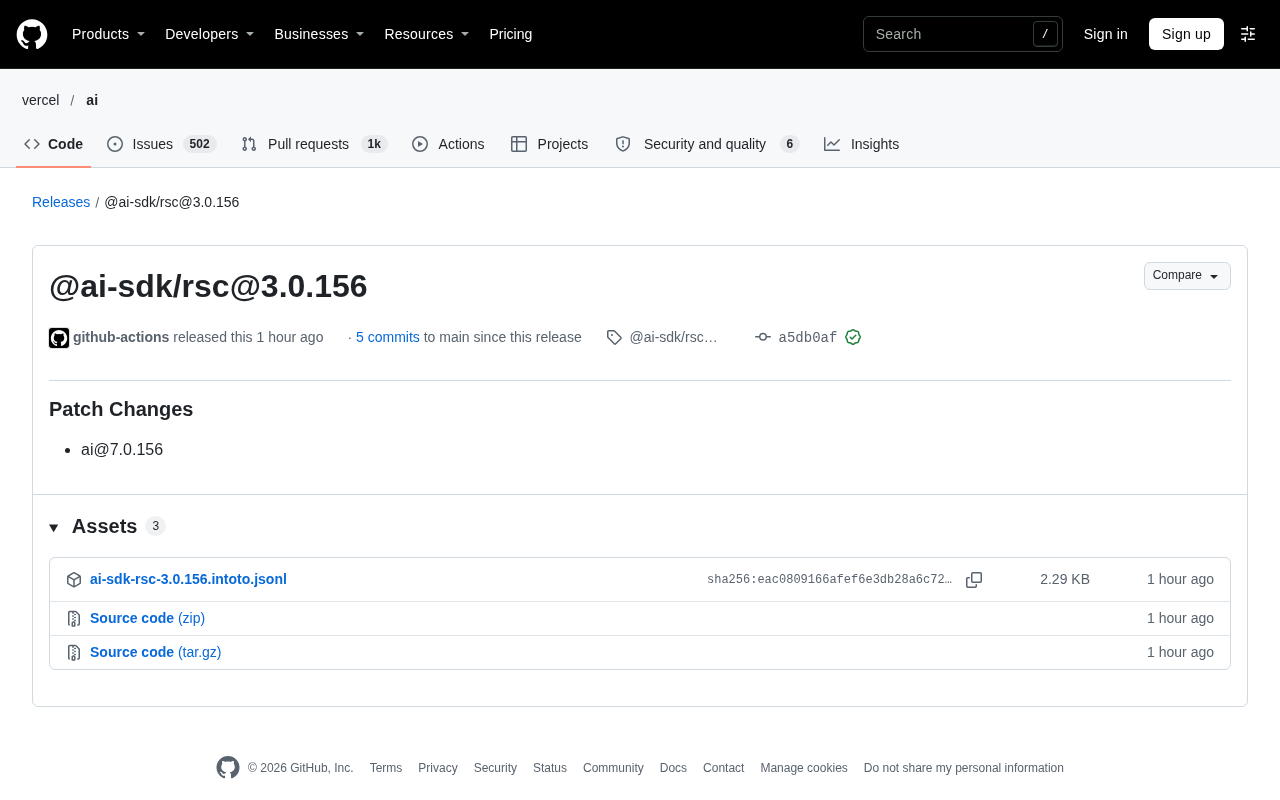
The @ai-sdk/rsc package in the AI SDK ecosystem has released version 3.0.156. This is a typical patch update, automatically published by GitHub Actions, containing 5 commits, with the main purpose of synchronizing dependencies and fixing details.
Version Positioning: The Significance of Patch Updates
Under the Semantic Versioning (SemVer) system, the increment of the patch number from .155 to .156 indicates backward-compatible bug fixes rather than the introduction of new features. For an SDK package like @ai-sdk/rsc that focuses on React Server Components scenarios, frequent patch releases usually reflect two rhythms: first, version advancement of upstream dependencies (such as the core ai package) forces synchronization; second, boundary issues reported by the community are quickly resolved.
The only change explicitly listed in this release note is the patch synchronization of ai@7.0.156. In other words, this update of @ai-sdk/rsc is essentially a follow-up release driven by the core package version.
Semantic Versioning (SemVer) consists of three segments: major.minor.patch, corresponding respectively to incompatible API changes, backward-compatible feature additions, and backward-compatible bug fixes. When the patch number increments, callers theoretically can upgrade safely without modifying code. However, in the actual ecosystem, patch versions may also include behavioral tweaks or indirect changes brought by dependency upgrades. Therefore, "low risk" does not equal "zero risk," and it is still recommended to evaluate based on the changelog and test coverage.
Dependency Synergy: The Transmission Effect of ai@7.0.156
There is a tightly coupled relationship between @ai-sdk/rsc and the ai package. The RSC package provides an encapsulation layer for calling AI capabilities within server components, and its API surface directly depends on the type definitions and runtime functions of the core package. Therefore, when the ai package releases a patch, the RSC package needs to synchronize its version number to ensure semantic consistency and avoid type mismatches or runtime behavior differences when developers mix versions.
This synergy mechanism is common in multi-package monorepos. The benefit is clear version alignment, while the cost is that a patch to any core package triggers a chain of releases for downstream packages. For users, when upgrading, they should ensure that @ai-sdk/rsc and ai versions are matched, rather than updating only one of them.
A monorepo (a single code repository managing multiple packages) is a common organizational approach for tool libraries like AI SDK: the core package ai and various adapter packages share types, build configurations, and release pipelines, referencing each other via the workspace protocol. During release, tools like Changesets or similar are typically used to automatically derive version numbers and generate changelogs, and then CI uniformly publishes the packages. This mechanism ensures that inter-package version relationships are traceable, but it also means that an underlying patch may trigger a chain of releases for multiple upper-layer packages. Users need to pay attention to "matched versions" rather than isolated version numbers.
The Value of AI SDK in RSC Scenarios
React Server Components have changed the boundary between data fetching and component rendering. Executing AI calls within server components can avoid exposing API keys to the client while leveraging server-side streaming capabilities to directly render AI-generated content. @ai-sdk/rsc is the entry point designed for this pattern, allowing developers to naturally integrate model calls into the asynchronous rendering flow of RSC without manually building intermediate-layer API routes.
Although patch-level updates do not change these core capabilities, continuous version maintenance indicates that the package is still actively maintained, which is a positive signal for teams relying on it to build production applications.
React Server Components (RSC) is a component model introduced by React. Server components execute only on the server and do not send component code to the client; they can directly access databases, file systems, and environment variables. Server Actions, which work in conjunction with them, allow the client to trigger server-side logic in the form of function calls. Placing model calls in server components or Server Actions can both protect keys and leverage streaming rendering to push generated content to the frontend in chunks; the cost is that one must understand the boundary rules between server and client components—for example, server-only modules cannot be directly referenced in client components.
How to View This Type of Release
For teams using this package, two points are worth noting: first, whether to upgrade to 3.0.156 in package.json. Patch updates are usually low-risk, but they should be evaluated together with the version constraints of the core package. Second, pay attention to changes in the dependency chain behind the release rhythm. If the core package frequently releases patches, it may indicate that upstream is intensively fixing issues.
The release information itself is relatively limited and does not disclose specific fix content or scope of impact. Developers can obtain more complete context by comparing commit records or checking the changelog of the core package ai@7.0.156.
Related articles

Qwen4 Architecture Preview Open-Sourced: 125B Parameters, 512 Experts, Designed for VRAM-Constrained Hardware
Qwen4 isn't released yet, but its architecture is previewed via open-source Qwen3.8 Flash Next: 125B params, 6B activated per token, 512 experts, 262K context, built for VRAM-limited hardware. This article covers official confirmations, key config.json metrics, and local deployment tests on 24G memory.

Run 8K Images on 6GB VRAM! Hands-On Test of Fudan's Open-Source MOSS-Image Model
Fudan OpenMouse team and Shanghai MOSS Intelligence open-source MOSS-Image, a 500M-parameter DT architecture text-to-image model that runs locally on 6GB VRAM with precise text rendering, structured layout control, and 4K Token prompt support—ideal for e-commerce posters and local deployment by individual creators.

Overseas Blogger Tests Local Deployment of 100B-Parameter MoE Model: Key Lessons on Quantization and Tool Calling
Overseas blogger tests local deployment of Alibaba's Qwen 3.8 Flash Next 100B MoE model on a Strix Halo mini PC and CUDA workstation, revealing how quantization precision affects tool-calling success and the real-world performance of the Strata and GUFO inference engines.